Showing posts with label Massillon. Show all posts

Sunday, December 18, 2011

Common roots

The way I see it, American sports fans can be divided into two groups: those who think that Bob Knight is a jerk and those who hold him in high regard.

Count me among the latter.

Maybe I like Bob Knight for the same reason that I like Woody Hayes -- that is, I'm practiced at looking past irascible demeanor and forgiving childish outbursts. Or perhaps it's because Knight and I both were born in Massillon, albeit 17 years apart, and we grew up surrounded by the same Heartland culture.

The story of his formative years is familiar to me, as mine would be to him. Less than nine miles of Ohio countryside separates the brick ranch-style house of his childhood and the brick cape where I spent my own. I know well the crackerbox high-school gym where he was a star -- years later I played there, too, once or twice each season.

This morning's edition of The Columbus Dispatch features an article about the coaching icon's loyalty to his hometown of Orrville. Dispatch scribe Todd Jones writes of this rural company town as the source of Knight's unshakable pride and old-school values. It's a great piece, no doubt introducing many readers to another side of the man.

Not me -- Bob Knight and I share the same Heartland roots.

Tuesday, March 1, 2011

Frank talk

Every true sports junkie knows about the high-school football rivalry between Massillon and Canton. It's been waged since 1894, the prep equivalent of Ohio State-Michigan.

Each of these northeast-Ohio cities has a blue-collar heritage -- rather like
Pittsburgh and Green Bay, actually -- and historically the friendly friction has reached beyond the gridiron to factory floors, secretarial pools and advertising departments.

Today I'm remembering one corporate faceoff in particular.

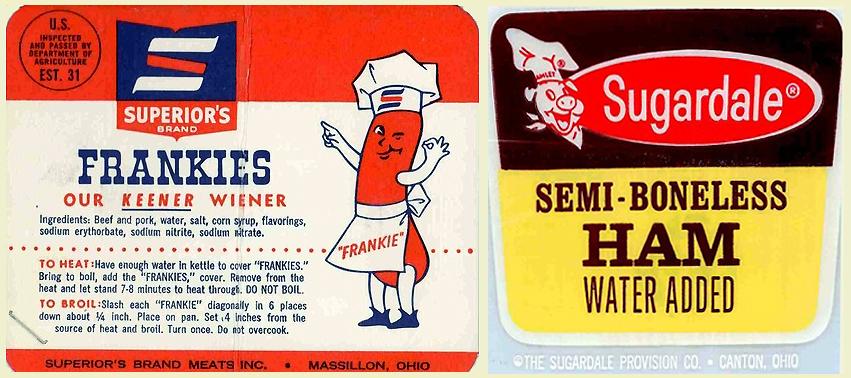
Two local meat-packing operations vied for a share of my family's grocery budget in the '60s and '70s. Canton had
Sugardale, founded in 1920; hometown Massillon had Superior's, tracing its roots to 1933.

The symbol of Sugardale was a cartoon pig named "Hamlet." Not to be outdone, Superior's countered with "Frankie," an animated hot dog.

As a kid, I loved hot dogs -- and what American kid doesn't? -- and I begged my mom to buy the Superior's brand. I had a preference not because Superior's was a Massillon company, but because I liked the mascot...well, that and the
radio jingle:
Fun-to-eat treats from Superior's Meats;
Frankies -- the Keener Wiener!
On the playground, as you might imagine, we'd sing that jingle to any boy unlucky enough to have been named "Frank."

Superior's and Sugardale came together in 1976 under the
Fresh Mark corporate banner. I don't know if the rivalry survived their meaty merger, but both venerable brands -- as well as Frankie and Hamlet, believe it or not -- are still around today.

Monday, February 28, 2011

Home yet again, 1920s


Here's one more image of
downtown Massillon. It's said to be from the 1920s, about the time that my father was born in a farmhouse a few miles outside of town.

Like the 1966 photo I posted a couple of weeks ago, in this shot the camera faces east. From what I can tell, it was taken from an upper floor (or perhaps the rooftop) of one the bank buildings on the south side of Lincoln Way near the center of town.

That's the facade of the Lincoln Theater in the left foreground and the spire of the Methodist church rising against the winter sky. They were there during my own youth 40 years later, and both still stand today.

Thursday, February 24, 2011

Over my grandfather's farm

In the years after World War II, a handful of former U.S. Navy and Army Air Corps reconnaissance photographers formed The Zekan-Robbins Company in Harlan, Iowa. They flew all over the country taking aerial snaps of farms, estates and villages, selling their images to small-town newspapers and proud property owners.

I can't say exactly when Zekan-Robbins took this photo of my paternal grandfather's farm, but if I had to guess I'd say it was 1950 or so.

My grandfather's death and the sale of the property would follow several years later, not quite two years before I was born. I grew up not far away, and yet I visited the farm only twice -- once when
my father and I went plinking at the adjacent quarry and again in the late 1970s the morning after the farmhouse, which was abandoned by then, burned to the ground.

In the foreground of the aerial photo are the big frame house in which my father and his siblings were born, the spring house, vegetable gardens and the chicken coop. Beyond the farmhouse are stables where the draft horses were kept. Those are fruit trees to the right.

The outbuildings include the barn, a bow-roof implement shed and a corn crib. An empty wagon rests just off the driveway, a hay rake sits idle in the corner of a newly baled field, and that looks like a late-1940s Ford pickup truck parked inside the haymow.

It's all gone now, of course.

Monday, February 14, 2011

Home again, facing west

Finding a photo like the one I posted yesterday... well, it was like pulling on a raveling.

Casting about for other views of the city in which I was born, I found the east-facing perspective relatively less common. At left are five more images of Massillon -- 1850, the 1930s, 1941, 1955 and 1966 -- looking west toward the river.

(Click on the collage for a larger view; if your browser re-sizes images to fit your screen, you may have to click again to display it at full size.)

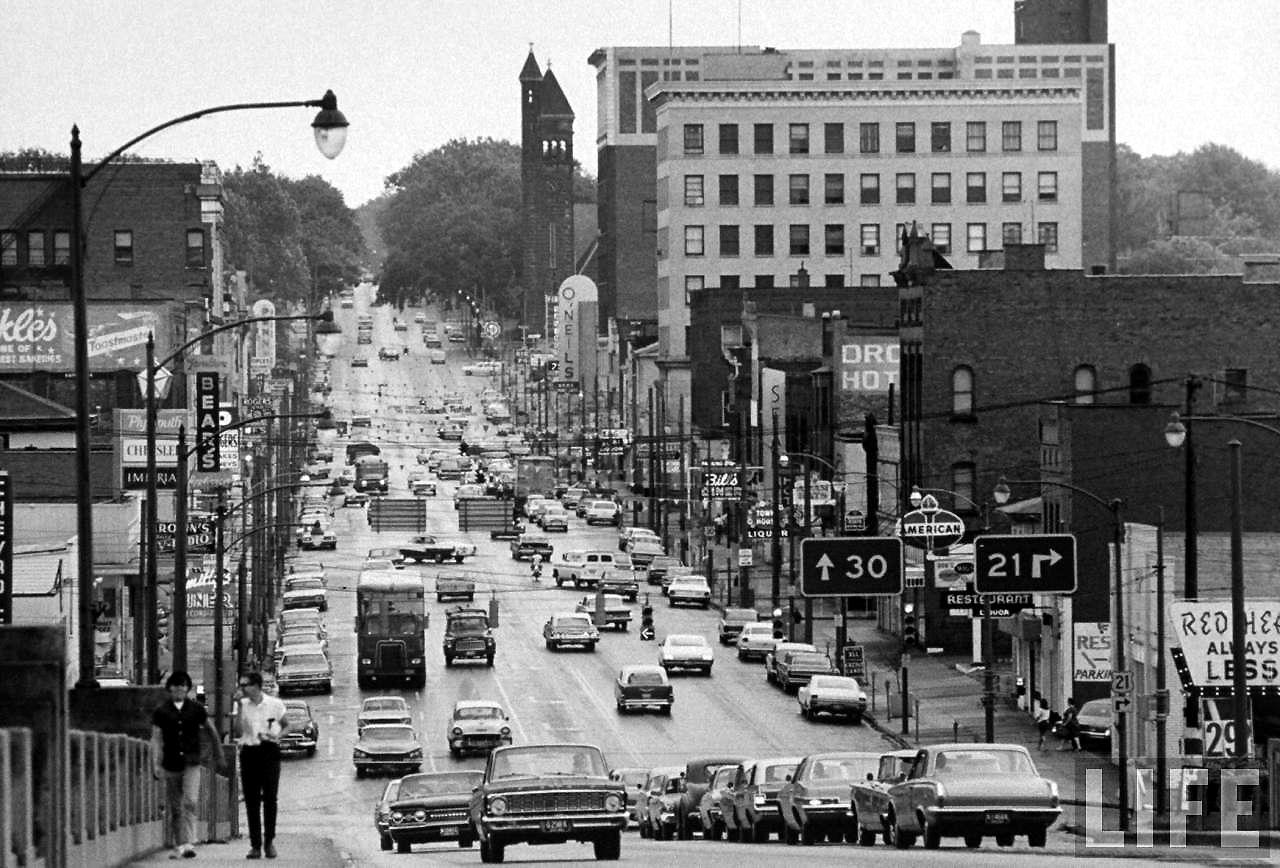
The graphic chronology intrigues me. Naturally, I identify most with the latest photos, since they depict the city's "main drag" as it was during my childhood. Massillon's annual Sidewalk Festival, for example, preserved in the 1966 image, was something that I remember looking forward to all year long. (Check out higher-resolution versions of that Life image
here and here.)

That 1955 photo is my favorite, though -- the
Tiger Swing Band high-stepping through town on a football Friday, Obie in the lead, six cheerleaders captured in mid-leap. (Higher-res image here.)

Lest anyone get the idea that I'm painting this blue-collar city as perfect, even idyllic -- it was neither.

I'll take my leave of the subject by suggesting that KintlaLake Blog readers make one more visit to Google Books. "A Town's Troubled Mood As a War Comes Home: The 'credibility gap' widens in Massillon, Ohio" (Life, August 12, 1966) is a stark portrait of my hometown during America's turbulent mid-1960s.

"Massillon, like many small cities in the country's heartland, is a blend of payroll town and rural trade center, of boosterism and nostalgia for the past, of complacency, generosity, bigotry, progress and decay."

"Though it voted for Lyndon Johnson over (Barry) Goldwater in 1964, Massillon, like much of America between the coasts, is politically, economically and socially conservative. It has a staunch John Birch chapter. Its citizens voted down urban renewal and twice rejected fluoridation of the city's water. Its school system, run by young Ph.D.s, is good. But progress has largely bypassed the shabby downtown, which is losing shoppers to the suburbs."

The eight-page article is, for this native son, poignant. It's also disturbing in places, particularly if filtered through present-day sensibilities, but I'm here to tell you that it's real, honest, accurate.

It's home.

Sunday, February 13, 2011

Home, 1966


I grew up exactly four miles west of this spot, in farm country but on the same side of the same street. The image, from the
Life archives hosted by Google, looks east into gritty downtown Massillon from the Lincoln Way viaduct over the Tuscarawas River.

I could spend hours burrowing into this photograph. I probably will.

Friday, November 20, 2009

The anti-poseurs

When I was in my teens, I came to know Stefanie Belcher as the kid sister of a couple of girls who ran with my circle of friends. A few years later, everyone would know her boyfriend -- Chris Spielman, football star for Massillon Washington High School, Ohio State and three NFL teams.

The high-school sweethearts would marry, and had our introduction to them ended there it would've been a great love story. But at age 30, Stefanie was diagnosed with breast cancer, and a simple fairy tale became an inspiration to millions.

Chris put his All-Pro career on hold so that he could be with his wife while she fought the disease -- it remains one of the manliest (for lack of a better word) and most selfless acts I've ever seen by a public figure. Stefanie refused to play the victim, turning an ominous diagnosis into a chance to raise awareness about breast cancer and funds for research. After just six months, her appeal for $250,000 had been met with donations totaling four times that amount; ten years on, the foundation that bears her name has raised over $6.5 million.

Stefanie and Chris joined every challenge as true lifemates. As we saw them in public, candid and faithful, so they were in more private moments. Together they showed the world their unconditional love and a depth of character that's all too rare these days.

She pressed the monster into remission four times but, sadly, lost her fight in the fifth round. Stefanie Spielman died yesterday at 42, at home with her family by her side.

The echoes of Stefanie's personal courage will ring with all who knew her or simply know of her. I have no doubt that Chris will forge on with their mission, albeit now without his beloved partner.

What resonates within me, however, goes beyond any hometown connection or admirable struggle against terminal illness. In this world of spin, stunts and selfish superficiality, Stefanie and Chris Spielman -- inseparable, as both would insist that we see them -- leave me with an example of what it means to be real.

That's one helluva legacy.

Wednesday, June 10, 2009

Of two generals

When I drew parallels between Lancaster, Ohio and the city of my birth in Monday's post, I forgot something.

One town is the birthplace of a famous (or infamous) Civil War general. The other has the distinction of being linked forever to a self-styled "general" who led an "army" of jobless Americans.

William Tecumseh Sherman, best known for his brutal campaign near the war's end, was articulate, if rough-edged, and an accomplished military commander. Some judged him to be insane, but more than once those who doubted his decisions saw them lead to victory on the battlefield.

Ulysses S. Grant often seemed to be the only one who believed in Sherman, and vice versa:
"Grant stood by me when I was crazy, and I stood by him when he was drunk, and now we stand by each other."
Through the wavy glass of history, Sherman is seen as a warmonger. The general's own words thwart attempts to simplify a complex man:

"War is cruelty. There is no use trying to reform it. The crueler it is, the sooner it will be over."

"I am tired and sick of war. Its glory is all moonshine. It is only those who have neither fired a shot nor heard the shrieks and groans of the wounded who cry aloud for blood, for vengeance, for desolation. War is hell."

Sherman also had a thing or two to say about the media of his day.

"I think I understand what military fame is; to be killed on the field of battle and have your name misspelled in the newspapers."

"I hate newspapermen. They come into camp and pick up their camp rumors and print them as facts. I regard them as spies, which, in truth, they are."

"If I had my choice I would kill every reporter in the world, but I am sure we would be getting reports from Hell before breakfast."

The deeds and words of this son of Lancaster are remembered, and in some quarters reviled, to this day. Those of that other "general" are, to most living Americans, either unknown or forgotten.

Jacob Sechler Coxey was born in Pennsylvania in 1854, moving to Massillon, Ohio when he was in his mid-twenties. There he ran a scrap-iron operation and later owned a sandstone quarry and a lumber mill. By all accounts, he was a successful businessman.

Coxey fancied himself a populist, a reformer, a savior of the downtrodden working man. Politically, during his life he was an independent, a Democrat, a member of the Greenback Party and the People's Party and the Union Party and the United States Farmer-Labor Party and the Interracial Independent Political Party.

He ran for public office, including U.S. Senator and President, at least 20 times. He won only once, as a Republican, serving as Massillon's mayor from 1931 to 1933. He failed to win re-election.

Among his children was a son, whom he named Legal Tender Coxey -- an odd nod to the Greenbacks and a living symbol of his opposition to the gold standard.

Coxey's true and lasting legacy, however, is his citizen army. After the Panic of 1893, "General" Coxey, disturbed that the federal government was providing neither work nor wages for the unemployed, organized what he predicted would be an imposing march from Massillon to Washington.

A day before Coxey's Army was to set out for the nation's capital, according to The New York Times, things didn't look promising:

"Nearly 100 recruits for Coxey's Commonweal Army arrived today from different points. Most of them are tramps who camped in the woods surrounding the town overnight. A number of them slept in the lock-up, but were released this morning."

"It is now estimated that Coxey will start from Massillon with anywhere from 100 to 500 followers. Most of those here now to join the movement are hard-looking people, but up to the present time they have shown no disposition to be unruly."

A United Press reporter found the elusive Coxey and asked,
"'But how about the army, General? Isn't it time that some of your followers were beginning to join you here?'"
Coxey's reply, as reported by the Times, typifies the idealist:
"'Oh, they'll be coming in to-morrow,' Gen. Coxey replied, as he has replied every day for a week past. 'I expect that to-morrow's sun will rise upon an assemblage of at least 10,000 members of our army. They will be marshaled up on the circus grounds, from which point the start is to be made Sunday at 12:30 P. M. sharp.'"
The army, such as it was, did make its march to Washington, its general arriving with some 400 grimy protesters in tow. Once there, Coxey promptly was arrested and spent 20 days in jail -- for walking on the grass.

Was the movement a failure? Hardly. Coxey's trademark pitch -- that the government issue $500 million in paper currency and spend it on public projects, putting the unemployed back to work -- often is credited as the seed of FDR's New Deal. It wouldn't be far-fetched to view it as an ideological ancestor of today's Recovery and Reinvestment bonanza, either.

It's argued that Coxey, his rag-tag "Commonweal for Christ" Army and their marches laid the political foundation for Social Security, unemployment insurance and Labor Day -- not to mention serving as inspiration for L. Frank Baum's The Wonderful Wizard of Oz.

And who hasn't shown up at a picnic, potluck or Thanksgiving dinner to hear someone refer to table-crushing bounty as "enough food to feed Coxey's Army"?

Lancaster and Massillon, two old working-class towns, each with a general on its résumé. So which has the better claim?

Perhaps I'm swayed by my childhood memories of secret visits to a place the locals called "Coxey's Quarry," a place where my father once played when he was a dirt-poor farm boy and the owner was mayor. All things considered, I'm going to rule this one a tie.

Wednesday, August 6, 2008

Requiem, reclamation

Yesterday, Forbes published an article entitled, "America's Fastest-Dying Cities."

Naturally, the old Rust Belt dominates the list, and as a native Buckeye myself, it saddens me to see four Ohio cities in the top ten. It's the first entry on the list, however, that gets my attention:
Canton-Massillon, Ohio.

That's where I was born and raised.

During my Heartland childhood, I always knew that I lived at the center of the nation's industrial base. After graduation, many of my classmates spurned college in favor of returning to family farms or, with the right connections, stepping into high-paying jobs in the mills.

Stainless steel, industrial bearings and plastics. Tires and auto assembly. Meat-packing, jelly and potato chips. In return for honest labor and union dues, the promise of employment for life.


The family farm, as I knew it in my youth, vanished 20 years ago. While a handful of manufacturing jobs and nominal "corporate headquarters" remain, most are mere tokens, nothing more than public-relations placeholders for multi-national operations.

What's left is a gash across Middle America, a wound that's still bleeding jobs, talent and the vitality that once staked a proud country to its bright future. Worst of all, it's become infected with the despair of a generation increasingly unlikely to finish high school.

If we're looking for villains, sure, we can point bitter fingers at heartless capitalists, incompetent government and impotent unions -- but assigning blame changes nothing.

The shelves at the company store are bare and probably offshore. We can't (and shouldn't) rely on our government to rescue us. Organized labor, without workers to organize, is an anachronism.

It's time to close the scrapbook on our memories of mills and milking parlors that built and nourished a nation. Those days are gone, and pining for them won't help us.

The task of rebuilding our cities, towns and countryside falls to those who stayed and those of us who came back. Yes, we're older now, older than the rest of the country, and maybe we're wise enough to see what kind of economic tomorrow we need to create for our Heartland, our home.

We can once again lead America into its future, but this time we'll do it by example, not as a supplier. Whatever we do over the next decade -- everything we make, raise, grow and teach -- we must do for ourselves.

We need to reclaim the Heartland for our own.