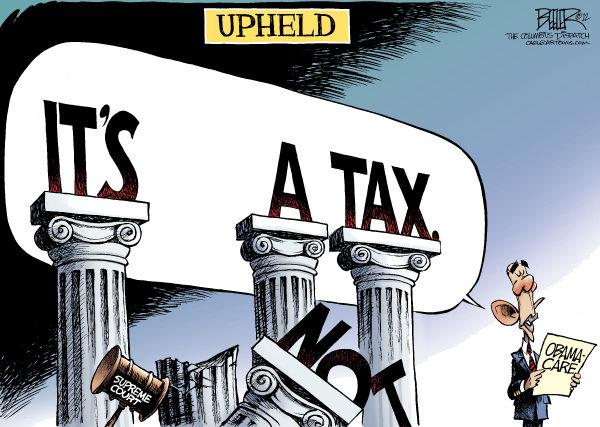
If you've been paying attention to right-leaning media since this time yesterday, you've heard this question: Does the Supreme Court's ruling on "Obamacare" signal the end of America as we know it?
Answer: Of course it doesn't. We already knew that the People are being smothered by an intrusive federal government.
It does, however, in this independent citizen-patriot's opinion, mark the end of our country as it was founded.
See, even if the Supreme Court's decision mobilizes Liberty-loving citizens to deny Pres. Obama a second term, or even to press our elected officials to "repeal and replace" Obamacare -- a dumb idea, swapping one big-government program for another -- it establishes precedent at the highest level of the federal judiciary. With a single ruling, the Court cleared the way for our bloated government to regulate and tax not only what we do, but also what we don't do.
(Somewhere, HRH Michael Bloomberg is toasting his unexpected windfall with expensive champagne.)
The damage is done. There's a deep gash in our founding principles, hemorrhaging Liberty.
July 4th, the day that we celebrate independence, is less than a week away. America is still the best and freest country on Earth and I will, indeed, celebrate that -- but I'll do so on Wednesday with tears in my eyes, knowing that our liberties are, perhaps, mortally wounded.
If you've been paying attention to right-leaning media since this time yesterday, you've heard this question: Does the Supreme Court's ruling on "Obamacare" signal the end of America as we know it?
Answer: Of course it doesn't. We already knew that the People are being smothered by an intrusive federal government.
It does, however, in this independent citizen-patriot's opinion, mark the end of our country as it was founded.
See, even if the Supreme Court's decision mobilizes Liberty-loving citizens to deny Pres. Obama a second term, or even to press our elected officials to "repeal and replace" Obamacare -- a dumb idea, swapping one big-government program for another -- it establishes precedent at the highest level of the federal judiciary. With a single ruling, the Court cleared the way for our bloated government to regulate and tax not only what we do, but also what we don't do.
(Somewhere, HRH Michael Bloomberg is toasting his unexpected windfall with expensive champagne.)
The damage is done. There's a deep gash in our founding principles, hemorrhaging Liberty.
July 4th, the day that we celebrate independence, is less than a week away. America is still the best and freest country on Earth and I will, indeed, celebrate that -- but I'll do so on Wednesday with tears in my eyes, knowing that our liberties are, perhaps, mortally wounded.
The Supreme Court today affirmed that the Affordable Care Act, a.k.a "Obamacare," doesn't violate the Constitution -- not because it's permissible under the Commerce Clause to compel citizens to purchase a product or service, but because Congress has the power under the General Welfare Clause to levy taxes.
What was sold to the People as a penalty, not a tax, has been upheld as a tax, not a penalty. It's a distinction without a difference, either way, and now it's settled law.
Chief Justice John Roberts, whose siding with the 5-4 majority confounds me, concluded the Court's opinion with this:
"The Framers created a Federal Government of limited powers, and assigned to this Court the duty of enforcing those limits. The Court does so today. But the Court does not express any opinion on the wisdom of the Affordable Care Act. Under the Constitution, that judgment is reserved to the people."
Limited powers? My ass -- not any more.
This landmark decision fundamentally transforms our nation. It unleashes a government of virtually limitless reach.
It's dark day for the People, a very dark day for Liberty.
[I've been debating whether or not to post Steve Moore's piece since I read it in The Wall Street Journal
almost a week ago. I present it now, unabridged, not as gospel but as a thoughtful perspective.]
We've Become a Nation
of Takers, Not Makers
More Americans work for the government than in manufacturing, farming, fishing, forestry, mining and utilities combined.
 By Stephen Moore
If you want to understand better why so many states -- from New York to Wisconsin to California -- are teetering on the brink of bankruptcy, consider this depressing statistic: Today in America there are nearly twice as many people working for the government (22.5 million) than in all of manufacturing (11.5 million). This is an almost exact reversal of the situation in 1960, when there were 15 million workers in manufacturing and 8.7 million collecting a paycheck from the government.
It gets worse. More Americans work for the government than work in construction, farming, fishing, forestry, manufacturing, mining and utilities combined. We have moved decisively from a nation of makers to a nation of takers. Nearly half of the $2.2 trillion cost of state and local governments is the $1 trillion-a-year tab for pay and benefits of state and local employees. Is it any wonder that so many states and cities cannot pay their bills?
Every state in America today except for two -- Indiana and Wisconsin -- has more government workers on the payroll than people manufacturing industrial goods. Consider California, which has the highest budget deficit in the history of the states. The not-so Golden State now has an incredible 2.4 million government employees -- twice as many as people at work in manufacturing. New Jersey has just under two-and-a-half as many government employees as manufacturers. Florida's ratio is more than 3 to 1. So is New York's.
Even Michigan, at one time the auto capital of the world, and Pennsylvania, once the steel capital, have more government bureaucrats than people making things. The leaders in government hiring are Wyoming and New Mexico, which have hired more than six government workers for every manufacturing worker.
Now it is certainly true that many states have not typically been home to traditional manufacturing operations. Iowa and Nebraska are farm states, for example. But in those states, there are at least five times more government workers than farmers. West Virginia is the mining capital of the world, yet it has at least three times more government workers than miners. New York is the financial capital of the world -- at least for now. That sector employs roughly 670,000 New Yorkers. That's less than half of the state's 1.48 million government employees.
Don't expect a reversal of this trend anytime soon. Surveys of college graduates are finding that more and more of our top minds want to work for the government. Why? Because in recent years only government agencies have been hiring, and because they offer of near lifetime security is highly valued in these times of economic turbulence. When 23-year-olds aren't willing to take career risks, we have a real problem on our hands. Sadly, we could end up with a generation of Americans who want to work at the Department of Motor Vehicles.
The employment trends described here are explained in part by hugely beneficial productivity improvements in such traditional industries as farming, manufacturing, financial services and telecommunications. These produce far more output per worker than in the past. The typical farmer, for example, is today at least three times more productive than in 1950.
Where are the productivity gains in government? Consider a core function of state and local governments: schools. Over the period 1970-2005, school spending per pupil, adjusted for inflation, doubled, while standardized achievement test scores were flat. Over roughly that same time period, public-school employment doubled per student, according to a study by researchers at the University of Washington. That is what economists call negative productivity.
But education is an industry where we measure performance backwards: We gauge school performance not by outputs, but by inputs. If quality falls, we say we didn't pay teachers enough or we need smaller class sizes or newer schools. If education had undergone the same productivity revolution that manufacturing has, we would have half as many educators, smaller school budgets, and higher graduation rates and test scores.
The same is true of almost all other government services. Mass transit spends more and more every year and yet a much smaller share of Americans use trains and buses today than in past decades. One way that private companies spur productivity is by firing underperforming employees and rewarding excellence. In government employment, tenure for teachers and near lifetime employment for other civil servants shields workers from this basic system of reward and punishment. It is a system that breeds mediocrity, which is what we've gotten.
Most reasonable steps to restrain public-sector employment costs are smothered by the unions. Study after study has shown that states and cities could shave 20% to 40% off the cost of many services -- fire fighting, public transportation, garbage collection, administrative functions, even prison operations -- through competitive contracting to private providers. But unions have blocked many of those efforts. Public employees maintain that they are underpaid relative to equally qualified private-sector workers, yet they are deathly afraid of competitive bidding for government services.
President Obama says we have to retool our economy to "win the future." The only way to do that is to grow the economy that makes things, not the sector that takes things.
Mr. Moore is senior economics writer for The Wall Street Journal editorial page.
By Stephen Moore
If you want to understand better why so many states -- from New York to Wisconsin to California -- are teetering on the brink of bankruptcy, consider this depressing statistic: Today in America there are nearly twice as many people working for the government (22.5 million) than in all of manufacturing (11.5 million). This is an almost exact reversal of the situation in 1960, when there were 15 million workers in manufacturing and 8.7 million collecting a paycheck from the government.
It gets worse. More Americans work for the government than work in construction, farming, fishing, forestry, manufacturing, mining and utilities combined. We have moved decisively from a nation of makers to a nation of takers. Nearly half of the $2.2 trillion cost of state and local governments is the $1 trillion-a-year tab for pay and benefits of state and local employees. Is it any wonder that so many states and cities cannot pay their bills?
Every state in America today except for two -- Indiana and Wisconsin -- has more government workers on the payroll than people manufacturing industrial goods. Consider California, which has the highest budget deficit in the history of the states. The not-so Golden State now has an incredible 2.4 million government employees -- twice as many as people at work in manufacturing. New Jersey has just under two-and-a-half as many government employees as manufacturers. Florida's ratio is more than 3 to 1. So is New York's.
Even Michigan, at one time the auto capital of the world, and Pennsylvania, once the steel capital, have more government bureaucrats than people making things. The leaders in government hiring are Wyoming and New Mexico, which have hired more than six government workers for every manufacturing worker.
Now it is certainly true that many states have not typically been home to traditional manufacturing operations. Iowa and Nebraska are farm states, for example. But in those states, there are at least five times more government workers than farmers. West Virginia is the mining capital of the world, yet it has at least three times more government workers than miners. New York is the financial capital of the world -- at least for now. That sector employs roughly 670,000 New Yorkers. That's less than half of the state's 1.48 million government employees.
Don't expect a reversal of this trend anytime soon. Surveys of college graduates are finding that more and more of our top minds want to work for the government. Why? Because in recent years only government agencies have been hiring, and because they offer of near lifetime security is highly valued in these times of economic turbulence. When 23-year-olds aren't willing to take career risks, we have a real problem on our hands. Sadly, we could end up with a generation of Americans who want to work at the Department of Motor Vehicles.
The employment trends described here are explained in part by hugely beneficial productivity improvements in such traditional industries as farming, manufacturing, financial services and telecommunications. These produce far more output per worker than in the past. The typical farmer, for example, is today at least three times more productive than in 1950.
Where are the productivity gains in government? Consider a core function of state and local governments: schools. Over the period 1970-2005, school spending per pupil, adjusted for inflation, doubled, while standardized achievement test scores were flat. Over roughly that same time period, public-school employment doubled per student, according to a study by researchers at the University of Washington. That is what economists call negative productivity.
But education is an industry where we measure performance backwards: We gauge school performance not by outputs, but by inputs. If quality falls, we say we didn't pay teachers enough or we need smaller class sizes or newer schools. If education had undergone the same productivity revolution that manufacturing has, we would have half as many educators, smaller school budgets, and higher graduation rates and test scores.
The same is true of almost all other government services. Mass transit spends more and more every year and yet a much smaller share of Americans use trains and buses today than in past decades. One way that private companies spur productivity is by firing underperforming employees and rewarding excellence. In government employment, tenure for teachers and near lifetime employment for other civil servants shields workers from this basic system of reward and punishment. It is a system that breeds mediocrity, which is what we've gotten.
Most reasonable steps to restrain public-sector employment costs are smothered by the unions. Study after study has shown that states and cities could shave 20% to 40% off the cost of many services -- fire fighting, public transportation, garbage collection, administrative functions, even prison operations -- through competitive contracting to private providers. But unions have blocked many of those efforts. Public employees maintain that they are underpaid relative to equally qualified private-sector workers, yet they are deathly afraid of competitive bidding for government services.
President Obama says we have to retool our economy to "win the future." The only way to do that is to grow the economy that makes things, not the sector that takes things.
Mr. Moore is senior economics writer for The Wall Street Journal editorial page.
Well, we didn't have to wait for the new Congress to be seated -- we have our gridlock now.Oh, there's plenty of actual governing to be done in this lame-duck session -- taxes, unemployment benefits, START, DADT and the rest. This month could be our legislators' audition, if you will, a time to show the People that they can collaborate in our interest.
Fat chance.
GOP leaders, feeling their post-election oats, refused to devote even two hours to meet with Pres. Obama and ranking Democrats. They strutted afterward for the obligatory photo-op, certainly, just long enough to pay lip-service to bipartisanship. They even took time to assert right-wing censorship of art on display at the Smithsonian.
And then, with all that's at stake here and now, Senate Republicans found time to pen a letter to the chamber's majority leader. The gist:
"...we will not agree to invoke cloture on the motion to proceed to any legislative item until the Senate has acted to fund the government and we have prevented the tax increase that is currently awaiting all American taxpayers."
In other words, Republicans will block everything else until the Senate votes to extend the (so-called) Bush-era tax cuts.
 It's a political tantrum, a shameful partisan stunt. While it keeps an intellectually dishonest promise not to raise taxes, it flouts fiscal conservatism and lacks any semblance of economic credibility.
Calling the prospective failure to extend tax cuts "job-killing," invoking a pithy old GOP chestnut, presumes that the cuts created jobs when they were implemented -- they didn't, they haven't and (if they're extended) they won't. I find it hard to believe that anyone still subscribes to "trickle-down economics," since it's never, ever worked beyond the anecdotal.
And just like Dems' wish to turn federal unemployment benefits into another entitlement program, extending the tax cuts effectively adds to a deficit Republicans pledged to reduce. The perpetual practice of spending money we don't have -- by both parties -- is fundamental to why our nation's economy is on the road to ruin.
Any meaningful proposal to fix what's broken must be the product of collaboration among factions now preoccupied with the next election cycle. Neither side would get everything it wants -- which would be fine, since neither side has a monopoly on good ideas. Their solutions must incorporate both cuts in spending and increases in revenue.
No, I'm not excited about paying higher taxes, nor am I looking forward to (for example) working years longer before drawing Social Security. But if I want my country to be here for my spawns and their spawns, that's what it'll take. There are no other options.
Time is short, too -- we have two years, maybe less, to get our national barge turned around. And that means that we've already elected the representatives who will (or won't) do what's required to save our country.
I don't think they can. Even if they could, we wouldn't let them.
Governing is crippled by politics. Economic recovery -- like everything else, it seems -- is poisoned by ideology. We're screwed.
I ache for my country.
My generation, carrying the last banners of the Baby Boom, is facing reality: The American Dream isn't quite what we thought it'd be.
 Prosperity once was grounded in opportunity, to each citizen according to ability, but our American Dream has become staked to ownership -- big house, luxury sedan, RV, bass boat and myriad other toys that money can buy.
What we've come to call "financial security" means taking two-week vacations, kicking back at the country club, sending the kids to college, living comfortably in retirement and all the rest.
Now the national economy has soured and our prospects have dimmed. For our children, the future looks even less rosy.
We blame government and banks, liberal Democrats and capitalist pigs, illegal immigrants from Mexico and opportunistic Commies from China, all the while denying the obvious: The U.S. economy has been undermined by The American Dream itself.
When we made the Dream about immediate personal acquisition, we begged for deregulation, easy credit, outsourcing and (because our actions speak louder than our words) corporate bailouts. The trade deficit balloons because we keep demanding something for nothing, cramming our lives with cheap imports.
Craftsmanship, quality and community don't serve our self-absorbed pursuit of getting more for less, so we're surrounded by shuttered businesses and abandoned houses. The staggering national debt is the product of our insistence that we're entitled not merely to the open door of opportunity, but to the final destination of prosperity -- without effort or sacrifice.
And by the way, we're pretty sure that our taxes are too high.
Assigning blame according to ideological stereotypes -- fat-cat conservatives blew up Wall Street and spendthrift liberals created The Entitlement Culture -- is manifest ignorance. Looking to either side of the political aisle for salvation is likewise idiotic.
We, the People, transformed The American Dream from beacon to time-bomb. Our short-sighted selfishness has weakened our nation's economic foundation -- perhaps irreparably.
Parents and school-age kids in Kansas City, Missouri know what it feels like to be squeezed.
The Kansas City public schools, fast running out of money, last night decided to close 29 of its 61 schools beginning next fall. Its 18,000 students will be portioned among the schools that'll remain open. The district also will slash about 700 of 3,000 jobs, 40% of those cuts in teaching positions.
Vacant school buildings in KC, Detroit and communities across the country are monuments to overspending in the face of a shrinking tax base. Urban flight, home foreclosures and high unemployment have reduced revenue, while districts have continued to buckle under pressure to build more, bigger and grander facilities that declining enrollment can't support -- and which, in the end, have had little constructive effect on education anyway.
Now, even knowing the pain brought on by the squeeze, the worst thing we could do is try to reopen shuttered schools any time soon. Without money to pay for them, that would postpone rather than prevent the inevitable. It'd probably make things even worse.
KC's public school district did the right thing. There should be no federal or state bailouts. If Kansas City wants more than 32 schools, then its citizens need to bear the tax burden of supporting them.
As I typed that I could hear so-called "fiscal conservatives" cheering. I wonder if they could hear me laughing.
Present-day conservatism advocates reducing spending and promises lower taxes -- a contradiction that fuels economic train wrecks like the one in Kansas City. (At least fiscal liberals are consistent, if patently irresponsible, in inflating both entitlements and taxes.) Conservatives are quick to support closing schools and gutting social programs, but they blink when asked to let a big bank fail.
Hold the principle, pass the bailout. Extra debt on the side, please.
This capitalist perversion is the punch-line of fiscal conservatives' inside joke. The rest of us say, straight-faced, that mismanagement is mismanagement, whether it afflicts an automaker, an insurance company or a school district. An economic crisis exacerbated by declining revenue and overspending must be attacked from both ends -- increasing taxes and cutting services or, in the commercial sector, raising prices and reducing costs.Does it hurt? Absolutely -- and it's the only way to clean up the colossal mess we've made. Suck it up, People.
But what about those kids? Crammed into classrooms with too few teachers, without the extracurricular activities that help develop well-rounded young citizens, won't the children suffer?
If we, as parents and communities, do nothing differently, of course they'll suffer. We can't make tough choices without accepting the consequences.
Wait -- did I say consequences? For those who rely on schools to educate and raise our children, consequences may be the right word. Some of us, however, see it as an opportunity to do more of what we've been doing -- or should have been doing -- all along.
Yes, I was a "spin doctor" in a previous life. As a practitioner of critical thought, however, I've grown weary of six Big Lies.
Big Lie #1: "We've turned the corner."
This flows from the belief that upticks in equity markets, sporadic reports of quarterly profits and anecdotal accounts of hiring are so-called "leading indicators" of a hoped-for economic turnaround.Don't believe it.
We haven't yet learned that recovery will begin only when we, individually and collectively, change the ways that we consume and spend. If our goal is to return to "the way things were" before the downturn, we're dooming ourselves (and likely our children) to "the way things are" right now.Until we move from want-driven consumption closer to need-based consumption, nothing of long-term consequence will change.
We can't rely on providers of goods and services to cooperate -- they'll continue to play to our desires and prey on our emotions. It's up to us to resist their hype. We have to make better choices.
Big Lie #2: "We must cut taxes and reduce the national debt."
Like a woman who slathers on makeup to hide her age, this Big Lie is a "blocker" -- attractive from a block away, but don't look too closely.
Reining-in revenue is (by itself) wholly incompatible with eliminating debt. It's simple-minded (along with delusional and selfish) to favor political candidates because they promise to cut our taxes -- it exacerbates the problem rather than solving it.
Lightening the burden on the next generation can be accomplished only through a combination of increasing revenue and reducing spending. Taxes will need to be higher, not lower, and government services must be far fewer.Pay attention, all you low-hanging-fruit conservatives: gutting social-welfare programs won't get the job done. Spending would need to be slashed throughout the bureaucracy, and that includes defense and infrastructure. Get a grip on that.
It's fine, especially in hard times, to complain about the taxes we pay, but let's start telling the truth about that and stop trying to turn this Big Lie into a pseudo-intellectual argument.
Big Lie #3: "The Tea Party can be a player."
The current incarnation of the Tea Party is little but a smoke-screen for anti-administration ideologues. Soon it'll be reduced to a handful of far-right klaxons within the Republican Party and that'll be that.
What's more, the Tea Party shames true independence. It claims to be beholding neither to the Democrats nor to the Republicans and makes good on only half of its promise. It's a scam, and an extremist scam at that.
Our political climate doesn't need a third party. We need millions more independent citizens who pledge allegiance to no party.
Big Lie #4: "It's Obama's economy."
It's no more credible to blame (or praise) this President than it is to blame (or praise) previous administrations. The government isn't the problem -- we're the problem.
In short, there are entirely too many people bitching about bailouts while paying for an oil change at a GM dealer with a Citi VISA card.
This is our economy. We created it, we broke it and we must fix it. Until we get that -- and act like it -- what's broken can't be fixed.
Big Lie #5: "Bipartisanship."
Party loyalty reigns. Collaboration is dead. Statements to the contrary are sheer puffery.Our only escape from The Big Lie of Bipartisanship is independence -- not just independence from the two dominant parties, but from political and ideological herds in general.
Big Lie #6: "Socialism."
This canard owes its life to The Cult of Talk Radio. That alone would be enough to torpedo its credibility.
Any attempt to label the current administration as "socialist" reflects a gross misunderstanding of "socialism" itself. Adding insult to ignorance, objecting only to "socialist" government programs that fail to line-up with conservative ideology, while giving a convenient pass to pets of the far right, is intellectually laughable.And that's the rub, really, with all of these Big Lies -- under scrutiny, they're patently ridiculous.Because the future of my country is at stake, however, I don't feel much like laughing.
My father-in-law is in the habit of mumbling observations from behind his morning newspaper, usually in response to what he's reading, occasionally to the ideological drumbeat of Faux News blaring from the kitchen television.
Sometimes he lobs comments at things that other family members say at the table, and he takes particular delight in buttonholing me. Such was the case last night, when Mrs. KintlaLake and I were talking idly about my old and seldom-used GPS unit.
"So whaddaya gonna do when the satellites go down?" he grumbled while twirling his spaghetti.
"I'll use paper maps, of course, and a compass if one's handy," I replied quickly. "See, it's unwise to rely on technology, but personally I have no problem with learning how to use it."
"Hmph." He felt the dig and stopped twirling.
I reminded him of something that happened not long after my family and I moved in, a day that I'd innocently dead-bolted the door between the attached garage and the house. It seemed a reasonable thing to do when leaving the place unoccupied.
When my in-laws returned from the grocery that day, they used the electric garage-door opener to raise the overhead door but were unable to get into the house -- because neither carries a key.
"So what happens if you come back and the power's out?" I asked.
"Whaddaya mean?" He wasn't making the connection.
"How would you get into this house without electricity?"
There was a pause while the light dawned. "I guess we wouldn't."
I hesitate to chalk up this sort of thing to his advanced age or incurable narrow-mindedness. His unwillingness to think things through is simply expected now.
 Not long ago he popped off about "the damned casino issue," otherwise known as statewide Ballot Issue 3. If Ohio voters approve the measure at the polls today, it'd clear the way for casino gambling in Cleveland, Cincinnati, Toledo and nearby Columbus.
"Oh, you mean the jobs issue," I responded, leaning on independent studies projecting that the four casinos would generate 34,000 temporary and permanent jobs, plus $1 billion dollars in revenue and $500 million in taxes annually.
"No, it's about casinos and I'll vote against it. It's a bad deal for Ohio," he said, parroting TV commercials telling him that all of the money would go to out-of-state casino operators -- TV commercials funded by those very same out-of-state casino operators.
When I pressed him for more, he explained that he didn't feel that it was right "to set up a way for poor people to gamble away money they can't afford to lose."
By that logic, I thought, presumably he also opposes alcohol, tobacco, eBay, QVC, Wal-Mart and individual investing.
"The way I see it," I said, "part of the price of life in a free society is allowing some of our fellow citizens to make unwise choices -- to make choices that we wouldn't make ourselves."
"You really think this is a free society?" he shot back.
"Not if we keep voting against it, it's not."
When a touch-screen ballot machine asked me this morning for my vote on Issue 3, I didn't hesitate -- I pressed "YES." It's about jobs.
More than that, perhaps, it's about actually thinking things through.
(This article by Rick Newman appeared on USNews.com ten days ago. It's thought-provoking and worth the read.)
If we're lucky, the recession is winding down, and life will start to feel a bit more comfortable before long. But that doesn't mean things will go back to the way they used to be.
The global recession that began in America's housing market has shaken the world's economic order and possibly knocked the United States down a notch or two. The spendthrift American consumer is out of money. American wages are flat. Despite some hopeful signs, the U.S. economy could muddle along for years.
Meanwhile, actions in China -- rather than the United States -- may have been the initial trigger for a global economic recovery. Many other nations will grow faster than the United States over the next few years and command an increasing share of the world's resources. "The message to Americans," says Mauro Guillen, an economist at the University of Pennsylvania's Wharton School, "is you need to redouble your efforts to be more competitive."
American innovation has solved daunting problems before and could again. But it would be a mistake to assume that American prosperity will continue on some preordained upward course. Nations rise and fall, often realizing what happened only in retrospect. Here are four problems that are undermining our future prosperity:
We don't like to work.
Sure, now that jobs are scarce, everybody's willing to put in a few extra hours to stay ahead of the ax. But look around: We still expect easy money, hope to retire early, and embrace the oversimplistic message of bestsellers like The One Minute Millionaire and The 4-Hour Workweek. Unfortunately, the rest of the world isn't sending as much money our way as it used to, which makes it harder to do less with more.
White-collar jobs are now migrating overseas just like blue-collar ones. Kids in Asia spend the summer studying math and science while American mall rats are texting each other about Britney and Miley. "We need a different mind-set," says Guillen. "People need to invest more in their own future. Instead of buying stuff at the mall, spend the money on evening classes. Learn a language or skills you don't have."
I recently interviewed entrepreneur Gary Vaynerchuk, who transformed his father's neighborhood liquor store into a $60 million business anchored by the Web site winelibrarytv.com. An overnight success? Hardly. Vaynerchuk has big plans, and he works at least 16 hours a day to achieve them. "If you want to work eight hours a day," he says, "you're going to get eight-hour-a-day results. There's nothing wrong with that, but I don't want to hear you bitch about money if you're only willing to work eight hours a day."
Vaynerchuk is 33 and has something in common with John Bogle, the founder of the Vanguard mutual fund firm, who's 80. I talked to Bogle recently about how Americans need to change their approach to work and money. He told me this: "We need more caution, more savings, and we may have to work harder. Maybe we need more people who like to work and don't count down every day 'til retirement."
Nobody wants to sacrifice.
Why should we? The government is standing by with stimulus money, banker bailouts, homeowner aid, cash for clunkers, expanded healthcare, and maybe more stimulus money. And most Americans will never have to pay an extra dime for any of this. Somehow, $9 trillion worth of government debt will just become somebody else's problem.
When he was campaigning, candidate Obama dabbled with the "personal responsibility" theme, and in his acceptance speech in November he called for a "new spirit of sacrifice." But now that he's in office, there's less interest in such quaint ideas. During his prime-time news conference about healthcare reform in July, a reporter asked Obama if ordinary Americans would have to give up anything in exchange for better, more widely available care. Obama's answer: "They're going to have to give up paying for things that don't make them healthier." Hooray! Something for nothing! He may as well have said, "Here's a magic pill that will make all your problems go away."
Obama's plan is to get a tiny portion of the American public -- the wealthy -- to pay higher taxes for the benefit of the majority. Hey, while we're at it, let's see if we can convince 1 percent of the population to bear the entire responsibility for fighting two open-ended wars that are supposedly in the interest of every American. It would just be too uncomfortable to tell the middle class that if they want something, they need to earn it themselves.
We're uninformed.
The healthcare smackdown -- sorry, "debate" -- is Exhibits A, B, and C. The soaring cost of healthcare is a problem that affects most Americans. It's shrinking paychecks, squeezing small businesses, bankrupting families and swelling the national debt. Yet outraged Americans seem most concerned about fictions like death panels and government-enforced euthanasia, while clinging to the myth that our current system of selective availability and perverse incentives somehow represents capitalist ideals. But let's take a break from that burdensome issue to examine the likelihood that President Obama was born in a foreign country and hoodwinked America into believing he was eligible to run for president.
People who lack the sense to question Big Lies always end up in deep trouble. Being well informed takes work, even with the Internet. In a democracy, that's simply a civic burden. If we're too foolish or lazy to educate ourselves on healthcare, global warming, financial reform, and other complicated issues, then we're signing ourselves over to special interests who see nothing wrong with plundering our national -- and personal -- wealth.
The iCulture.
We may be chastened by the recession, but Americans still believe they deserve the best of everything -- the best job, the best healthcare, the best education for our kids. And we want it at a discount -- or better yet, free -- which brings us back to the usual disconnect between what we want and what we're willing to pay for.
Rationing is a dirty word, so we can't have a system that officially rations something as vital as healthcare or education. Instead, we have unacknowledged, de facto rationing that directs the most resources to those with the best connections, the most money, or the savvy to game the system. What keeps the rest of us content is the illusion that we, too, will be able to game the system someday -- as long as the government doesn't interfere.
Solutions that serve some public good -- like Social Security and bank deposit insurance in the 1930s and Medicare in the 1960s -- usually require everybody to give something to get something. If it works, the overall benefits outweigh the costs. Good programs leave individuals the option to pay more if they want more. Bad programs promise more than they can deliver. But often we don't know that until it's too late.
Driving in thick fog, it's hard to see the edges of the road, never mind the bridge that's out up ahead.
Last night the U.S. Senate failed to muster enough support to bring the automaker bailout to a vote, essentially killing corporate-welfare legislation until late January. President Bush reportedly is considering issuing an executive order, tapping TARP money to temper the inevitable crash, but whether it's his action or the legislature's, no matter if it's this Congress or the next, an unimaginative addiction to taxpayer-funded corporate bailouts solves nothing.
 It certainly won't lift our national economic fog. Here in Ohio, we're pumping the brakes -- not because we're afraid of the gloom, but because we know what lurks within.
If the auto industry goes belly-up, we could lose as many as 41,000 more jobs, paying a price second only to Michigan's. Home foreclosures are higher than 43 other states, unemployment has climbed to 7.3% and families have reined-in spending to the point that many small businesses are shuttering quietly. Even the usually prosperous holiday season is turning out to be an unmitigated bust.
State government, already pinched by shrinking revenues, is threatening to pull out an even bigger axe. Yesterday Gov. Ted Strickland painted a disturbing picture of an unprecedented 25% cut in state spending. According to this morning's edition of The Columbus Dispatch, here's a snapshot of what my fellow Buckeyes and I could be facing.
- Six prisons would close, 5,237 workers would be laid off and some inmates would be triple-bunked.
- Two juvenile-detention facilities would close and all parole supervision would be eliminated.
- Tuition and fees at state colleges and universities would increase by an average of $2,000.
- State aid to primary and secondary schools would be slashed by $840 per student next year, $870 the following year.
- Some of Ohio's 74 state parks would close or be mothballed.
- Child-care and pre-school programs would cut $300 million and 56,000 children would no longer be served.
- Alcohol- and drug-treatment services would be reduced or eliminated for 25,000 Ohioans.
- Unspecified cuts in the Ohio National Guard would "severely strain our ability to maintain the readiness of our forces and to respond in a timely manner when needed."
Increasing state taxes, according to Gov. Strickland, isn't an option for closing the gap, and it's important to note that these are projected cutbacks -- Ohio, like many of the 39 other states with budget shortfalls, is still chasing federal money. (Natch.)
County and municipal governments, of course, find themselves caught in the same revenue-spending pickle. We're seeing across-the-board cuts, from law enforcement to recreation and parks, senior services to snow removal. School districts, in the wake of voters rejecting November levies, are reacting by eliminating teaching jobs, sports, buses and more.
Chicken Little has left the building. This isn't pessimism -- this is life.
We're where we are because, as citizens and consumers, we've made stunningly poor decisions, and we can't rise above the current crisis by repeating a dysfunctional history. In the words of Abraham Lincoln:
"The dogmas of the quiet past are inadequate to the stormy present. The occasion is piled high with difficulty, and we must rise with the occasion. As our case is new, so we must think anew and act anew. We must disenthrall ourselves, and then we shall save our country."
Chief among our mistakes has been counting on federal, state and local governments to save us, and first among our remedies must be weaning ourselves from that reliance. We're citizens of this nation, not of its detached leadership -- we must stop reaching empty hands up to our government and start extending servants' hands out to our neighbors.
We must disenthrall ourselves. We need to raise our children to be independent, not entertained. We must pull in, stay close, stand together, count on each other.
This is our Heartland. This is our home. Saving it is up to us.
* * *
 Even in the best of economic times, those of us who cherish our Constitutional right to keep and bear arms often say, "When seconds count, help is just minutes away." And while we honor the dedicated service of law-enforcement professionals, we've never been wholly dependent on official agencies for our personal defense.
Now, cash-strapped governments are gutting police departments and hamstringing the National Guard. They're closing prisons, shutting down juvie halls and slashing the number of parole officers. For law-abiding citizens, the threats are more present and our rights more precious than ever before.
So here's a message for the incoming administration, the new Congress and anyone else bent on disarming individual American citizens: Leave my Second Amendment rights the hell alone.
If that's perceived as a gauntlet, so be it. Μολὼν λαβέ.
If you know me well, you know two things: I keep meticulous records and I pay my taxes.The recordkeeping thing is equal parts nurture and nature. I was raised to be orderly, and I have a penchant for knowing exactly where I stand.I pay my taxes, without exception or evasion, because I reap the benefits of this society and taxation is part of the price I pay for those benefits. Both the process and the cost can be burdensome, but I view it as a civil obligation. Should I oppose a tax, I have the right and the duty to express my opposition at the ballot box, in public forums and by other means.A month ago, I got a letter from my state's department of taxation, informing me that I hadn't filed my 2006 income-tax return for the school district in which I live. Knowing that the notice was in error -- and after uttering more than a few dammits -- I gathered, copied and mailed my 2006 return and every shred of supporting documentation.Problem solved -- or so I thought.On Wednesday of this week, I received yet another letter from the tax department, along with a bill for unpaid 2006 taxes, penalties, fees and interest -- a total of $700, almost twice my obligation for the year. That evening, a few more dammits later, I dashed off a calm-but-quizzical e-mail to the department -- essentially,"I filed and paid my 2006 taxes two months before they were due and complied with your request last month. I don't understand why you're billing me."
To my surprise, an e-mail response awaited me the next morning. Seems the tax authority's automated system still couldn't find evidence of either my return or, more important, my withholding statement. Mid-morning today, after two more e-mails and a fax, I got this message:"We have cleared your bill. Your 2006 records show paid."
Done.You'll notice that I'm not engaging in some rambling, vitriolic indictment of an incompetent bureaucracy -- in fact, the one bureaucrat I dealt with resolved the matter quickly and professionally. Automation, usually our friend, was the culprit in this case.It took two humans -- one who accepts his responsibilities as a taxpayer and one who's competent in their role with the tax authority -- to clear this computer-generated error in less than 36 hours. Having the right attitude didn't hurt, either.(Dammits notwithstanding.)One thing, however, still has me scratching my head. When that helpful bureaucrat supplied me with a fax number, I discovered that The Great State of Ohio apparently has "outsourced" some of its operations -- not offshore, I'm glad to say, but to the State of Washington.No offense, Washingtonians, but I have a problem with that.According to the Bureau of Labor Statistics, Ohio's unemployment rate is 5.6% -- 9th-highest in the U.S. and a tick above the national rate of 5.5%. Washington's unemployment rate is 4.7%, lower than 21 other states.I believe I'll drop a line to the Ohio Department of Taxation -- a note of thanks, of course, but also to encourage the department to keep its business close to home, where it belongs.