Sunday, March 6, 2011
A Nation of Riflemen: The (very) old refrain
As a nation we are not what one would call modest and retiring. We do not carry self-effacement to embarrassing lengths -- we have a fair working knowledge of our good points and there have been cases on record where we have spoken of our various merits in a spirit akin to boasting. All in all we consider ourselves a pretty fine little people and the worst of it is we are most generally right.
We are the impudent youngster among nations and the special providence that watches over children has allowed us to accomplish the most amazing things in direct opposition to all reason. We brag like children and so far -- thanks be -- we have, in most cases, made good our bragging. There is one old moth-eaten boast, however, that should be put into storage for all time. This whiskered patriarch among verbal vacuums is the wholly false statement that "we are a nation of riflemen."
Perhaps it is a misplaced spirit of patriotism or it may be merely the effect of constant repetition that has caused this venerable lie to gain credence among those of us who should know better. Whatever the cause, the fact remains that this faith in our ability as marksmen is going to bring us up with a terrible jolt one of these days unless we can disabuse our minds of it and do it in a hurry.
The truth of the matter is that we are as far from being a nation of riflemen as it is possible for a people supplied with the usual number of arms and eyes to be -- and the quicker we realize this truth the less painful will be our awakening when the time comes. The phrase was not always a lie -- it had its birth back in revolutionary times when we were a nation of marksmen. Conditions fairly forced us to be crack shots -- when a citizen has to pause between furrows to pick off a scalp-hunting red brother it is safe to say that he will, in time, develop accuracy with the rifle.
The ability to shoot straight retreated westward before the civilization which swept away the necessity for that ability until today with arms and ammunition developed to the nth power of efficiency we have become absurdly inefficient ourselves.
If you were to stop the first hundred men you met to-day on Broadway, or State Street or on Any Street -- how many of them do you suppose could hit the other side of the street with a rifle? How many of these representative citizens, do you think, would have ever seen a Springfield, much less handled one? Good shots we have a plenty, the mortality among day pigeons is heavy and the amount of game that makes up our annual bag is shameful, but just how much is your field-shooting experience going to be worth to you when you have an army rifle put into your hands with instructions to use it on an animated target that fights back?
The need of consistent rifle practice among Americans is a vital issue and one which is growing in importance hourly. The National Guard contributes little if anything toward training our citizenry in the use of fire arms. Of the entire organized militia 33 per cent failed to make use of the State ranges last year, 80 per cent neglected indoor practice while 66 per cent did not qualify as marksmen. In case of war training camps would put our amateur soldiery into physical trim, but no two or three months will suffice to make marksmen of them.
The N. R. A. in conjunction with the Federal Government is doing good work as is evidenced by the record-breaking increase in membership during the past few months and it is to this organization that we must look for a solution of the problem. Every inducement is offered for the formation of local rifle clubs and it remains only to arouse public interest into action. Outing will be glad to furnish full details as to the formation of Government Civilian Rifle Clubs and to put you in touch with the proper authorities.
Form a club in your town and in addition to enjoying the most fascinating of sports under most favorable conditions you will be doing your share to re-establish our national standing among riflemen.
("The Need of Rifle Practice" led off "The Council Fire," a regular feature edited by L. Stewart Wells, in the December 1916 issue of Outing magazine. Cited previously on KintlaLake Blog: "Where are Tomorrow's Minutemen?" in the January 1959 issue of Guns Magazine; and "The Rifleman in Civil Defense" in the April 1959 issue of Guns Magazine.)
Friday, February 11, 2011
Back fifty-two to 'Fifty-nine
The dangers confronting us today bear little resemblance to the ones we faced then -- nukes and nations have been supplanted in our collective consciousness by terrorism, shadowy cells and lone wolves. Still, I find it interesting (and arguably instructive) to revisit Americans' attitudes toward the threats of two generations ago.
To that end, I offer a pair of snapshots from 1959. These two articles were published in Guns Magazine just a few months apart, and both were received enthusiastically by readers.I'll provide links to the entire magazines (in pdf format) at the end of this post, but to start with, here are the opening paragraphs of "Where are Tomorrow's Minutemen?" from the January 1959 issue:
"The Rifleman in Civil Defense," which appeared in April, begins,"We like to think of ourselves as 'a nation of riflemen,' self-armed, ready and able to dash out any time and become an effective, fighting, guerrilla force in resisting any enemy who might attack our country.
"But is it true?
"Except for a very few widely scattered individuals -- and possibly small groups in certain also widely scattered areas -- no.
"We're not 'a nation of riflemen.' Hardly 5 per cent of the men inducted into the armed forces for World War Two knew how to shoot a rifle even passably well. A stunningly high percentage had never so much as fired a rifle or handgun. And it is highly doubtful that as many as one of 100 of the men who were familiar with weapons knew enough about woodscraft to live off the land and fight effectively as guerrillas.
"If this seems to you to be a pessimistic appraisal, ask yourself this question: If this country were hit tonight and you were a survivor, what would you do?
"Involved in that question are these questions: Where would you go? With whom? How would you get there? What would you take with you? And what would you do, or try to do, after you got there?
"Time was, you remember, when the American colonies helped defeat invaders by the more or less individual efforts of the 'Minute Men.' Armed with gun skills and woods skills gained in Indian fighting and in getting meat for their tables, these men were a formidable force against the world's finest soldiery. But times have changed, and men have changed with the times. How many men today could survive and fight under similar conditions?"
If you consider those words to be anachronistic or alarmist... or if your ass catches at the mere mention of the word "militia"... or if you see our current government as "tyrannical" or "socialist" and you're itchin' to overthrow it... you've missed the point completely."You were somewhere else when it happened. Now you stand beside the smoking pile of rubble that an hour ago was your home -- in the debris-strewn area that was your city. The sights and sounds around you are horrible. Seventy miles away the big metropolis was Ground Zero -- one of 63 major U.S. cities defense authorities estimate would be vaporized in the first minutes of nuclear attack. Your car radio is chattering hysterically about enemy troops dropping from the sky -- they'll be here soon, you think.
"What do you do? Some fellow on television told you last fall, but you switched to the ball game. A magazine article had suggestions, but you were too busy to read it. Will a Civil Defense Rescue Unit come charging up the street to help you? You doubt it. Neither you nor your neighbors paid much attention to Civil Defense over the past few years, and it's too late now.
"So, what do you do? What are you going to do it with? You don't know...so you are chalked off along with seventy-five million other Americans in those 63 major cities who sat, fat and happy, and laughed at the people in Civil Defense who warned, and played cops-and-robbers with fire hoses and guns. Now you, too, would like to play the game, but there aren't enough "toys" to go around. You're out. You are dead...not because Civil Defense has failed to try to save you, but because you and your neighbors rejected their efforts.
"Can this picture be prevented? Not entirely, but your chances of survival can be increased many times by efficient, effective preparation. In your home, now, you can organize things to help yourself cope with disaster. Matters such as at least two weeks food supply for your household; containers of water tightly sealed; towels, bandages, blankets, and first aid supplies, could make a difference. And you can join your local Civil Defense unit now, and become an important member in the organized fight for survival."

When you get right down to it, it's pretty simple. Here it is:
Threats come and go, technology advances and tactics evolve, but the preparedness mindset doesn't change.
Think about it -- and while you're at it, take a lesson from the 'Fifties.
(As I post this, both of those 1959 issues of Guns Magazine still are available in pdf format. You can view the complete original layout of "Where are Tomorrow's Minutemen?" here and "The Rifleman in Civil Defense" here. And if you enjoy those two, you also may appreciate ".22's for Survival?" from August of 1958 -- it's another intriguing piece, quite thought-provoking.)
Thursday, March 10, 2011
At last, a few words from Remington
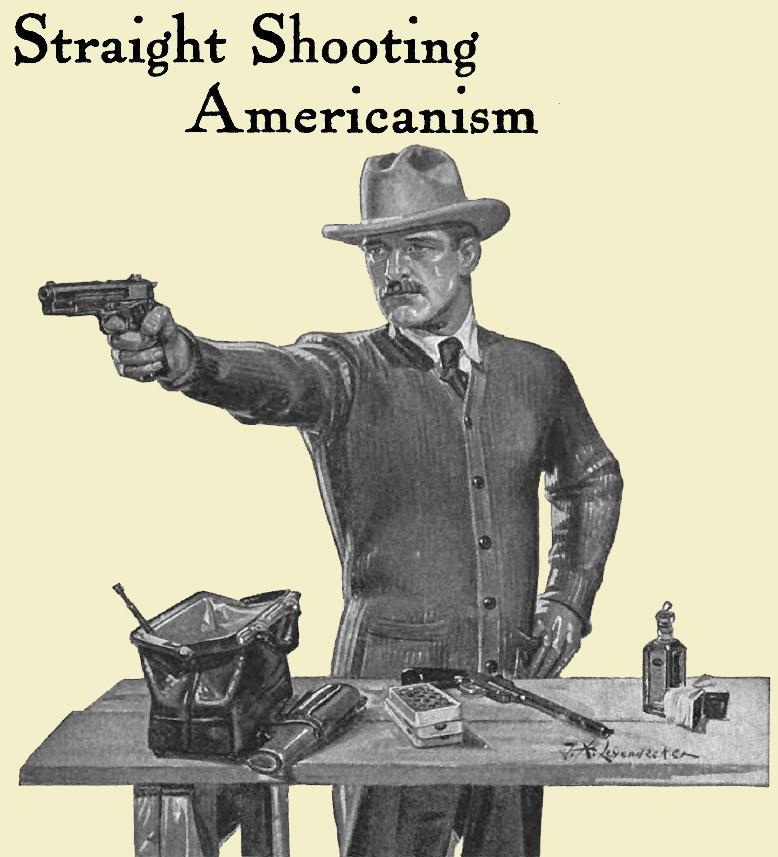
After all, Remington reportedly is the oldest company in the U.S. still making its original product, and it's the oldest continuously operating manufacturer on the continent, and it's the only American company that makes both guns and ammo here in the U.S., and it's the largest domestic manufacturer of long guns.So I'll take this opportunity, then, to highlight the "Remington UMC: for Shooting Right" campaign, a series of ads that ran in outdoors magazines throughout 1919.
Illustrated with art commissioned specifically for the purpose, the ads promoted the range of Remington products -- shotguns, rifles, pistols and ammunition. Each depicted a prototypically masculine American marksman or sportsman -- "dominating, well-coordinated manhood," to quote one of the ads -- and nodded to a segment of the company's market, from youngsters to hunters to recreational shooters.

The tone of the campaign was manly as hell and unabashedly nationalistic. This was post-WWI jingoism at its best, going well beyond flag-waving patriotic pride. (A latter-day jargonista might say that it made a case for "American exceptionalism.") In "Trap Shooting Becomes of World-wide Importance," for example, the copy began,
From "Civilian America on the Rifle Range":"Every man who makes trap shooting one of his recreations thereby contributes both to his own pleasure and success in life and to the success and security of his country.
"The present great world demand for American leadership raises this long popular, valuable and distinctly American pastime of virile men to greater-than-ever importance."
"America can not forget -- nor will the world -- that in assuming world-leadership she must make more than ever sure of backing up with reality the traditional skill in marksmanship of her citizens."Between those two ads, it sounds to me like Remington advocated that Americans claim (or reclaim) the title, "a nation of riflemen."
My favorite, however, of those I've seen, has to be "More American Reserve Power." Below the image of a hunter resting with his kill, a Rocky Mountain Goat, this:
Wow -- any questions?"The strength that comes from the hills was never worth more in this country than it is today. Both to the man himself and to all about him.
"No poison-pollen of Old World imperialism gone to seed can contaminate -- nor any attempt of crowd-sickened collectivism undermine -- the priceless individualism of the American who truly keeps his feet on the earth."
Saturday, March 17, 2012
Winchester Junior Rifle Corps, revisited

Monday, March 7, 2011
A Nation of Riflemen: RWVA's 'Project Appleseed'

(Appleseed is a project of the non-profit Revolutionary War Veterans Association, which aims to teach us about our shared heritage and history along with traditional rifle-marksmanship skills. Traveling volunteer instructors acquaint students with the difficult choices, heroic actions and sacrifices made by the Founders on behalf of present-day Americans. To learn more about Project Appleseed, click here; for a pdf version of the February 2008 S.W.A.T. magazine article pictured above, click here.)
A Nation of Riflemen: Winchester Junior Rifle Corps

(This Winchester ad appeared in the June 1918 issue of Popular Science Monthly; a similar ad appeared in Boys' Life. The newspaper clipping is from the May 21, 1922 edition of The New York Times. The Winchester Junior Rifle Corps was absorbed by the NRA in 1926.)