Showing posts sorted by date for query estwing. Sort by relevance Show all posts

Saturday, December 18, 2010

Backyard firebuilding, Part I

It's the perfect winter's morning -- there's snow on the ground, the sun shines from a clear sky and the winds are calm. Bitter as it is, it doesn't feel unpleasantly cold.

The temp hadn't reached 10°F when I headed outside to liberate our American flag, which had hung up on the front-porch gutter and froze fast. As I was putting the ladder away after, I spied my old
Estwing carpenter's hatchet hanging on the garage wall and hatched an idea.

Grabbing the hatchet and a folding saw, I walked back to the edge of the woods. I'd had my eye on a dead hardwood, probably an Ohio Buckeye, for a while now. At four inches in diameter and about eight feet long it'd be easy to process. And because it was a "leaner," held off the snow-covered ground by surrounding growth, it was ideally dry.

I used the saw to cut it into three portable sections -- crown, trunk and base -- and hauled it home in one trip. After stripping twigs and smaller limbs, I bucked the trunk (with the saw) into 12-inch lengths.

A carpenter's hatchet may not be my first choice to split kindling, but for this backyard fire I'm using backyard tools. My antique-store Estwing worked just fine cleaving the dry, frozen wood (stubborn knots notwithstanding).

I made one more trip back to the tree line, harvesting a couple of resinous pine stubs to serve as a natural firestarter. Less than 45 leisurely minutes after I began, I had the makings of a respectable fire.

One of the best things about this morning's exercise, I think, was doing the job with less-than-ideal hardware -- a used hatchet and a cheap lawn-and-garden saw. It's a reminder that skills, not tools, matter.

I'm not sure when we'll light our backyard fire -- maybe later today, maybe tomorrow. That'll be Part II.

Wednesday, October 6, 2010

Urban Resources: The Other Economy

I spent my growing-up years living near a large community of Amish. Their buggies were common on our rural roads, and I often saw them tending their fields with teams of draft horses.

As a kid, naturally I viewed my Amish neighbors as isolated, plain and backward. My perspective evolved as I grew older, realizing that their simple life gives them a great measure of independence.


When a summer storm knocks out electricity to our "English" homes and businesses, the Amish are unfazed. It doesn't matter how much snow falls in the winter -- their lives go on unhampered, virtually without interruption.

When a farm implement breaks, an Amish man fixes it himself or solicits the help of another member of the community. If an Amish barn burns, the community musters to rebuild it in a single day.

Don't worry, I won't propose that KintlaLake Blog readers adopt the ways of the Amish. I will, however, suggest that we can learn from their self-sufficiency.

This installment of
Urban Resources isn't going to dwell on the concept of simplicity -- I'll talk more about that some other day. This time I'll focus on another way to pursue independence: the principle of doing business, as much as possible, in The Other Economy.

Just as the Amish aren't inconvenienced when our lights go out, so they're less affected by the ups and downs of The Economy. You and I, by contrast, live in a weakening commercial climate exacerbated by our own conduct, both as consumers and as citizens.

We must have New Stuff; we thrive on disposables. We crave The Next Big Thing as soon as it hits the market.

We shop The Web and hurtle out of town to get The Lowest Price at big-chain retailers, driving past struggling businesses in our own communities.

Worst of all, I think, we've allowed ourselves to be persuaded that we're hopelessly at the effect of The Economy.

We're not. The tools we need to move toward economic independence -- and to strengthen our communities -- are close at hand.

The Other Economy operates within every city, village, town and township. Its worldwide headquarters is in each and every home.

It's largely separate from The Economy we hear about every day. The Other Economy isn't listed on an exchange and it doesn't figure much in statistics like unemployment, consumer confidence or inflation. Taxpayers never have had to hand it a bailout.

The Other Economy doesn't presume to duplicate the insular (albeit not completely insulated) character of Amish communities, but here are some practices that we can bring into our modern society.

First, an attitude shift
Truth is, The Other Economy can't provide everything we want. Taking full advantage of it requires an
honest move from want-driven consumption closer to need-based consumption. As the saying goes:
Use it up, wear it out;
Make it do or do without.
Without that change in perspective this becomes, at best, merely a perfunctory exercise without any real benefit.

Oh, there's one more attitude thing: It's not your responsibility (or mine) to pull The Economy out of the ditch it's in.

'Commerce, close to home'
The most conventional aspect of The Other Economy is a commitment to doing business locally. I
wrote about that principle in the early days of KintlaLake Blog:
"As much as possible...I patronize local businesses, ideally independent shops in my township and town. My next preference is a 25-mile radius, followed by a 100-mile range and my state's borders."
That's easier said than done, of course, but acting on the intent to keep business within a certain radius (which will vary depending on where we live) is absolutely fundamental to the commercial vitality of our communities.

Used, not used-up
Here in the KintlaLake household we're big fans of buying used. In previous posts I've written about buying used
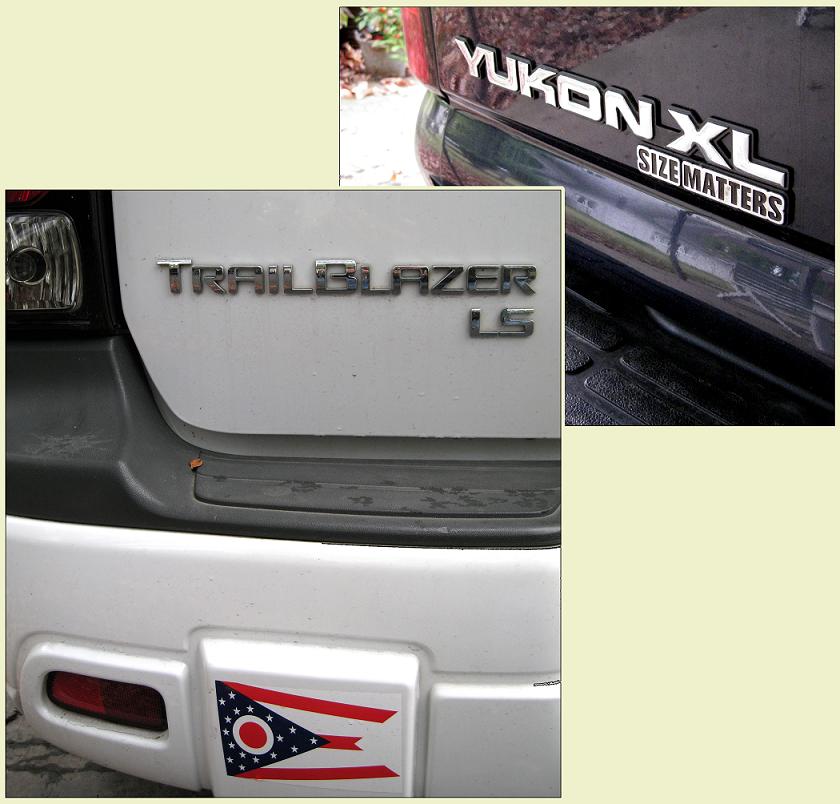
furniture, a used Spyderco Endura I, a used Estwing carpenter's hatchet and, out of dire necessity a couple of years ago, a used Chevy TrailBlazer.

Last summer we picked up a second SUV, a 2004 GMC Yukon XL with over 106,000 miles on the odometer. It's an absolute beast that quickly became my wife's daily driver.

Coincidentally (and sadly), buying the big Yukon now gives us two vehicles assembled in plants that GM closed on
December 23rd, 2008.

Whether shopping a car lot, an antique shop or a secondhand store, the key to buying used is avoiding items that are bona fide lemons, irreparable or well-and-truly huffed. That can be tricky at times, but a good used product often can be had less expensively than an inferior new item. And in the case of "pre-owned" vehicles, all that nasty
depreciation was somebody else's problem.

Shopping the roadside
Each region has its own name for these sales -- garage, yard, tag, rummage -- and we drive by them all the time. That's probably a good idea, since they're magnets for hoarders and full of useless junk.

Still, private sales can be a great source of decent used stuff. I suggest treating them like a trip to the grocery -- make a mission of it, shop from a list and buy with care.

Don't forget that roadside commerce also gives us orchard stores, farmers' markets and garden stands. Some of the best produce I've ever had came from a table under a tree in someone's front yard.

Bazaars of the bizarre
For the purposes of this discussion, I'll lump flea markets and eBay together into this category.

Flea markets these days make Wal-Mart look like Bloomingdales -- they're dominated by cheap Chinese junk -- but they still can yield a pearl or two. I've found good used garden tools at great prices, for example, at a weekly market south of here. I once saw a retired military truck there, a real steal of a deal that I wish I could've afforded at the time.

As for eBay, it's definitely a big part of The Other Economy, but rarely do I find true bargains there, nor does it satisfy my penchant for keeping commerce close to home. (craigslist is better for that, actually.) For the most part I limit my patronage of eBay to selling items that have some sort of recognized collectible value.

'Will work for...'
Bartering was part of my upbringing, though at the time I didn't have a name for it -- it's just what we did. My father often would work for local farmers in return for milk, cheese, meat or produce, even carpentry and masonry.

Over the years I've bused restaurant tables and mucked horse stalls, receiving my "payment" in the form of home-cooked meals. I've traded my writing for everything from herb plants to custom knives, my photography for
concert tickets and my graphic-design services for film and lenses.

One of my fellow
punkin' pickers last month was working for bow-hunting privileges on the farmer's land. With luck, he'll take a deer that'll help feed his family this winter.

And so on -- you get the idea. Bartering arguably is the lynchpin of The Other Economy.

Build a 'DIY bank'
The Economy generally expects us to be greedy, lazy, disinterested and have limited competence. Its success depends on impatient consumers farming-out even the simplest of tasks.

The Other Economy demands thoughtful participation; it cultivates independence and personal responsibility. It requires that individuals acquire, develop and share skills.

Every skill that we have goes into a "DIY bank" that (at a minimum) conserves our other resources. A skill can be bartered or "spent" in more conventional commerce. Skills, if practiced, don't lose their value -- they only appreciate.

It's never too late to learn how to repair plumbing, drive a tractor, fix a flat tire, change engine oil or sharpen lawn-mower blades. Saving money is only the beginning -- the right collection of skills, employed in the right community, can become a downright windfall.

Give it away
One important component of The Other Economy, the last I'll cover in this installment of
Urban Resources, is neither obvious nor is it typically quid pro quo -- the decidedly un-capitalistic practice of volunteering labor, goods and services.

I'm talking about doing something for a neighbor or for the community at large and expecting nothing in return. Fix a furnace or prune a tree. Mow the village green or cook a pot of chili for the township's firehouse. Don't advertise it -- pay forward:

"There is a force that makes us all brothers. None goes his way alone. All that we send into the lives of others comes back into our own."
See, what makes The Other Economy really hum is that it values principles that'd make Gordon Gekko sneer -- and that's precisely why, in my opinion, its time has come.

Tuesday, September 14, 2010

Urban Resources: Firewood

Our house sits on a postage-stamp lot, a tiny patch of land in a Midwestern village. On its face, it appears to offer little in the way of natural resources.

A closer look reveals what a first glance doesn't.

I believe this post will be the first of a series I'll call "Urban Resources" -- seeking and finding materials often discarded and practices neglected. Today I'll talk about making use of a ridiculously simple source of firewood for our backyard pit or, in a pinch, the indoor fireplace.

There are but four trees on our lot -- two maples, a crabapple and a 60-year-old ash. On township property to the east are a magnificent bur oak and a catalpa, each estimated to be 180 years old, as well as a handful of tall pines and spruces. Our southern neighbor's sweetgum and poplar hang over our driveway.

Because all of those trees are relatively mature, they shed onto our lawn every day -- just how much depends on the weather. I've made an early-morning ritual of collecting fallen wood and carrying it to a semi-tidy pile I've built behind the garage.

It's not all small twigs, either. We had an arborist prune the ash of dead limbs back in May, which added some respectably large rounds, and our decrepit crabapple seems to lose a branch or two every time the wind blows.

Bucking the larger limbs requires nothing more than a pruning saw, although occasionally I resort to using a small
chainsaw that operates on rechargeable batteries. I also break out my old Estwing hatchet from time to time. The tool I use most often, however, is a machete.

Specifically, it's 22-inch Collins that I've had for 27 years. The blade is stained and the edge is nicked, and the fractured phenolic handle is wrapped in adhesive tape -- that is, it's just about broken-in. A few minutes' attention with a flat file and a genuine Carborundum stone is all it takes to keep the blade brutally effective.

In four months I've gathered about one-third of a cord of imperfect firewood for my inelegant woodpile. Yes, much of it is kindling and some of it is tinder, but I figure I have enough wood for about a dozen good cooking fires -- so far -- and every bit of it was free.

In the next installment, I'll talk about a surprising source of the ultimate natural firestarter: fatwood. Stay tuned.

Monday, April 5, 2010

Another swing of the hatchet

While I was on the phone this morning, expressing my habit of doodling in three dimensions I picked up that old Estwing hatchet and began turning it over in my hands. I mentioned in yesterday's post that I'd found three letters scribed into the tool's carbon-steel shank, but until today I hadn't spotted a second set of scratchings on the opposite side.

Some hours later I squinted through a magnifying glass at the faint letters -- first name and surname, postal route, town and state. A quick bit of research, colored by a splash of speculation, gives me a story to tell.

The place-name leads to a farming community north of Chillicothe, Ohio. As for the hatchet's owner, two candidates emerge -- father and son, Sr. and Jr.

The father was of my grandparents' era, born in Ross County in October of 1901; his death was recorded in the same locale in January of 1981. His namesake, who in his eighties reportedly goes by "Sonny," apparently still lives there. A satellite image shows the address to be a collection of buildings, surrounded by cultivated fields, at the end of a long lane.

With only sketchy information it's impossible to say for sure, of course, but it's my guess that the hatchet was employed on the family farm and may have been sold as part of the father's estate.

By today's standards, this scarred-up tool should've been retired long ago. It's not new, hardly state-of-the-art, neither pretty nor perfect.

Human hands in Rockford, Illinois forged this hatchet to last and, by god, it survived under the unsentimental lash of Depression-hardened Heartlanders. It saw a lifetime of use before finding
its way to me -- what to do with it now?

I think I know what the tool's original owner might've said:

Use it up, wear it out;
Make it do or do without.
That's certainly what my father and his father would've said. There is indeed a story in this humble hatchet, and the telling of that tale isn't finished quite yet.

Sunday, April 4, 2010

Sharps: Estwing carpenter's hatchet

Each and every time I've wandered the maze of aisles at an indoor antiques mall recently, a certain old-school tool has caught my eye. Yesterday I shelled out a few bucks and brought it home.


It's an Estwing carpenter's hatchet, 13 inches long with a straight, stacked-leather handle. Its condition testifies to hard use. The letters "THH" are scratched into the shank.

Estwing has been around since 1923 and this hatchet is typical of the company's one-piece forged designs. I have no idea how old it is, but I can say with near-certainty that it has no value whatsoever as a collectible -- it looks like the blade was shortened by a half-inch or more and re-profiled at some point, perhaps because the edge broke or chipped.

It came to me crudely ground, with a handle so grimy that it looked like it was wrapped in electrician's tape. I spent five minutes scrubbing the gucked-up leather and ten more knocking the shoulders off of the bevel.

It feels like a keeper and a user -- not much of a woods tool, really, but it could be an ideal backyard companion. Kindling, anyone?

Mid-weekend roundup

Rolling out of bed at 6:30am borders on sloth, at least for me, but that's what I've done both yesterday and today. Once awake, just like I do on weekday mornings, I sift through business e-mail and end each day the same way.

This being a weekend, Mrs. KintlaLake and I occupy the in-between hours with new-house matters.

Yesterday we got detailed reports from a 48-hour radon test and Friday's home inspection. The results of the former don't alarm us (we'll tackle mitigation measures ourselves) and the only pressing concern from the latter is the active presence of carpenter ants and termites in two places near the foundation. There's no apparent damage yet and the homeowner has agreed to pay for a licensed exterminator of our choosing. That takes care of that.

Three days after closing -- April 25th, according to the contract -- the house will be vacant and ours to fill. Until then we won't know if we'll be cleaning carpet, replacing carpet or refinishing hardwood floors that we hope are lurking beneath wretched shag. Equally important, since we
sold or gave away virtually all of our stuff when we moved last year, right now we have no beds of our own, no table and chairs and few everyday furnishings.

Without a pile of money to spend, bang-for-buck is our top priority. We know that we can get great used furniture for a quarter of the price of new, often less than that, so for several weeks we've window-shopped regularly at flea markets and secondhand stores.

On Saturday afternoon we put our name on a 1960s-vintage pecan-wood dining-room table, a clean-lined Scandi design with two leaves and eight (count 'em) tall-backed chairs. The affordable package deal included two buffets, which we'll sell to recoup most of what we paid for the lot. (The house's built-in cabinets make sideboards unnecessary, and the dining room is way too small for them anyway.)

Twin beds for the boys' rooms set us back a hundred bucks -- for two.

Those were the big bits. My wife also picked up an original pink flamingo for the back patio. (I love that woman.) I came home with a small tin sign advertising The Columbus Dispatch and a well-loved Estwing hatchet with stacked-leather handle -- just because.

In the long run our plans call for preserving the house's 1950s-1960s character without turning it into a Disney World diner. Yes, we're still looking for a classic Formica-top dinette to fill the breakfast nook, for example, but we have no interest in retro-repro appliances. All of the built-ins, along with the wonderfully odd bathroom fixtures, will stay.

It's a fun and fresh project. We scour the Web and often fall asleep to HGTV these days, absorbing knowledge while resisting a gotta-have-the-latest mentality. Used stuff is the best, and we'll acquire what we need as funds allow.

There's more happening in this life than just the new house, of course. My TrailBlazer is serving up a couple of problems -- that
check-engine light still glows, owing to a misbehaving air pump. And both low-beam headlights quit working unceremoniously Friday night, a failure traced to a blown under-hood relay. I'll let the expensive air-pump issue go a bit longer and replace the relay ($40) after it arrives at the local NAPA tomorrow.

Our older spawn, who's pushing the limits of (chronological) adulthood, has been giving us serious heartburn lately. I expect to begin exercising the privileges granted by my new
CCW permit this week. Income taxes will be due soon and, because we submitted info to our preparer only a week ago, we're not yet sure what the bill will be. I'm battling bronchitis brought on by inhaling a cloud of attic dust over at the new place.

Stuff like that.

Our perspective keeps us from veering into life's weeds. We can't forget the trials of the last year or that it's been since 2006 that my wife and I have marked Easter Sunday with two jobs, two regular incomes. The four of us are alive and (mostly) well. We grasp our present good fortune and the promise of bright days to come.