My fascination with vintage ads, especially those promoting firearms and outdoors gear, continues. I'm especially drawn to depictions of the Winchester Model 67, of course, like the 1956 ad that I posted on Friday, and to the Winchester Junior Rifle Corps.
First up this morning is "Add a Colt to Your Motoring Equipment," clipped from a 1922 issue of Life magazine. In the early days of the automobile Americans were learning that their new-found mobility, however rudimentary by today's standards, quickly could transport them "beyond the reach of help." What Colt called "the growing menace of auto bandits and thieves" was a relatively fresh concern for the motoring masses.
The other ad I'll share today, "Don't envy the fellows who own rifles," comes from a 1918 issue of Arms and the Man, forerunner of the National Rifle Association's American Rifleman magazine. Even though the readership of Arms and the Man was predominantly adult males, clearly Winchester's aspirational pitch also drew a bead on young boys. This line spoke to both audiences:
"Every boy wants to own a rifle, and every boy who has the right stuff in him should have one."
What American boy, after all, doesn't believe that he has "the right stuff"? And what self-respecting father would admit that he's raising a boy who lacks it?
The two-pronged approach is reminiscent, it seems to me, of another Winchester ad that I posted here last year.
Naturally, the ad includes the W.J.R.C. spiel. It's interesting to note that the program was taken over by the NRA in 1926.
Each of my favorite Super Bowl commercials, posted here yesterday, promotes a venerable American brand. Chevy. Chrysler. Budweiser. None of those corporate icons represents what it once did. Chevrolet (founded in 1911) and Chrysler (1925) survived Chapter 11 thanks to billions in taxpayer-funded bailouts and, in the case of Chrysler, because an Italian carmaker bought almost 60% of the company. Budweiser (1876) is the flagship brand of a brewer headquartered not in St. Louis, but in Belgium. Ever since the commercials ran on Sunday, pundits have been cranking out commentary after ironic commentary. The Chrysler ad has come in for special criticism. Pres. Obama's backers see the spot as supporting his approach to our national economic crisis. Conservative klaxons view it the same way, accusing Clint Eastwood of being a shill for the administration. When you're a hammer, as it's said, everything looks like a nail. Of all the perspectives I've read and heard, only three ring remotely true with me. The first came from Jay Leno:
"One of the most talked about [Super Bowl] commercials was the one with Clint Eastwood, where he said, 'It's halftime in America, and our second half is about to begin.' "The bad news? China has the ball and we're down $15 trillion."
"When the next Republican assumes the Oval Office, whether in four years or eight, he or she will find that the political culture is set up to destroy rather than build. Unifying the nation absent an urgent crisis is increasingly difficult, if not impossible. The organized activist class from your own party will not tolerate dissension from ideological purity, even in the face of real-world responsibilities. The opposition will have been conditioned to reflexively attack, demonizing the duly elected president almost regardless of what policies he proposes. This cannot be good for the country."
Last, here's what Eastwood himself said to FOXNation:
"I just want to say that the spin stops with you guys, and there is no spin in that ad. On this I am certain.
"I am certainly not politically affiliated with Mr. Obama. It was meant to be a message...just about job growth and the spirit of America. I think all politicians will agree with it. I thought the spirit was ok.
"I am not supporting any politician at this time.
"Chrysler, to their credit, didn't even have cars in the ad.
"Anything they gave me for it went for charity.
"If...Obama or any other politician wants to run with the spirit of that ad, go for it."
Now permit me, please, to offer my own view: Attacking Chrysler's "Halftime in America" commercial because it's somehow pro-Obama is intellectually dishonest and ideologically crippled. There's nothing so patriotic as (to quote Avlon) "making the case for American resilience." That's what the ad did, simply and with the conviction of an independent citizen, and that's why I love it.
Okay, so you think that "Chevy Runs Deep" commercial is sappy or cliché and yeah, maybe the acting won't win any prizes. But if you can't help dismissing it, whatever the reason, you don't get it. You wouldn't give your right arm for just one more ride in your granddad's truck. You're an incurable consumer, buying shiny new stuff rather than maintaining or restoring perfectly useful old stuff. You'll probably never understand the satisfaction I get from paring an apple with my late father's pen knife, hauling brush in his old wheelbarrow or turning soil with the shovel he used in his own garden. You haven't the faintest idea what akeeperis, do you?
In yesterday's much-ballyhooed (but patently inconsequential) Ames Straw Poll, Rep. Michele Bachmann won a squeaker over Rep. Ron Paul. Stealing a piece of their thunder, Gov. Rick Perry of Texas announced that he, too, wants to be President. Never mind what you hear from giddy conservatives -- neither development heralds the defeat of Pres. Barack Obama. So far Bachmann and Paul have polled poorly in a hypothetical matchup with the incumbent, and Perry will show that he's incapable of shedding the perception that he's nothing more (or less) than George W. Bush II. Worse, and despite thumping the "Liberty!" tub, all three of these GOP hopefuls pander shamelessly to (so-called) "social conservatives" -- white evangelical Christians, mostly, whose ideology couldn't be more antithetical to Liberty. Barely a week before declaring his candidacy, Perry led 30,000 in a "Prayer-Palooza" at a stadium in Houston -- a sitting governor keynoting a camp meeting. Even Paul, arguably dean of the small-government movement, has been sucked into the anti-libertarian abyss on abortion and other issues. Considering the weak Republican field, this is not good. "I may not be the gearhead I used to be, but I'm still plenty redneck." Those aren't my words -- they came from my smiling wife as we sat along a curb in nearby Reynoldsburg last night, joining thousands of others to watch the annual Mopar Nationals "Brice Road Cruise." The air was thick with tire smoke. Some of the onlookers, many of them children, laid down patches of water on the pavement, hoping to lure a good burnout. Drivers were more than willing to oblige, a token police presence having little effect. Either you get this sort of thing or you don't. We had a ball, and besides, dropping by the Brice Road Cruise was Mrs. KintlaLake's idea. I married a redneck gearhead. Somebody pinch me. Ohio's state flag appears on a new postage stamp, released on Friday. It's part of the "Flags of Our Nation" series and, since I'm a born-and-bred Buckeye, it's a source of pride. Yet another harvest shot, this haul from midday today -- nine large cukes, five peppers, two Romas and five yellow pear tomatoes. I'll end this roundup with the way our weekend began -- at the Huntington Park Hoedown, a benefit concert held Friday evening at the home ballpark of the Columbus Clippers. We arrived at the will-call window just before the gates opened, fetched my media badge and my wife's field pass and made our way to the visitors' dugout to deposit my photo gear. Local solo artist Chris Logsdon took the stage first, followed by Jonalee White and her band. Both treated the crowd to typically great performances. McGuffey Lane, by far our favorite local band (and the source of our comp passes, by the way), was next on the bill and didn't disappoint. My wife and I adjourned to the parking lot for a smoke after their set. When we returned, the reunited Exile was onstage. Of all the acts, we figured, this was the lone take-or-leave proposition. Boy, were we wrong. I don't remember the last time I was as blown away by a performance. I mean, here was an '80s pop-turned-country band showing chops that had the show's other musicians gathering, awestruck, behind the stage. Exile's a capella rendition of "People Get Ready," the Curtis Mayfield classic, had the ballpark so quiet I swear I heard the outfield grass growing. Seriously, people -- if you have a chance to catch Exile live, with all five of its founding members, do it. I promise you won't regret it. Hoedown headliner Pure Prairie League, over five hours after their sound check, closed the show with a high-energy set, including three of my favorites: "Early Morning Riser," "Two-Lane Highway" and, of course, "Amie." Photographically the night had me wishing for faster glass and steadier hands. But incomparable music performed in a great venue, on a clear summer evening that saw a full moon rise over the Columbus skyline behind the stage -- it doesn't get better than that.
For efficiency's sake, I try to wrap errands into my daily trips to fetch the younger spawn at school. And in the interest of remaining aware of my surroundings, I vary my route and survey a different part of the local landscape each day.
While heading south on a rural road this afternoon, I ended up behind a county sheriff's cruiser. The deputy maintained a steady 32mph in the 45mph zone -- only mildly annoying, since I was running well ahead of schedule.
We came to a stop sign; he turned left. I turned right toward the high school, easing the Trailblazer up to the 50mph posted limit.
No sooner had I reached cruising speed than I attracted a tailgater, a pickup truck riding my ass so close that I couldn't see his grille in my rearview mirror. It was textbook get-outta-my-way behavior, consistent with his passing maneuver a mile later -- he shaved it close when re-entering the lane, his way of sending me a message.
They're out there, aren't they?
As luck would have it, I pulled up right behind him at a traffic light a few hundred yards down the road. On the tailgate of the pickup was the the image of a scroll bearing the heading, "Bill of Rights" -- I'm not sure if it was paint or die-cut vinyl, but it was quite impressive. On the bumper below was a vanity plate: GOP NRA.
Seems the guy's big on sending messages.
Since I share two-thirds of his advertised sentiments, I'll chalk up his poor road manners to what (I predict) he was listening to on the radio at the time -- I mean, it was between noon and 3pm. And Rushdoes have a way of making otherwise decent people discard common sense and act like complete idiots...
Like millions of other Americans, my wife, younger spawn and I watched Super Bowl XLV. We settled in our living room, the glow of the TV before us and a fire flickering on the hearth behind.
From the bluest of blue-collar cities, small markets both, Green Bay and Pittsburgh brought a refreshingly non-NFL atmosphere to the Jerry Dome, an enthusiasm rivaling that of big-time college football. And three former Buckeyes -- A.J. Hawk, Ryan Pickett and Matt Wilhelm -- earned championship rings as members of the Packers.
It turned out to be a pretty good game, too.
As you might expect, I could do without six hours of pre-game falderal. Ditto a pop star flubbing the one song she was paid to sing -- the National Anthem. I was out of the room during the halftime fluff, but from what I hear it was a gremlin-infested Charlie Foxtrot.
I do enjoy the commercials. Bridgestone's beaver brought a grin, as did the VW ad with the kid in the Dick Cheney getup. But my runaway favorite -- by a mile -- was this Chrysler spot.
That one pulled me out of my recliner -- from concept to production it's pure genius. Whether coincidence or not, it's the second Chrysler commercial that I've dropped here on KintlaLake Blog.
As the football season faded into memory last night, we turned off the TV and retired to bed. Sleep eluded me for a time -- my mind was restless, but it wasn't replaying Super Bowl highlights. It was still stuck on rewind, conjuring scenes from 42 years ago, remembering one foggy summer morning when my father and I went plinking down by Coxey's Quarry.
It'll be a while, I think, before I can shake those visions and move on. (My father hadn't yet marked his first birthday when this ad appeared in the July 1927 issue of Boys' Life. Methinks that Remington's claim is a bit of a stretch.)
I spent my growing-up years living near a large community of Amish. Their buggies were common on our rural roads, and I often saw them tending their fields with teams of draft horses.
As a kid, naturally I viewed my Amish neighbors as isolated, plain and backward. My perspective evolved as I grew older, realizing that their simple life gives them a great measure of independence.
When a summer storm knocks out electricity to our "English" homes and businesses, the Amish are unfazed. It doesn't matter how much snow falls in the winter -- their lives go on unhampered, virtually without interruption.
When a farm implement breaks, an Amish man fixes it himself or solicits the help of another member of the community. If an Amish barn burns, the community musters to rebuild it in a single day.
Don't worry, I won't propose that KintlaLake Blog readers adopt the ways of the Amish. I will, however, suggest that we can learn from their self-sufficiency.
This installment of Urban Resources isn't going to dwell on the concept of simplicity -- I'll talk more about that some other day. This time I'll focus on another way to pursue independence: the principle of doing business, as much as possible, in The Other Economy.
Just as the Amish aren't inconvenienced when our lights go out, so they're less affected by the ups and downs of The Economy. You and I, by contrast, live in a weakening commercial climate exacerbated by our own conduct, both as consumers and as citizens.
We must have New Stuff; we thrive on disposables. We crave The Next Big Thing as soon as it hits the market.
We shop The Web and hurtle out of town to get The Lowest Price at big-chain retailers, driving past struggling businesses in our own communities.
Worst of all, I think, we've allowed ourselves to be persuaded that we're hopelessly at the effect of The Economy.
We're not. The tools we need to move toward economic independence -- and to strengthen our communities -- are close at hand.
The Other Economy operates within every city, village, town and township. Its worldwide headquarters is in each and every home.
It's largely separate from The Economy we hear about every day. The Other Economy isn't listed on an exchange and it doesn't figure much in statistics like unemployment, consumer confidence or inflation. Taxpayers never have had to hand it a bailout.
The Other Economy doesn't presume to duplicate the insular (albeit not completely insulated) character of Amish communities, but here are some practices that we can bring into our modern society.
First, an attitude shift Truth is, The Other Economy can't provide everything we want. Taking full advantage of it requires an honestmove from want-driven consumption closer to need-based consumption. As the saying goes:
Use it up, wear it out; Make it do or do without.
Without that change in perspective this becomes, at best, merely a perfunctory exercise without any real benefit.
Oh, there's one more attitude thing: It's not your responsibility (or mine) to pull The Economy out of the ditch it's in.
'Commerce, close to home' The most conventional aspect of The Other Economy is a commitment to doing business locally. I wrote about that principle in the early days of KintlaLake Blog:
"As much as possible...I patronize local businesses, ideally independent shops in my township and town. My next preference is a 25-mile radius, followed by a 100-mile range and my state's borders."
That's easier said than done, of course, but acting on the intent to keep business within a certain radius (which will vary depending on where we live) is absolutely fundamental to the commercial vitality of our communities.
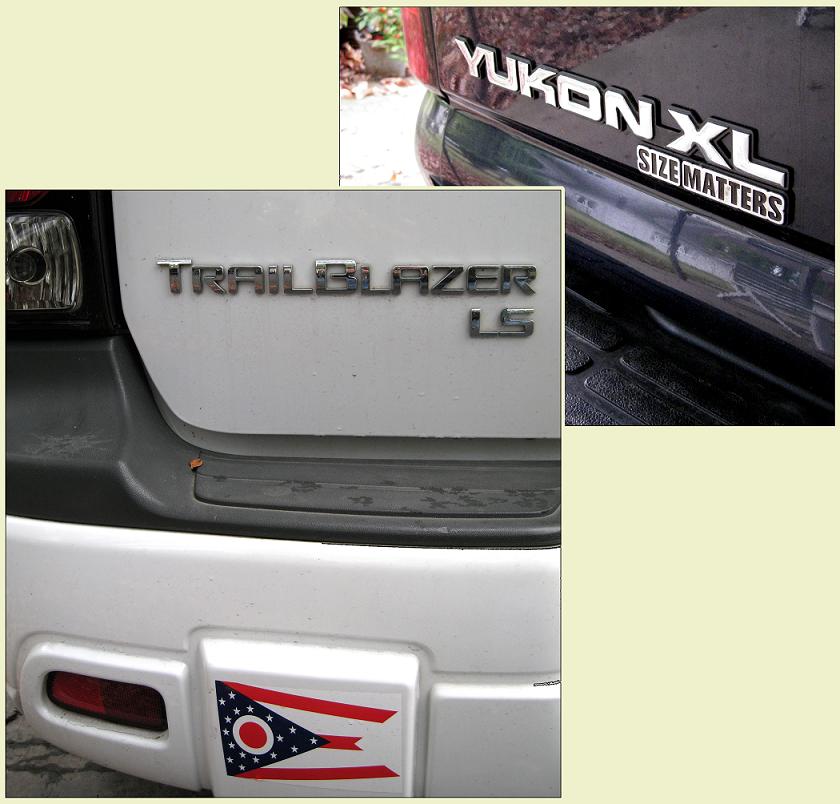
Last summer we picked up a second SUV, a 2004 GMC Yukon XL with over 106,000 miles on the odometer. It's an absolute beast that quickly became my wife's daily driver.
Coincidentally (and sadly), buying the big Yukon now gives us two vehicles assembled in plants that GM closed on December 23rd, 2008.
Whether shopping a car lot, an antique shop or a secondhand store, the key to buying used is avoiding items that are bona fide lemons, irreparable or well-and-truly huffed. That can be tricky at times, but a good used product often can be had less expensively than an inferior new item. And in the case of "pre-owned" vehicles, all that nasty depreciation was somebody else's problem.
Shopping the roadside Each region has its own name for these sales -- garage, yard, tag, rummage -- and we drive by them all the time. That's probably a good idea, since they're magnets for hoarders and full of useless junk.
Still, private sales can be a great source of decent used stuff. I suggest treating them like a trip to the grocery -- make a mission of it, shop from a list and buy with care.
Don't forget that roadside commerce also gives us orchard stores, farmers' markets and garden stands. Some of the best produce I've ever had came from a table under a tree in someone's front yard.
Bazaars of the bizarre For the purposes of this discussion, I'll lump flea markets and eBay together into this category.
Flea markets these days make Wal-Mart look like Bloomingdales -- they're dominated by cheap Chinese junk -- but they still can yield a pearl or two. I've found good used garden tools at great prices, for example, at a weekly market south of here. I once saw a retired military truck there, a real steal of a deal that I wish I could've afforded at the time.
As for eBay, it's definitely a big part of The Other Economy, but rarely do I find true bargains there, nor does it satisfy my penchant for keeping commerce close to home. (craigslist is better for that, actually.) For the most part I limit my patronage of eBay to selling items that have some sort of recognized collectible value.
'Will work for...' Bartering was part of my upbringing, though at the time I didn't have a name for it -- it's just what we did. My father often would work for local farmers in return for milk, cheese, meat or produce, even carpentry and masonry.
Over the years I've bused restaurant tables and mucked horse stalls, receiving my "payment" in the form of home-cooked meals. I've traded my writing for everything from herb plants to custom knives, my photography for concert tickets and my graphic-design services for film and lenses.
One of my fellow punkin' pickers last month was working for bow-hunting privileges on the farmer's land. With luck, he'll take a deer that'll help feed his family this winter.
And so on -- you get the idea. Bartering arguably is the lynchpin of The Other Economy.
Build a 'DIY bank' The Economy generally expects us to be greedy, lazy, disinterested and have limited competence. Its success depends on impatient consumers farming-out even the simplest of tasks.
The Other Economy demands thoughtful participation; it cultivates independence and personal responsibility. It requires that individuals acquire, develop and share skills.
Every skill that we have goes into a "DIY bank" that (at a minimum) conserves our other resources. A skill can be bartered or "spent" in more conventional commerce. Skills, if practiced, don't lose their value -- they only appreciate.
It's never too late to learn how to repair plumbing, drive a tractor, fix a flat tire, change engine oil or sharpen lawn-mower blades. Saving money is only the beginning -- the right collection of skills, employed in the right community, can become a downright windfall.
Give it away One important component of The Other Economy, the last I'll cover in this installment of Urban Resources, is neither obvious nor is it typically quid pro quo -- the decidedly un-capitalistic practice of volunteering labor, goods and services.
I'm talking about doing something for a neighbor or for the community at large and expecting nothing in return. Fix a furnace or prune a tree. Mow the village green or cook a pot of chili for the township's firehouse. Don't advertise it -- pay forward:
"There is a force that makes us all brothers. None goes his way alone. All that we send into the lives of others comes back into our own."
See, what makes The Other Economy really hum is that it values principles that'd make Gordon Gekko sneer -- and that's precisely why, in my opinion, its time has come.
As my family and I pulled out of a local restaurant's parking lot last evening, the amber "check engine" icon began glowing on the instrument panel of my Chevy TrailBlazer -- no reason to panic, of course, just something to notice.
I reached for the rearview and pressed the OnStar button. A few seconds later a person named John answered, asking how he might assist me. He tapped a keyboard while I explained the appearance of the light, and then he put me on hold for a half-minute or so.
When OnStar John returned to the line, first he confirmed my exact location -- and I mean right down to the off-ramp that I was taking at the time -- before telling me that the exhaust-gas monitor in my vehicle's emissions-control system triggered the dashboard alert. He suggested that I attend to the problem within the next seven days, even volunteering to connect me immediately with my dealer.
I politely declined his offer, thanked him and said goodbye.
As for the emissions-system bug, I'll chase it myself before calling a dealer. I've already connected my CarChip, setting it to extinguish the idiot light. If and when the fault recurs, the indispensable gizmo will record the OBD code, arming me with knowledge to present to a mechanic (if it even comes to that).
Often, I've learned, these are nothing more than electro-mechanical hiccups, transient glitches that pop up and then disappear. We'll see.
And then there's that whole I-know-where-you-are thing.
"The past was dead, the future was unimaginable."(George Orwell, from 1984 Part 1, Chapter 2)
Now I'm not one to walk around in some paranoid Orwellian fog -- I embrace technology's risks as well as its gifts. It can be disconcerting at times, but we coexist with "Big Brother" every day. Everything we do can be monitored; our every move can be fixed and followed.
Sure, my mail goes to a post office box. I know how to interrupt power to my truck's OnStar and EDR systems and I can disable or confuse my mobile phone's tracking features.
I also know that for those of us who want to enjoy the benefits of this tech-thick society, attempting to live life completely "off the grid" is, at best, a fool's pursuit.
Don't kid yourself -- it's way, way too late for us to waste time trying to "disappear." We'd be wiser, in my opinion, to spend our energy learning what ol' Bubba knows about us (and how He knows it, and whom He tells) than on trying to prevent Him from finding out.
I don't watch awards shows -- not the Grammys or the Tonys, and not last night's Oscars. I was pulling hard, however, for one of this year's Academy Award nominees in the "Documentary Short" category.
The Last Truck: Closing of a GM Plant, co-written by Steven Bognar and Julia Reichert, who also directed the film, chronicles the final days of a factory in Moraine, Ohio, 80 miles west of where I'm sitting right now. As I've mentioned before in KintlaLake Blog -- here, here and, by reference, here -- it's the plant that built the 2005 Chevy TrailBlazer that I drive every day.
Moraine Assembly was shuttered two days before Christmas 2008.
Of the film's nomination, co-writer Bognar said, "It's very bittersweet. We're very honored, but I would happily trade the nomination, or even an Oscar, for people to have their jobs back. So I think we both carry a complicated bunch of emotions.
"I want to stay grounded in the reality of this: the only reason we're getting this great honor is because something really terrible happened in our community."
An excruciatingly relevant story, no matter how well it's told, doesn't guarantee a statuette, and The Last Truck didn't win the Oscar. Still, I want to honor it -- along with all of the displaced Moraine workers, my neighbors -- in this space.
Interstate 95 took us south and I-64 east to Williamsburg after dawn this morning. We rolled up to the condo where my mother and my sister live just after noon.
Thus began a three-hour visit with two people I hadn't seen in five-plus years. It's a long story, and today wasn't quite the catharsis you might expect.
That said, the time we spent there was pleasant and long enough.
Turning back the way we'd come, next we prepared for another reunion of sorts, this time with one of my wife's old friends.
The deep snow was melting fast today up in the mid-Virginia foothills, making the unpaved roads muddy enough to deserve the label "quagmire." It was dark by the time we slithered to a stop in front of a log cabin hidden in the woods.
There are so many ways to describe my wife's friend -- Dutch, hippie, stroke victim, widow, free spirit. Tonight we ferried her to a store selling her brand of unfiltered smokes and took her out to dinner.
"Memorable" doesn't come close to describing the evening.
We'll slog back home tomorrow. Now I lay me down to sleep...
It looks like my family and I will begin our road trip, postponed once already, late this afternoon.
My wife is off to work and the spawns are on their way to school. I was at my desk working before 5am, planning to wrap things up by noon. At that point I'll pack, prepare the TrailBlazer, await the return of the rest of my family and we'll head east toward the mountains.
I've mapped our route, along with a couple of alternates in case of bad weather or man-made hiccups, and this trip we'll bring our GPS. We need to make good time to accomplish the 1,200-mile whirlwind adventure in two-and-a-half days, so I have my fingers crossed that the main roads, at least, will be clear.
When I start packing this afternoon I'll be considering more than the requisite toothbrush and change of clothes. I'll include provisions for first aid, communications, food, water, fire and yes, defense. (The last, incidentally, will account for two states that haven't yet codified reciprocity agreements with Ohio.) Fortunately, it should be a simple matter of collecting four grab'n'go bags and a few other items.
I am, by at least two definitions, anxious, both looking forward to the all-too-rare weekend trip and dreading hours-long drones along iffy Interstate highways, especially at night.
This latest winter storm, our third in two weeks, began yesterday morning. It snowed steadily for about 20 hours, continuing in squalls well after daybreak today.
Atypically, metro Columbus and its surrounding communities took the brunt of the blast -- usually we dodge the big accumulations, but not this time. All of the schools (including Ohio State's main campus) and many businesses are shut down, and what's not closed is delayed.
It's great.
I would've liked to get down to the woods this afternoon but settled for experiencing our winter wonderland during a quick trip to the post office. My TrailBlazer sat in the driveway, which had been shoveled clean before dusk last night, under ten inches of snow. Once it was cleared off I got underway, the little four-wheel-driver churning eagerly up and out of the semi-plowed neighborhood.
I roosted repeatedly, gleefully, broadsliding at every opportunity just to annoy the locals. This is, at long last, winter -- and isn't that what winter is for?
Although I didn't mention it, late last week we got almost a foot of snow -- wet, heavy stuff that turned to hydro-concrete when the temps dropped. It took me 45 minutes yesterday morning to liberate my wife's car, which hadn't moved since Friday afternoon and was encased in five inches of stubborn stuff. In the process I destroyed my best snow brush and a brand-new ice scraper.
Now it's snowing again, and the "experts" say that we'll get another five to eight inches by this time tomorrow. They also predict winds gusting over 40mph.
Schools are closed. (Natch.)
I'm on my third cup of coffee here, re-reading Mike Lupica's biting (and correct) column from yesterday's edition of The Daily News and preparing for another satisfying day of work.
I do need to get out more, though -- and I will, in a big way, this weekend. My family and I are going to log more than a thousand miles over two-and-a-half days, driving to southeastern Virginia to retrieve a few of my late father's possessions. On the return trip we plan to visit one of my wife's old friends and (we hope) make a quick stop in Morgantown.
Time and road conditions will tell. With iffy weather and mountains ahead of us, I'd better ready the TrailBlazer and our grab'n'go kits.
It'll be both an adventure and a grind, that's for sure, but at least it'll get me out of the house -- way out.
One of those imaginary light bulbs appeared over my head as I stood at the pumps last week, filling my TrailBlazer with 87 octane. It was brutally cold, a stiff wind driving single-digit temps well below zero.
I shivered uncontrollably. For all of my high-toned blogging about layering, there I stood -- woefully under-dressed for the conditions.
Since making a professional move indoors I've been ignoring much of my own advice, wearing no base layer and just a thin insulating layer. I've accommodated the steady 54°F in my basement office by sitting next to an electric space heater. When the time has come to run errands, I've thrown on a jacket and headed outdoors.
Obviously, an important chunk of my preparedness mindset lapsed. Another lesson learned.
Wintertime is, in my experience, the best season for learning. I now know to keep an expanded survival kit -- supplemented with insulated overalls, snow boots, a small shovel and extra food and water, among other things -- in my truck. I tuck my lap belt under my bulky parka and stow an extra pair of Thinsulate-lined ragg-wool gloves (the kind with rubber "grip-dots") in the console. I always carry a firesteel, ideally in a compact fire kit. Little stuff.
A half-century of trials and errors also has taught me things perhaps less apparent -- for example, that using fabric softener when washing wool and fleece will cripple their ability to insulate.
Most lessons, like the one I learned at the gas pump, are as valuable as they are cheap. Once survived, the key is to apply the knowledge -- or, in my case, the embarrassing reminders.
Mrs. KintlaLake's car, a seven-year-old Saab 9-3 that she bought used, has been hinting recently that its battery was on the way out. Yesterday I put the family jump-starter -- one of those portable power-pack things -- into her trunk, just in case.
Sure enough, on this sub-20° morning the battery refused to spin the starter. Dutifully I donned my coat and gloves and came out to help. I pulled out the jumper-gizmo and shut the trunk, hooked up the cables and...wait for it...success!
After disconnecting the cables, I walked to the back of the car and rapped on the lid, signaling my wife to pop it open -- after all, she might need the power pack again and I wanted her to have it along. Thing is, this marvel of Swedish automotive engineering wouldn't allow the trunk to open while the key was still in the ignition.
So my wife switched off the engine, removed the key and opened the boot. I stowed the jump-starter and closed the lid. She re-inserted the key and turned it.
Nothing productive happened, of course -- the car still had a dead battery. We repeated the process (leaving the trunk lid open this time) and soon Mrs. KintlaLake was on her way to work.
My wife loves her Saab and so do I. The older spawn has a '99 9-3, essentially a re-numbered version of the '96 900SE that I once owned, and it serves his teenage purposes well. (Now that I think about it, perhaps too well.) We're disappointed that these days the company is, at best, an orphan.
But if you see one of those old ads claiming that Saabs are "Born from jets," don't you believe it.