Tuesday, March 8, 2011

It doesn't get much better

Lately I've been treating myself to (or torturing myself with) 20 minutes of Rush Limbaugh each weekday, going so far as to impose the experience on my 15-year-old during the ride home from school. We find it entertaining, in a disturbing sort of way.

Shortly after 2pm today, Limbaugh began yakking about holding one particularly hot story until the final hour of his show -- and then regretting the move, because,
"...I realized that while people have heard [the story], they probably don't really know what to think about it totally 'til I've commented on it."
That, right there, tells us all we need to know about talk radio.

Anyway, the aforementioned hot story had to do with National Public Radio fundraising VP Ron Schiller getting hoodwinked by a couple of guys hired by right-wing slimeball
James O'Keefe, the pair posing as members of a phony Muslim group. And I was listening to the Prince of Pomposity prattle about the Duke of Deception duping a Lord of Liberalism. Entertainment-wise, that's just about as good as it gets.

On Limbaugh's website, the headline blares, "
NPR Executive Caught on Tape Being an Ignorant, Arrogant Liberal." The transcript captures the host highlighting Schiller's greatest hits:

"The current Republican Party, particularly the Tea Party, is fanatically involved in people's personal lives and very fundamental Christian...and I wouldn't even call it Christian. It's a weird, evangelical kind of movement.

"The current Republican Party is not even the Republican Party. It's been hijacked by this group that is...not just Islamophobic, but really xenophobic. I mean, basically...they believe in sort of white, middle America, gun-toting. I mean, it's pretty scary. They're...seriously racist, racist people."

"It feels to me as though there's a real anti-intellectual mood on the part of a significant part of the Republican Party. You know, in my personal opinion liberals today might be more educated, fair and balanced. I am most disturbed by and disappointed by in this country, which is that the educated, so-called elite in this country is...too small a percentage of the population, so that you have this very large uneducated part of the population that...carries these ideas. It's...much more about anti-intellectualism than it is about [politics]."

"Republicans play off of the belief among the general population that most of our funding comes from the government. Very little of our funding comes from the government, but they act as though all of it comes from the government. ... Frankly, it is very clear that we would be better off in the long run without federal funding."

I'm hard-pressed to disagree with some of those points -- raging anti-intellectualism, xenophobia and the failure of the Tea Party, now polluted by the religious right's social agenda, to lift a libertarian message above an undercurrent of hate. And if public broadcasting really doesn't want taxpayers' money, we should grant Schiller's wish that federal funding disappear.

Problem is, Schiller stakes his claim to higher ground because he's a liberal -- his ideology makes him superior. That’s bullshit, of course.

Limbaugh, O'Keefe and their ilk, though they'd never admit it, suffer from the same condition that afflicts the left-wing Schiller. That they're "ignorant, arrogant" conservatives is the disease, not the cure.


(Watch the 12-minute version of Schiller's comeuppance here. If you have two hours to kill, you'll find the full video punking here.)

51% of Republicans


(For an explanation of the title of this post, presented in pdf form, click here.)

Monday, March 7, 2011

A Nation of Riflemen: RWVA's 'Project Appleseed'


(
Appleseed is a project of the non-profit Revolutionary War Veterans Association, which aims to teach us about our shared heritage and history along with traditional rifle-marksmanship skills. Traveling volunteer instructors acquaint students with the difficult choices, heroic actions and sacrifices made by the Founders on behalf of present-day Americans. To learn more about Project Appleseed, click here; for a pdf version of the February 2008 S.W.A.T. magazine article pictured above, click here.)

A Nation of Riflemen: Winchester Junior Rifle Corps


(This Winchester ad appeared in the June 1918 issue of Popular Science Monthly; a similar ad appeared in Boys' Life. The newspaper clipping is from the May 21, 1922 edition of The New York Times. The Winchester Junior Rifle Corps was absorbed by the NRA in 1926.)

Sunday, March 6, 2011

A Nation of Riflemen: Camp Perry, Ohio


(The National Rifle & Pistol Championships -- a.k.a. the National Matches -- have been held at Camp Perry, Ohio since 1907. Each summer, military and civilian shooters compete over five weeks in a variety of events. For information about the 2011 National Matches, click here and here.)

A Nation of Riflemen: The (very) old refrain


The Need of Rifle Practice

As a nation we are not what one would call modest and retiring. We do not carry self-effacement to embarrassing lengths -- we have a fair working knowledge of our good points and there have been cases on record where we have spoken of our various merits in a spirit akin to boasting. All in all we consider ourselves a pretty fine little people and the worst of it is we are most generally right.

We are the impudent youngster among nations and the special providence that watches over children has allowed us to accomplish the most amazing things in direct opposition to all reason. We brag like children and so far -- thanks be -- we have, in most cases, made good our bragging. There is one old moth-eaten boast, however, that should be put into storage for all time. This whiskered patriarch among verbal vacuums is the wholly false statement that "we are a nation of riflemen."

Perhaps it is a misplaced spirit of patriotism or it may be merely the effect of constant repetition that has caused this venerable lie to gain credence among those of us who should know better. Whatever the cause, the fact remains that this faith in our ability as marksmen is going to bring us up with a terrible jolt one of these days unless we can disabuse our minds of it and do it in a hurry.


The truth of the matter is that we are as far from being a nation of riflemen as it is possible for a people supplied with the usual number of arms and eyes to be -- and the quicker we realize this truth the less painful will be our awakening when the time comes. The phrase was not always a lie -- it had its birth back in revolutionary times when we were a nation of marksmen. Conditions fairly forced us to be crack shots -- when a citizen has to pause between furrows to pick off a scalp-hunting red brother it is safe to say that he will, in time, develop accuracy with the rifle.

The ability to shoot straight retreated westward before the civilization which swept away the necessity for that ability until today with arms and ammunition developed to the nth power of efficiency we have become absurdly inefficient ourselves.

If you were to stop the first hundred men you met to-day on Broadway, or State Street or on Any Street -- how many of them do you suppose could hit the other side of the street with a rifle? How many of these representative citizens, do you think, would have ever seen a Springfield, much less handled one? Good shots we have a plenty, the mortality among day pigeons is heavy and the amount of game that makes up our annual bag is shameful, but just how much is your field-shooting experience going to be worth to you when you have an army rifle put into your hands with instructions to use it on an animated target that fights back?

The need of consistent rifle practice among Americans is a vital issue and one which is growing in importance hourly. The National Guard contributes little if anything toward training our citizenry in the use of fire arms. Of the entire organized militia 33 per cent failed to make use of the State ranges last year, 80 per cent neglected indoor practice while 66 per cent did not qualify as marksmen. In case of war training camps would put our amateur soldiery into physical trim, but no two or three months will suffice to make marksmen of them.

The N. R. A. in conjunction with the Federal Government is doing good work as is evidenced by the record-breaking increase in membership during the past few months and it is to this organization that we must look for a solution of the problem. Every inducement is offered for the formation of local rifle clubs and it remains only to arouse public interest into action. Outing will be glad to furnish full details as to the formation of Government Civilian Rifle Clubs and to put you in touch with the proper authorities.

Form a club in your town and in addition to enjoying the most fascinating of sports under most favorable conditions you will be doing your share to re-establish our national standing among riflemen.


("The Need of Rifle Practice" led off "The Council Fire," a regular feature edited by L. Stewart Wells, in the December 1916 issue of Outing magazine. Cited previously on KintlaLake Blog: "Where are Tomorrow's Minutemen?" in the January 1959 issue of Guns Magazine; and "The Rifleman in Civil Defense" in the April 1959 issue of Guns Magazine.)

Friday, March 4, 2011

The week's notable quotes

For a news junkie like me, the past several days have been the proverbial candy store. A few quotes stood out -- and you may be surprised to see that Caribou Barbie isn't even on this week's radar.

Xenophobes, your table is ready
There's a lot to like about
Mike Huckabee -- his folksy eloquence, his humor and a number of his more thoughtful positions. He won't get my vote for President, should he run again, because he also reminds me that we must never elect a cleric to that high office.

All the same, he's always struck me as a refreshingly different kind of politician -- until yesterday, that is.

Earlier this week Huckabee asserted that Pres. Barack Obama was raised in Kenya, later claiming that he "misspoke." I believe he's way too smart for that, but I gave him a pass anyway. Continuing to backpedal on talk radio yesterday, however, he said,
"...I do think [Pres. Obama] has a different world view, and I think it's in part molded out of a very different experience. Most of us grew up going to boy scout meetings, and you know, our communities were filled with rotary clubs, not madrassas."
Like I said, Huckabee's a smart guy. It's laughable to argue that he dropped the M-bomb innocently -- without a doubt, he invoked it to fan right-wingers' reflexive fear of all things different. (Read: all things not Christian, all things foreign, especially all things Muslim).

See, Mike Huckabee wants us to know that Pres. Obama spent part of his childhood in another country (Indonesia, not Kenya), in another culture -- therefore he's un-American and unfit to lead. But by appealing to irrational fear, Huckabee exposes his own unfitness.

He'll have a lot of xenophobic company on the 2012 campaign trail, of course, and fearmongering is bound to draw predictably mindless crowds, but I can't imagine any thinking person buying his brand of unfiltered bullshit.

(By the way, it's worth clarifying the makeup of Huckabee's broadcast audience yesterday. He was speaking on
American Family Radio -- not Family Radio Worldwide, which is run by über-fearmonger Harold Camping, the doddering nutjob who preaches that the world will end on May 21, 2011. I realize that I may be highlighting a distinction without a difference, but there it is.)

I must've missed civics class that day
Rick Santorum, the former U.S. Senator from Pennsylvania, wants to be the next President of the United States -- maybe. Recently liberated from a FauxNews contract which prohibited him from appearing on competing networks, on Wednesday he did an interview with CNN's John King.

King asked Santorum if he subscribes to some conservatives' call to table (temporarily) social issues like abortion rights and gay marriage, in order to devote more attention to righting our national economy. From Santorum's response:
"...America is a moral enterprise. I mean, we are a people who believe in certain things and want to see a society in a certain way. We have common shared values. And those values are morally based."
A moral enterprise? Funny, I was taught that the United States of America is a representative republic with democratic moving parts.

Santorum is a Roman Catholic hammer. If he doesn't make every single issue look like some kind of moral nail, he loses his gimmick -- along with his base and any shot he might have at the Oval Office.

When he speaks of we, of certain things...in a certain way, he doesn't speak for me. He equates, arrogantly and incorrectly, Catholic doctrine with American morality [sic]. And by doing so, he's taken a swan dive off of the list of presidential candidates I might consider.

Truth? Or consequences?
Felipe Calderón, President of Mexico, came a-calling at the White House yesterday. During a
press conference that followed the high-level meeting, a Mexican reporter asked the U.S. president if (essentially) he'd be willing to use his veto power to block laws upholding the Second Amendment to the Constitution.

I swear I'm not making that up. Pres. Obama answered, in part,

"Well, the Second Amendment in this country is part of our Constitution and the President of the United States is bound by our Constitution. So I believe in the Second Amendment. It does provide for Americans the right to bear arms for their protection, for their safety, for hunting, for a wide range of uses. That does not mean that we cannot constrain gunrunners from shipping guns into Mexico. And so we believe that we can shape an enforcement strategy that slows the flow of guns into Mexico, while at the same time preserving our Constitution."

"Part of that job is to enforce the laws that are already on the books more effectively. Part of it may be to provide additional tools to law enforcement so that we can prevent the shipment of these weapons across the border.

"But I do want to emphasize -- and I emphasized this privately with President Calderón -- we are very mindful that the battle President Calderón is fighting inside of Mexico is not just his battle; it’s also ours. We have to take responsibility just as he’s taking responsibility. And that’s true with respect to guns flowing from north to south; it’s true about cash flowing north to south."

First, let's give our president credit for hitting the right rhetorical notes in those first two paragraphs: stand by the Second Amendment, enforce existing laws. That said, to my ears it almost sounded like if he weren't the President, he wouldn't be bound by the Constitution and might take a different position.

I remain wary (to say the least) of his stated commitment to an individual American citizen's right to keep and bear arms. Never mind his words -- his record doesn't inspire confidence.

As for the U.S. taking responsibility for murderous Mexican narcotics cartels, well, that's where I get off the presidential train to Tijuana. The history of U.S.-Mexico cooperation [sic] is indisputably one-sided -- we give, they take. We export taxpayers' money and they squander it. While the American economy sputters and stalls, the Mexican government shamelessly begs for more aid -- and gets it.

It's not isolationism to take an unapologetically aggressive approach to securing our borders, to spend more of our dwindling resources on bolstering our own nation. And even if it is, I'm proudly isolationist.

Thursday, March 3, 2011

Picking up threads

It feels like a good time to re-visit some topics covered on KintlaLake Blog in recent weeks and months. In no particular order, then...

Scouting arms
I posted a pointed
commentary last month about the disappearance of marksmanship from the list of essential Scouting skills. And while it may be endangered Scoutcraft, it's not yet gone.

Two long-gun merit badges remain -- Rifle Shooting and Shotgun Shooting. Earning each requires a Scout to demonstrate knowledge and proper mindset as well as skill with firearms.

Rifle Shooting gives a candidate the option of firing a .22 rifle, an air rifle or a muzzle-loader. The marksmanship standards might sound simple -- putting five three-shot groups inside an inch at 50 feet, for example -- but I'll wager that many of us gray-haired shooters can't do that reliably with open sights. Shotgun Shooting is similarly challenging.

It's also worth noting that Shooting Sports is an elective Ranger Award in the Venturing program, which succeeded Exploring in the 1990s.

There's no telling how long it'll be before runaway political correctness relegates those awards to Scouting's trash heap, but I wanted to temper my previous pessimism with some (encouraging) facts.

Urban Resources: Ranger Bands
Seldom does the sun set without another use for "Ranger Bands" popping into my head. It's a curse.

One sub-zero February evening I pulled a Mini Maglite from my
TrailBlazer's console, and after just a few minutes the ice-cold aluminum had my hands aching. The next morning I cut a length of road-bike tube and slipped it over the housing -- problem solved.

I also found a neat idea (
above) in a 1919 issue of Popular Science. Soon I believe I'll cannibalize a motorcycle tube and use that "cobbled" sheath on my Vaughan Sub-Zero Axe. Pictures (mine) to follow.

Sharps: Pocket sheaths
Looking at my "pocket sheath for the woods" the other day, it occurred to me to dose the hide with Montana Pitch-Blend Leather Dressing -- beeswax would help repel water, protecting the knife and (especially) the tinder in the fire kit.

The sweet-smelling paste darkened the leather slightly and gave it a nice sheen. Tested afterward, the surface beaded and shed moisture well. I treated my
smaller pocket sheath, too, but with the Leather Oil -- less water-repellent than Leather Dressing (owing to the lack of beeswax), but just fine for the application.

Waste management
I hate to see
food go to waste -- any food, for any reason. It's safe to say that it's one of my pet peeves. And although composting is a perfectly responsible way for us to turn truly disposable matter into fertilizer, I've been thinking about better ways to save fresh fruits and vegetables that risk spoiling before we're able to eat them.

At a local odd-lots store the other night I spied a brand-new five-tray food dehydrator. It was a convection-only model (no fan), so it wasn't ideal -- but it was "marked down" from $40 to $25. Besides, it came with a jerky kit.

So we brought it home. We'll do some drying, some vacuum-sealing and some
canning and see how it goes over the next year or so. As for making jerky, I'll use the nifty convection oven that was in the kitchen when we moved into our house.

Winchester Model 67

I uncovered a relatively recent article about my old single-shot .22 -- "Winchester Model 67: A Product of Another Era," written by Gil Sengel and published in the January-February 2009 issue of Rifle Magazine. It covers the M67's history, development and variants, and I found it a fascinating read.

I'm unable to offer a hot-link to the piece, however -- it's vanished from Google Books. Go figure.

Scout at 16 weeks
The last time I wrote about our new puppy, she could sleep in a teacup with room to spare. Now she's four months old (give or take) and weighs about 25 pounds. She looks more Lab-ish every day -- otter's tail and all.

I agree with our vet that she'll top-out between 50 and 60 pounds before she's done growing. I hope she doesn't grow out of her disposition, though -- she has the most amazing personality.

Smart? You betcha. She was obeying "sit" and "stay" a long time ago. And she doesn't just "shake hands" -- last week she mastered "gimme five," "high five" and "all ten, up high."

She's definitely Daddy's Girl -- and Daddy is incurably smitten.

Wednesday, March 2, 2011

Someday we'll thank them

As most observers predicted, today the U.S. Supreme Court announced its ruling that the First Amendment to the Constitution protects the right of the Westboro Baptist Church to conduct their hateful protests at funerals of our nation's war dead. And in this citizen's opinion, the high court acted exactly as it should have.

Justice Samuel Alito was alone in dissent. In his minority opinion, he crystallizes all arguments against objectionable speech:

"Our profound national commitment to free and open debate is not a license for the vicious verbal assault that occurred in this case."
That situational, emotional appeal is a poor constitutional case for "abridging the freedom of speech."

Chief Justice John Roberts wrote for the eight-judge majority. His opinion concludes,

"Westboro believes that America is morally flawed; many Americans might feel the same about Westboro. Westboro's funeral picketing is certainly hurtful and its contribution to public discourse may be negligible. But Westboro addressed matters of public import on public property, in a peaceful manner, in full compliance with the guidance of local officials. The speech was indeed planned to coincide with Matthew Snyder's funeral, but did not itself disrupt that funeral, and Westboro's choice to conduct its picketing at that time and place did not alter the nature of its speech.
"Speech is powerful. It can stir people to action, move them to tears of both joy and sorrow, and -- as it did here -- inflict great pain. On the facts before us, we cannot react to that pain by punishing the speaker. As a Nation we have chosen a different course -- to protect even hurtful speech on public issues to ensure that we do not stifle public debate. That choice requires that we shield Westboro from tort liability for its picketing in this case."
As much as I loathe Westboro and all it represents, there may come a time when my speech -- or yours -- offends the sensibilities of a majority of Americans. On that day, we'll be grateful that this court, this time, stood for Liberty.

Tuesday, March 1, 2011

'The Rifleman' mashup

The Rifleman, which starred Chuck Connors, was my favorite TV show during the early 1960s. (Sea Hunt with Lloyd Bridges ran a close second.) Even at a tender pre-school age, watching Lucas McCain wield that Winchester Model 1892 would get me grinning every time.

A
YouTube link that Mrs. KintlaLake sent me today, on the other hand, had me laughing out loud. It's a digital "mashup" of scenes from The Rifleman and...well, you'll just have to watch it.

Frank talk

Every true sports junkie knows about the high-school football rivalry between Massillon and Canton. It's been waged since 1894, the prep equivalent of Ohio State-Michigan.

Each of these northeast-Ohio cities has a blue-collar heritage -- rather like
Pittsburgh and Green Bay, actually -- and historically the friendly friction has reached beyond the gridiron to factory floors, secretarial pools and advertising departments.

Today I'm remembering one corporate faceoff in particular.

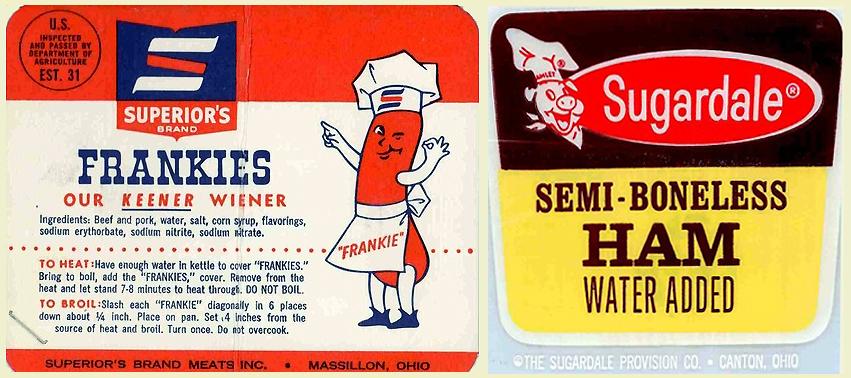
Two local meat-packing operations vied for a share of my family's grocery budget in the '60s and '70s. Canton had
Sugardale, founded in 1920; hometown Massillon had Superior's, tracing its roots to 1933.

The symbol of Sugardale was a cartoon pig named "Hamlet." Not to be outdone, Superior's countered with "Frankie," an animated hot dog.

As a kid, I loved hot dogs -- and what American kid doesn't? -- and I begged my mom to buy the Superior's brand. I had a preference not because Superior's was a Massillon company, but because I liked the mascot...well, that and the
radio jingle:
Fun-to-eat treats from Superior's Meats;
Frankies -- the Keener Wiener!
On the playground, as you might imagine, we'd sing that jingle to any boy unlucky enough to have been named "Frank."

Superior's and Sugardale came together in 1976 under the
Fresh Mark corporate banner. I don't know if the rivalry survived their meaty merger, but both venerable brands -- as well as Frankie and Hamlet, believe it or not -- are still around today.

Monday, February 28, 2011

Home yet again, 1920s


Here's one more image of
downtown Massillon. It's said to be from the 1920s, about the time that my father was born in a farmhouse a few miles outside of town.

Like the 1966 photo I posted a couple of weeks ago, in this shot the camera faces east. From what I can tell, it was taken from an upper floor (or perhaps the rooftop) of one the bank buildings on the south side of Lincoln Way near the center of town.

That's the facade of the Lincoln Theater in the left foreground and the spire of the Methodist church rising against the winter sky. They were there during my own youth 40 years later, and both still stand today.

Sunday, February 27, 2011

Four freedoms & seven steps

Staying on the beam about World War II-era culture here, today I'll take a look at a wartime leader's wishes for the world, and also how our government pressed citizens to help hold back inflation. One can tell us a lot about how we landed in our current fix, while the other exposes our refusal to do what it takes to get out.

In his 1941 State-of-the-Union address, less than a year before the Empire of Japan struck U.S. forces at Pearl Harbor, Pres. Franklin D. Roosevelt enumerated what he called "four essential human freedoms":

  1. Freedom of speech & expression
  2. Freedom of worship
  3. Freedom from want
  4. Freedom from fear
Here was the President of the United States articulating not freedoms but aspirations. His first two points are enshrined in our Constitution, which protects opportunity; the third and fourth "freedoms" are not.

FDR's vision is seen by many as defining the core principles of liberal political ideology. Some consider his "Four Freedoms" speech as tipping America in the direction of socialism. There's little doubt that it laid the foundation for the United Nations.

I could make a value judgment about each of those effects -- and if I did, it wouldn't be pretty -- but instead I'm going to focus on more practical matters.

The goal of ensuring "freedom from want" has bankrupted America. Domestically it created a "social safety net" and a parasitic entitlement culture. Globally it made us the world's bank, cop and philanthropist, at the expense of stability and solvency here at home.

"Freedom from fear" is the ultimate expression of government-as-parent. (See the illustration by Norman Rockwell, above.) Integral to the constitutional provision "for the common defense" is the bearing of arms -- collectively and individually -- and yet the fourth of FDR's "freedoms" has been used to support the gutting of military readiness and the wholesale disarmament of citizens.

Humans aspire to happiness, and certainly we'd be happier free from want or fear. The Declaration of Independence acknowledges "the pursuit of happiness" among our "unalienable rights" -- not the achievement of happiness but its pursuit.

Independent humans are satisfied with opportunity. We'll do the rest on our own, thanks.


During the wartime years of the 1940s, Americans had roughly 40% more purchasing power than there were goods available to buy -- a prescription for runaway inflation. After watching prices jump by more than 60% during World War I, the federal government was determined to avoid a repeat performance.

It instituted rationing, price controls and other measures, all promoted by posters, ads and events. Central to the "Help US keep prices down" propaganda campaign were seven steps that ordinary citizens could take:

  1. Buy only what you need.
  2. Don't ask more than you must for what you sell.
  3. Pay no more than ceiling prices.
  4. Pay taxes willingly.
  5. Pay off your old debts -- all of them.
  6. If you haven't a savings account, start one.
  7. Buy and hold War Bonds.
From our perspective, a few of those suggestions ring of common sense -- be frugal, save money, get rid of debt. A couple of others -- don't overcharge, don't overpay -- fly in the face of today's pseudo-capitalism. The remaining two won't sit well with neo-cons mindlessly committed to reducing taxes.

The government wants to raise my taxes? What, and I'm supposed to pay them cheerfully? And the feds want me to buy War Bonds, too?

Yes, actually, to all of the above. The reasons were both patriotically sound and fiscally responsible.

The Greatest Generation knew that supporting the war effort meant supporting the revenue-generating measures required to pay for it, distasteful and difficult as that may have been. Second, increasing taxes during wartime was intended to be a pay-as-you-go strategy -- squaring the national ledger as money was needed and spent. And third, reducing American consumers' purchasing power was an important anti-inflation by-product of higher taxes.

That wasn't sinister -- it was smart. The feds' scheme worked, too, by most historians' accounts, holding World War II inflation below 25%.

Today our nation is crippled by ideology. The left has abandoned constitutional principles for entitlements and the illusion of safety -- the government will provide. The right has forsaken the role that sacrifice plays in patriotism, acting as if representative taxation is antithetical to freedom.

If we don't learn from our history we are, in a word, screwed.

Saturday, February 26, 2011

Thursday, February 24, 2011

Over my grandfather's farm

In the years after World War II, a handful of former U.S. Navy and Army Air Corps reconnaissance photographers formed The Zekan-Robbins Company in Harlan, Iowa. They flew all over the country taking aerial snaps of farms, estates and villages, selling their images to small-town newspapers and proud property owners.

I can't say exactly when Zekan-Robbins took this photo of my paternal grandfather's farm, but if I had to guess I'd say it was 1950 or so.

My grandfather's death and the sale of the property would follow several years later, not quite two years before I was born. I grew up not far away, and yet I visited the farm only twice -- once when
my father and I went plinking at the adjacent quarry and again in the late 1970s the morning after the farmhouse, which was abandoned by then, burned to the ground.

In the foreground of the aerial photo are the big frame house in which my father and his siblings were born, the spring house, vegetable gardens and the chicken coop. Beyond the farmhouse are stables where the draft horses were kept. Those are fruit trees to the right.

The outbuildings include the barn, a bow-roof implement shed and a corn crib. An empty wagon rests just off the driveway, a hay rake sits idle in the corner of a newly baled field, and that looks like a late-1940s Ford pickup truck parked inside the haymow.

It's all gone now, of course.

Sole survivors

Five days after a pair of neglected old clod-hoppers emerged from long-term storage, they're ready for their closeup.

I'm absolutely thrilled with the way they turned out. The three-step restoration process -- a thorough scrubbing with a horse-hair brush and Montana Pitch-Blend Leather Oil Soap, followed by two applications of Leather Oil & Conditioner and finally a light coat of Leather Dressing -- brought back the uppers' original olive-brown hue and gave the hide a supple, like-new feel.

Still on my to-do list: adding a pair of simple foam
insoles and (maybe) replacing the laces. Other than that, they're ready for the woods -- or the yard, or whatever else I might ask of them.

I don't know who manufactured these boots for Sears four decades ago, but the all-leather construction -- upper, tongue, ankle collar and full lining -- is impressive. Most seams are double-stitched; a few actually are triple-stitched. That this pair is intact after years of hard use (and disuse) testifies to high-quality materials and workmanship.

Two things I do know for sure: The good stuff lasts, and it's always worth keeping.

(Sears lace-up boots, manufactured ca. 1971, before & after)

Wednesday, February 23, 2011

Urban Resources: 'Dry packs'

When I began resurrecting my 40-year-old hiking boots the other day, I washed them inside and out with Montana Pitch-Blend Leather Oil Soap. Then I stuffed them tight with wadded-up newspaper to preserve their shape and draw out some of the remaining moisture. Several hours later I removed the damp paper, stuffed them again and left them that way overnight.

By the next morning the leather lining was drier but not yet dry, so I tapped a simple
urban resource -- homemade "dry packs." Here's the shopping list:
  • Coffee filters (cone-type)
  • Cat litter (clumping, unscented)
  • Stapler
To make a dry pack, I pour a small amount of litter (one-third to one-half cup) into a filter, fold over the open edge and staple it closed. Then I fold in each "ear" and put in a couple more staples. That's all there is to it.

These inexpensive do-it-myself packs aren't meant to replace silica-gel desiccant packets, but they're great for dropping into shoes, motorcycle helmets, luggage, gun cases and ammo boxes -- anywhere that dampness could cause problems.

(Substituting baking soda for cat litter, by the way, makes an effective "odor pack." The imagination reels...)

Yesterday I put two dry packs in each of my old boots and stuffed the shanks with newspaper (loosely this time). I expect that they'll be good and dry by later today.

Tuesday, February 22, 2011

Quote of the day

"A constitution, a parliament, freedom of right -- of speech, freedom of -- of -- of whatever kind of freedom. I cannot -- I don't know freedom to speak about freedom. I have [been] born and raised in this generation. I have been brainwashed not to think that freedom is a right.

"What's next? What's next are the educated people, the civil people, the loved people, the peaceful people joining all together to rebuild this country again. I'm not going to call it the Libya of tomorrow. It's -- this is a term that everybody is getting sensitive of -- it's going to be the
real Libya, the Libya that nobody got to know so far."

(An unidentified Libyan woman, speaking by phone today to
CNN, on what she'd want to see after the hoped-for departure of dictator Muammar al-Gaddafi.)

Poster eyes

When I illustrated yesterday's entry with a half-dozen World War II-era posters, I could almost hear the reaction from some quarters -- a combination of nostalgia for a nation united and revulsion at government propaganda.

It was a different time, a different country. Most Americans alive today can't grasp the concepts of self-sufficiency, conservation and recycling even for their own sake, much less actually sacrifice in service of a greater good.

Take something as fundamental as food. During World War II, citizens were encouraged to plant "
Victory Gardens" (called "War Gardens" during World War I), ostensibly so that more farm-grown produce could be channeled to our fighting forces around the world.

It's estimated that by 1944 a stunning 40 percent of all vegetables consumed in the U.S. came from 20 million Victory Gardens.

The feds also urged Americans to "Can All You Can" -- to "put up" surplus home-grown produce for use between growing seasons. (Now you know why your grandma had all those Ball jars on her basement shelves.) Not only did gardening and canning help stretch families' budgets, they also made precious ration points go farther.

Sometimes we forget that
The Greatest Generation endured wartime rationing of -- ready? -- tires, cars, typewriters, sugar, gasoline, bicycles, shoes, silk, nylon, fuel oil, coffee, stoves, meat, lard, shortening, vegetable oils, cheese, butter, margarine, processed foods, dried fruits, canned milk, firewood, coal and more. The national speed limit was 35mph.

I have a lasting memory of how my father ate green onions -- base, leaves and all. He was the only person at our family table who did that. At the time I thought it strange. Now I get it.

He wasted nothing. As a child of The Great Depression, he never knew for sure when his next square meal would come. And as a young man during World War II, he understood that food was, in truth as well as by the government's definition, a weapon of that war.

He always cleaned his plate. So now do I and, coincidentally or not, I'm the only one at our family table who can be counted on to do that -- every single time.

Grow your own food. Make it last. Clean your plate. Sound advice -- but can you imagine the dustup today if those suggestions came from the federal government?

Big Brother! Groupthink! Socialism! Hell, these days the First Lady can't plant a garden or push breastfeeding without getting
criticized by Caribou Barbie or the Mindless Minnesotan. Nanny state!

There's no law against propaganda campaigns containing good stuff, and yet we've become embarrassingly adept at saluting or dismissing ideas based solely on the source. That's what sustains all anarchists and anti-government cynics. But as I said a couple of years ago,
"Blind rejection, blind acceptance -- both are manifestations of ignorance. Not everything that our government does is sinister, any more than everything it does is wonderful. Skepticism (not paranoia) instructs us to differentiate between the two, and then critical thought (not ignorance) allows us to see facts."
The same goes for political campaigns, of course.

Americans pulled together, albeit briefly, after the terrorist attacks of September 11, 2001. We couldn't sustain our unity, however, choosing instead to withdraw to safe cover behind walls of ideology.

I don't believe that we have it in us to do what The Greatest Generation did. Our "more perfect Union" is divided beyond the capacity of today's Americans to repair.

What individual citizens can do, within our homes and communities, is to begin reclaiming our American legacy of respect, hard work, frugality and selfless service. We won't see this nation's strength restored in our lifetime, but the work must start now.

How does your garden grow?

Monday, February 21, 2011

Missing, presumed lost

I was born to parents of "The Greatest Generation," their American ethic forged in the fires of The Great Depression and World War II.

They and their peers walked through this world as living examples of respect, hard work, frugality and selfless service. Their children, Baby Boomers like me, were given every opportunity to carry on their legacy.

We, as a generation, failed them.

We sabotaged our nation, living as if we're entitled to what our parents worked to achieve. Raised by good stewards, we became addicted to consumption and irresponsible acquisition.

We presumed that the "American Dream" was our birthright, that "
American exceptionalism" was in our DNA, willfully ignorant of the fact that both were earned through preceding generations' sacrifices.


As we grow older we see what we've done, who we've become. We struggle to right our self-absorbed ship and teach our kids, belatedly, what our parents taught us.

It's having little effect, of course -- and is it any wonder? They've been watching us. In their eyes we have no credibility on the subject.

Because our example is missing, the lessons are lost on them and probably for another generation at least. Perhaps our children will pass through trials of their own -- economic collapse, terrorism on these shores or other crises -- and build a new American ethic that'd make their grandparents proud.

I'm not optimistic about that.

(See hundreds of other wartime posters
here on The American Legion's website.)