Against the backdrop of the shooting involving a neighborhood-watch volunteer last month in Sanford, Florida, this subject seems timely.
 First, a little background: my wife and I are active in our local crime watch. It's a private effort, separate and distinct from the official community-watch program managed by our county sheriff's department.
Applicants for the sheriff's volunteer program are trained in basic protocol and procedures. If accepted, they're issued identifying clothing (cap, polo shirt and jacket) and patrol in radio-equipped marked cars.
Our group, by contrast, holds regular information-sharing meetings and leaves the rest to residents' interest and discretion. Mrs. KintlaLake and I often cruise the streets near our house and monitor nearby city parks, and we keep tabs on our neighbors.
We're crystal-clear about what we're legally empowered to do: observe and report. We don't pursue and we don't engage.
We have no authority to enforce the law -- we're not cops, nor do we aspire to be. We're simply citizens of this community, taking responsibility for a measure of its security.
Long-time KintlaLake Blog readers will recall that both my wife and I hold CCW permits, and yes, we carry when we're moving through our community to take note of goings-on. Then again, we always exercise our concealed-carry privileges, whenever and wherever possible.
(The sheriff's community-watch volunteers aren't permitted to carry firearms while on-duty, by the way.)
Getting involved in a crime-watch group (or forming one) is a good idea, in my opinion. A few suggestions:
First, a little background: my wife and I are active in our local crime watch. It's a private effort, separate and distinct from the official community-watch program managed by our county sheriff's department.
Applicants for the sheriff's volunteer program are trained in basic protocol and procedures. If accepted, they're issued identifying clothing (cap, polo shirt and jacket) and patrol in radio-equipped marked cars.
Our group, by contrast, holds regular information-sharing meetings and leaves the rest to residents' interest and discretion. Mrs. KintlaLake and I often cruise the streets near our house and monitor nearby city parks, and we keep tabs on our neighbors.
We're crystal-clear about what we're legally empowered to do: observe and report. We don't pursue and we don't engage.
We have no authority to enforce the law -- we're not cops, nor do we aspire to be. We're simply citizens of this community, taking responsibility for a measure of its security.
Long-time KintlaLake Blog readers will recall that both my wife and I hold CCW permits, and yes, we carry when we're moving through our community to take note of goings-on. Then again, we always exercise our concealed-carry privileges, whenever and wherever possible.
(The sheriff's community-watch volunteers aren't permitted to carry firearms while on-duty, by the way.)
Getting involved in a crime-watch group (or forming one) is a good idea, in my opinion. A few suggestions:
- Know the law -- local, state & federal.
- Don't fly solo -- maintain your independence, but enlist the participation of other members of the community.
- Involve law-enforcement authorities -- communicate, collaborate & cooperate.
- Watch out for eager-beavers, cop-wannabes & vigilantes -- a crime-watch group isn't a posse.
- I repeat: observe and report -- don't pursue & don't engage.
- Avoid divulging too much information about your own family's safety, security & preparedness plans to other members of your group.
Now more than ever, we need to take care of our communities. As long as we're smart about it, we needn't be intimidated by the shit-storm in Sanford.
It's a damp, overcast morning here at KintlaLake Ranch. Seems like a good time to catalog some unexpected finds.
In one of my Urban Resources posts I surveyed The Other Economy,
that rich source of goods and services operating outside the conventional marketplace. My family and I have been "shopping the roadside" a lot lately, turning up bargain after useful bargain.
I've regretted parting with my Black & Decker Benchtop Workmate since leaving it behind when I moved back to Ohio ten years ago. Introduced in the late 1970s, the Benchtop model eventually was discontinued, so if I wanted to replace it I'd have to explore the secondhand market.
 I discovered this one (above) earlier this summer at a garage sale halfway down a narrow alley in our village. Other than a few stains and a little rust, I found it in excellent condition, complete except for a pair of original-issue L-bolts that clamp it to a bench.
The price: just $3.00. Two carriage bolts, two flat washers and two wingnuts, purchased at the local hardware store, put it on my workbench for a grand total of four bucks.
 Because a man can never have enough vises (or vices, for that matter), at another garage sale that same day I picked up this "hobby vise" (left) for two dollars. It clamps to the work-surface with a thumbscrew and will come in handy for a variety of small projects.
Speaking of The Other Economy, our village held its annual flea market last weekend. It's not a big event, just a coupla dozen canopied tables piled with household castoffs. My wife and I came home with a three-foot chocolate rabbit (brown plastic, actually) that'll grace our front porch next Easter, and a 1960s-vintage glass-and-chrome teapot. Together, the two items cost us two bucks.
 I spent one more dollar, that on an old Boy Scout "contest medal." These awards were introduced in the late 1920s, as I understand it, but they'd been retired by the time I became a Scout myself.
Wanting to get a better fix on this medal's age, yesterday I examined it with a magnifying glass. Other than the word CAMPING cast into the front, the pendant bears no markings. Stamped on the clasp at the top of the ribbon, however, is PAT. NO. 2,795,064. A bit of web-sleuthing unearthed a copy of the original patent for the clasp -- applied for in 1953, granted in 1957.
So the clasp, at least, probably is as old as I am. A buck bought me a keeper and a pleasant exercise in discovery.
I love beer -- and I mean good beer. Sure, I'm willing to throw back my earthly portion of mass-produced barley pop, but I prefer beer that has actual flavor.
In a corner-store lager, for example, I enjoy an ice-cold Rolling Rock. If I had to choose a favorite, without a doubt it'd be Rogue Brewery Dead Guy Ale. And as you might expect, I'm especially partial to small-batch local brews, like those from Columbus Brewing Company.
 Recently I learned of Rockmill Brewery, located in nearby Lancaster, and its Belgian-style ales. As the story goes, Rockmill's founder discovered that the well on his family's farm produced water with the same mineral content as that found in Wallonia, Belgium, and that served as the inspiration for four unusual ales.
Mrs. KintlaLake and I savored a bottle of Rockmill Dubbel over a plate of summer sausage, sharp cheese and apple slices (this isn't a beer one serves with nachos), and we came away truly amazed. It's strong (6% to 8% ABM), full-bodied and fruity, as well as pricey ($16 for a 22-ounce bottle) -- and worth every penny.
Great beer, brewed barely a stone's throw from home -- that's as good as it gets. There's a bottle of high-octane Rockmill Tripel in my fridge, and I can't wait to pop the cork.
Finally, of course, our vegetable garden offers up discoveries almost every day -- take this green-and-yellow beauty (below) that sprang from one of the "volunteer" vines I mentioned last week. At about 12 inches long, it's the largest gourd that's set (so far). Our unintentional crop continues to spread, so there will be more.

Those of us who live in areas vulnerable to hurricanes, tornadoes, floods and similar natural hazards swear by our weather radios. The technology behind this urban resource has come a long way since I bought my first receiver at Radio Shack in the '70s.
 NOAA Weather Radio All Hazards (NWR) is a nationwide network of transmitters broadcasting weather forecasts, conditions and alerts directly from the closest National Weather Service office. In addition, NWR broadcasts information about non-weather threats -- earthquakes. chemical spills, AMBER alerts, 911 system outages and more.
The biggest difference between today's NWR receivers and older weather radios is something called Specific Area Message Encoding technology, or SAME, which makes it possible to program a receiver for a particular county or locality. Once set up, the receiver will respond only to broadcast alerts within the area programmed.
NOAA Weather Radio All Hazards (NWR) is a nationwide network of transmitters broadcasting weather forecasts, conditions and alerts directly from the closest National Weather Service office. In addition, NWR broadcasts information about non-weather threats -- earthquakes. chemical spills, AMBER alerts, 911 system outages and more.
The biggest difference between today's NWR receivers and older weather radios is something called Specific Area Message Encoding technology, or SAME, which makes it possible to program a receiver for a particular county or locality. Once set up, the receiver will respond only to broadcast alerts within the area programmed.
 The KintlaLake household relies on a pair of SAME-capable Midland WR-100 units (MSRP $50, street price $30 or less). One sits on a table in the master bedroom and the other lives in our basement shelter.
The WR-100 can operate on either plug-in AC or on-board AAs. I've set a reminder in my Palm Pre to replace the batteries annually, and we keep fresh spares near each radio. Also, because we live in a corner of our county, we've programmed our WR-100s with SAME IDs for two neighboring counties as well.
Throughout yesterday, meteorologists were forecasting nasty storms overnight and, sure enough, our bedroom receiver began barking shortly after midnight. It makes me cranky (to say the least) to drag my ass out of bed and across the room to silence alerts for severe thunderstorm warnings, but I'd rather know than not know.
The KintlaLake household relies on a pair of SAME-capable Midland WR-100 units (MSRP $50, street price $30 or less). One sits on a table in the master bedroom and the other lives in our basement shelter.
The WR-100 can operate on either plug-in AC or on-board AAs. I've set a reminder in my Palm Pre to replace the batteries annually, and we keep fresh spares near each radio. Also, because we live in a corner of our county, we've programmed our WR-100s with SAME IDs for two neighboring counties as well.
Throughout yesterday, meteorologists were forecasting nasty storms overnight and, sure enough, our bedroom receiver began barking shortly after midnight. It makes me cranky (to say the least) to drag my ass out of bed and across the room to silence alerts for severe thunderstorm warnings, but I'd rather know than not know.
By 2am we were under a tornado watch. I was still awake when the tornado warning came in at 2:30am.
We woke the 16-year-old, grabbed the dogs and took refuge in the basement. The NWS gave our village the all-clear an hour later, and my wife and the spawn returned to bed. I brewed a pot of coffee and stayed up to watch local news.
According to reports, a tornado touched down several miles south of here and straight-line winds in excess of 100mph were recorded to our northeast. Our immediate surrounds got quite a blow but escaped essentially without damage -- just heavy rain and downed limbs.
Our weather radios gave us a heads-up to the threat, however, providing us with the information we needed to protect ourselves. Along with a shortwave receiver, a couple of multi-band scanners and a handful of GMRS transceivers, they're invaluable components of this family's comm system.
 Today's savvy keyboard kommandos are familiar with Adobe Reader, the popular document-sharing software that allows us to read .pdf files. It's loaded on most new PCs, and even if it's missing, it's free to download and upgrade (here).
Most of us take Adobe Reader for granted, noticing it only when it shows up on its own. I approach this urban resource differently, creating and maintaining a digital library of .pdf documents.
As I post this, that library has grown to 7.2GB. I've amassed nearly 2GB of reference materials on bushcraft and survival, 800MB on firearms, 150 maps, 200 military manuals and more. I have 2.5GB of instructions and related information on virtually everything I own -- from computers to cameras, radios to razors, security to SUVs.
All of these documents are available to me offline, with or without an Internet connection. Loaded onto a thumb drive they're easily portable. Yes, they require a working computer to view, and no, they're not EMP-proof, but that's what paper is for -- it's wise, of course, to keep a printed library of critical information.
The easiest way I've found to search for .pdf files is via Google. I type a search string, followed by:
Today's savvy keyboard kommandos are familiar with Adobe Reader, the popular document-sharing software that allows us to read .pdf files. It's loaded on most new PCs, and even if it's missing, it's free to download and upgrade (here).
Most of us take Adobe Reader for granted, noticing it only when it shows up on its own. I approach this urban resource differently, creating and maintaining a digital library of .pdf documents.
As I post this, that library has grown to 7.2GB. I've amassed nearly 2GB of reference materials on bushcraft and survival, 800MB on firearms, 150 maps, 200 military manuals and more. I have 2.5GB of instructions and related information on virtually everything I own -- from computers to cameras, radios to razors, security to SUVs.
All of these documents are available to me offline, with or without an Internet connection. Loaded onto a thumb drive they're easily portable. Yes, they require a working computer to view, and no, they're not EMP-proof, but that's what paper is for -- it's wise, of course, to keep a printed library of critical information.
The easiest way I've found to search for .pdf files is via Google. I type a search string, followed by:
filetype:pdf
Because my simple searches often are polluted by torrents and other spam, eliminating them from the results (or at least trying to eliminate them) cuts down on the annoyance:
-torrent -rapidshare filetype:pdf
To sleuth .pdf files on a particular website, I go to the site and use Google Toolbar, entering filetype:pdf in the search box and choosing Search Site from the adjacent drop-down menu. The same can be done via the Advanced Search option on Google.
I've found Google Books to be another source of useful .pdf files. I confine my searches to items offering Free Google eBooks and, when viewing a publication, I look for a Download or PDF link in the upper-right corner of the page.
Other favorites: The Internet Archive and Scribd.
Slideshare, although it hosts mostly PowerPoint files, is worth mining for .pdf docs, too.
It's about knowledge, and there's a lot of it out there. With a little creative surfing, it's possible to build a considerable library.
It feels like a good time to re-visit some topics covered on KintlaLake Blog in recent weeks and months. In no particular order, then...
Scouting arms
I posted a pointed commentary last month about the disappearance of marksmanship from the list of essential Scouting skills. And while it may be endangered Scoutcraft, it's not yet gone.
 Two long-gun merit badges remain -- Rifle Shooting and Shotgun Shooting. Earning each requires a Scout to demonstrate knowledge and proper mindset as well as skill with firearms.
Rifle Shooting gives a candidate the option of firing a .22 rifle, an air rifle or a muzzle-loader. The marksmanship standards might sound simple -- putting five three-shot groups inside an inch at 50 feet, for example -- but I'll wager that many of us gray-haired shooters can't do that reliably with open sights. Shotgun Shooting is similarly challenging.
It's also worth noting that Shooting Sports is an elective Ranger Award in the Venturing program, which succeeded Exploring in the 1990s.
There's no telling how long it'll be before runaway political correctness relegates those awards to Scouting's trash heap, but I wanted to temper my previous pessimism with some (encouraging) facts.
Urban Resources: Ranger Bands
 Seldom does the sun set without another use for "Ranger Bands" popping into my head. It's a curse.
One sub-zero February evening I pulled a Mini Maglite from my TrailBlazer's console, and after just a few minutes the ice-cold aluminum had my hands aching. The next morning I cut a length of road-bike tube and slipped it over the housing -- problem solved.
I also found a neat idea (above) in a 1919 issue of Popular Science. Soon I believe I'll cannibalize a motorcycle tube and use that "cobbled" sheath on my Vaughan Sub-Zero Axe. Pictures (mine) to follow.
Sharps: Pocket sheaths
 Looking at my "pocket sheath for the woods" the other day, it occurred to me to dose the hide with Montana Pitch-Blend Leather Dressing -- beeswax would help repel water, protecting the knife and (especially) the tinder in the fire kit.
The sweet-smelling paste darkened the leather slightly and gave it a nice sheen. Tested afterward, the surface beaded and shed moisture well. I treated my smaller pocket sheath, too, but with the Leather Oil -- less water-repellent than Leather Dressing (owing to the lack of beeswax), but just fine for the application.
Waste management
I hate to see food go to waste -- any food, for any reason. It's safe to say that it's one of my pet peeves. And although composting is a perfectly responsible way for us to turn truly disposable matter into fertilizer, I've been thinking about better ways to save fresh fruits and vegetables that risk spoiling before we're able to eat them.
 At a local odd-lots store the other night I spied a brand-new five-tray food dehydrator. It was a convection-only model (no fan), so it wasn't ideal -- but it was "marked down" from $40 to $25. Besides, it came with a jerky kit.
So we brought it home. We'll do some drying, some vacuum-sealing and some canning and see how it goes over the next year or so. As for making jerky, I'll use the nifty convection oven that was in the kitchen when we moved into our house.
Winchester Model 67

I uncovered a relatively recent article about my old single-shot .22 -- "Winchester Model 67: A Product of Another Era," written by Gil Sengel and published in the January-February 2009 issue of Rifle Magazine. It covers the M67's history, development and variants, and I found it a fascinating read.
I'm unable to offer a hot-link to the piece, however -- it's vanished from Google Books. Go figure.
Scout at 16 weeks
 The last time I wrote about our new puppy, she could sleep in a teacup with room to spare. Now she's four months old (give or take) and weighs about 25 pounds. She looks more Lab-ish every day -- otter's tail and all.
I agree with our vet that she'll top-out between 50 and 60 pounds before she's done growing. I hope she doesn't grow out of her disposition, though -- she has the most amazing personality.
Smart? You betcha. She was obeying "sit" and "stay" a long time ago. And she doesn't just "shake hands" -- last week she mastered "gimme five," "high five" and "all ten, up high."
She's definitely Daddy's Girl -- and Daddy is incurably smitten.
When I began resurrecting my 40-year-old hiking boots the other day, I washed them inside and out with Montana Pitch-Blend Leather Oil Soap. Then I stuffed them tight with wadded-up newspaper to preserve their shape and draw out some of the remaining moisture. Several hours later I removed the damp paper, stuffed them again and left them that way overnight.
 By the next morning the leather lining was drier but not yet dry, so I tapped a simple urban resource -- homemade "dry packs." Here's the shopping list:
- Coffee filters (cone-type)
- Cat litter (clumping, unscented)
- Stapler
To make a dry pack, I pour a small amount of litter (one-third to one-half cup) into a filter, fold over the open edge and staple it closed. Then I fold in each "ear" and put in a couple more staples. That's all there is to it.
 These inexpensive do-it-myself packs aren't meant to replace silica-gel desiccant packets, but they're great for dropping into shoes, motorcycle helmets, luggage, gun cases and ammo boxes -- anywhere that dampness could cause problems.
(Substituting baking soda for cat litter, by the way, makes an effective "odor pack." The imagination reels...)
Yesterday I put two dry packs in each of my old boots and stuffed the shanks with newspaper (loosely this time). I expect that they'll be good and dry by later today.
 Here in the KintlaLake household, our arsenal of tools includes three snow shovels -- we have no snowblower and, unlike two years ago, we no longer own a tractor equipped with a dozer blade. One of our neighbors has a snow-plowing business, so occasionally (today, for instance) we'll have him give our driveway a quick scrape. For the most part, though, we move the white stuff by hand.
The ordinary task of shoveling snow, believe it or not, offers a great opportunity to practice an important survival skill: getting the job done without breaking a sweat. I call it "The Pace."
In a cold-weather survival situation, whether lost in the backcountry or stuck by the roadside in the middle of a blizzard, physical exertion may be necessary -- in those two examples, perhaps that means building a shelter or clearing snow from around a tailpipe. Whatever the reason, it's crucial to conserve physical energy and warmth.
Even if a person is dressed properly, excessive sweating will saturate a base layer, quickly crippling its vital wicking function -- and there's no way to dry it out. It's an E-ticket ride to hypothermia.
The trick, then, is to work at something less than full capacity. Some survivalists put a number on that level of exertion -- I've heard 40%, 50% and 60% -- but since conditions vary and each of us is different, self-awareness is the only realistic way to gauge The Pace.
While shoveling our driveway and sidewalks the last few mornings, I paid special attention to setting a no-sweat pace -- a useful exercise but not as easy as it sounds. When I noticed myself sweating I slowed down, took a break, vented or shed an outer layer.
Other wintertime chores and activities provide myriad ways to experiment with The Pace -- buck and split firewood, go sledding, take a hike and so on.
Simple? Sure, but this "urban resource" is far from trivial. Practicing a few basic skills outside of a survival situation just might make a difference when it counts.
I'll admit to being hesitant about this installment of Urban Resources. I mean, just about every outdoorsman, farmer, biker, cop and firefighter I know is familiar with Ranger Bands. I figure most KintlaLake Blog readers are, too, and the subject has been covered extensively on the Web.
Then last week I saw an online retailer selling a pack of ten for $9.95, and it occurred to me that this post might be worthwhile after all.
 My Scoutmaster, while prepping a group of us for a trip to Philmont Scout Ranch, introduced me to making industrial-strength rubber bands by cutting up inner tubes. On our trek through the Sangre de Cristo range, the bands were indispensable for securing all kinds of gear.
I've been using them ever since. It wasn't until years later that I learned that they're commonly called "Ranger Bands."
 Depending on the type of inner tube -- mountain bike, road bicycle, truck, tractor, motorcycle, etc. -- and the width of section cut, it's possible to make custom bands for specific tasks. Some folks use a utility knife; I prefer scissors. Either way, it's ridiculously easy.
So there's no need to spend money on pre-packaged "official" Ranger Bands. And although it may be forgivable (and less expensive) to buy new inner tubes for the purpose, that's not necessary, either.
Last evening, for example, the younger spawn needed professional help lacing a BMX wheel, so we paid a visit to a local bicycle shop. As the shop owner patiently wove spokes onto the rim, I asked him if he had any huffed tubes laying around.
"We've got tons of 'em," he said, gesturing toward a large cardboard box in the corner. "Help yourself."
I rummaged through the castoffs, picking out a couple of skinny road-bike tubes that should yield about a hundred small bands -- and they were absolutely free.
Over the years I've done the same thing at tire installers, motorcycle shops and tractor-supply stores. All I had to do was ask.
 There's truly no limit to the ways that Ranger Bands can be used. In the photo, there's a band around my motorcycle's tool roll and another securing the optics wrench supplied with my new Leatherman MUT. Lengths of bicycle tube make the Bic lighters grippier. Each of the Altoids tins holds a fire kit -- Ranger Bands keep the lids shut and the rubber can come in handy as a firestarter.
The band shown on my Bravo Necker's sheath gives me a place to stow a whistle, a compass, fatwood sticks or other small items. My modified Mora 640 no longer fits securely in its plastic sheath, but adding a wide mountain-bike band fixed the retention problem.
Beyond what's pictured, I'm always using Ranger Bands around the garage -- to clamp wood or leather, to suspend brake calipers while I have the wheels off my motorcycle, and more. Also, long strips of inner tube make dandy tie-downs.
I could go on, but I won't. Use your imagination -- just don't spend any money.
I'll readily admit that, in some ways, this series on "urban resources" is a collection of pretty obvious stuff. I mean, who actually thinks about leaf clippings?
I do, apparently. And I continue to be amazed at how often we discard something in the morning and then run to the store in the afternoon to spend money on a commercial product that fills the same need.
Yes, there is such a thing as garbage. Some stuff does need to be hauled away -- just not nearly as much as current custom dictates.
Case in point: our reliance on the ubiquitous InSinkErator. In virtually all modern American homes, everything from apple cores to zucchini peels gets shoveled into the sink, ground up and flushed down the sewer. Later we drive our BelchFire Eight down to Lowe's and swap hard-earned cash for a case of Miracle-Gro. It's such a waste.
 The KintlaLake household never has had a garbage disposal. We gather all of our leftover vegetable matter (no animal fats) and walk it out back to compost.
At our previous rural-suburban home, our compost pile was contained by welded-wire fencing and a half-dozen wooden stakes. This time around we invested $50 in a 115-gallon pre-fab compost bin -- a smartly designed plastic box fitted with a hinged lid that keeps hungry critters out. It also features access doors at the base for harvesting the finished compost.
 Beyond onion heels, corn husks and such, we compost things like coffee grounds and egg shells (rinsed), as well as dead jack-o-lanterns and the odd bag of lawn clippings, a wheelbarrow load of shrub prunings here and a bucket of rotting crabapples there. We don't get too terribly scientific about it.
We do add water and pitchfork the mix regularly to aerate it and speed decomposition, spiking it occasionally with a scoop or two of pelletized lime. That's about it.
Next April, once I've worked the layer of organic matter (which itself is passive compost) into our garden plot, I'll extract the finished compost from the bottom of our bin, scatter it over the soil and make another pass with our electric tiller. I'll reserve some of the "black gold" for setting shrubs and potting plants.The rich, earthy fragrance of this natural fertilizer -- the product of harvesting what most people throw away -- heralds the bounty to come. To my senses, there's nothing like it.
(By the way -- if for some reason you object to the aroma of compost, consider that it smells a helluva lot better than supporting an anti-libertarian corporation like Scotts Miracle-Gro.)
In a previous installment of Urban Resources, I talked about a source of free firewood for our backyard pit. This time I'll make good on a promise to explain how we handle another of gravity's gifts.
Most of our neighbors herd their fallen leaves toward the curb for pickup by the village. What they treat as trash, however, we convert into natural fertilizer.
Moving from disposal to harvest is a bit time-consuming but not at all difficult. We're fortunate to live where our lawn-care routine isn't governed by a homeowner's association, so we can do pretty much what we want.
 Yesterday morning, for example, I used an electric blower to create an enormous leafpile in the middle of the front lawn. Snapping a vacuum snout onto the blower, I hoovered the pile into the bagger attachment and deposited the processed leaves into a wheeled cart, hauling five loads back to our garden plot.
Ninety minutes later the pile was gone and the garden sat two feet deep in fluffy fertilizer-to-be. I added some to our compost bin, too, just for good measure.
(I'm always amazed, by the way, at how effective a blower-vac is at condensing a mountain of litter. Yesterday, because it's been fairly dry here lately and the leaves crumbled easily, my Black & Decker reduced the volume of the pile by about 80%, maybe more.)
 Meanwhile, the younger spawn piloted our walk-behind mower, mulching a thick layer of oak and catalpa leaves into the lawn out back. When he finished, the leaves had all but vanished, propelled down to soil level where they'll do the most good.
The key to taking full organic advantage of fallen leaves is reducing them to small pieces, postage stamp-sized flakes that'll decompose easily over the damp winter months. Whole leaves take much longer to break down -- simply heaping them onto the garden or letting them sit on the lawn is equivalent to deploying a water-repellent tarp.
One more pass with the mower-mulcher, probably after Thanksgiving, should do it for this season. Come springtime we'll till the rich organic matter into the garden and mow a healthier lawn -- and, other than a cup of gasoline for the mower and the juice to run the blower, it didn't cost us a penny.
I spent my growing-up years living near a large community of Amish. Their buggies were common on our rural roads, and I often saw them tending their fields with teams of draft horses.
As a kid, naturally I viewed my Amish neighbors as isolated, plain and backward. My perspective evolved as I grew older, realizing that their simple life gives them a great measure of independence.

When a summer storm knocks out electricity to our "English" homes and businesses, the Amish are unfazed. It doesn't matter how much snow falls in the winter -- their lives go on unhampered, virtually without interruption.
When a farm implement breaks, an Amish man fixes it himself or solicits the help of another member of the community. If an Amish barn burns, the community musters to rebuild it in a single day.
Don't worry, I won't propose that KintlaLake Blog readers adopt the ways of the Amish. I will, however, suggest that we can learn from their self-sufficiency.
This installment of Urban Resources isn't going to dwell on the concept of simplicity -- I'll talk more about that some other day. This time I'll focus on another way to pursue independence: the principle of doing business, as much as possible, in The Other Economy.
Just as the Amish aren't inconvenienced when our lights go out, so they're less affected by the ups and downs of The Economy. You and I, by contrast, live in a weakening commercial climate exacerbated by our own conduct, both as consumers and as citizens.
 We must have New Stuff; we thrive on disposables. We crave The Next Big Thing as soon as it hits the market.
We shop The Web and hurtle out of town to get The Lowest Price at big-chain retailers, driving past struggling businesses in our own communities.
Worst of all, I think, we've allowed ourselves to be persuaded that we're hopelessly at the effect of The Economy.
We're not. The tools we need to move toward economic independence -- and to strengthen our communities -- are close at hand.
The Other Economy operates within every city, village, town and township. Its worldwide headquarters is in each and every home.
It's largely separate from The Economy we hear about every day. The Other Economy isn't listed on an exchange and it doesn't figure much in statistics like unemployment, consumer confidence or inflation. Taxpayers never have had to hand it a bailout.
The Other Economy doesn't presume to duplicate the insular (albeit not completely insulated) character of Amish communities, but here are some practices that we can bring into our modern society.
First, an attitude shift
Truth is, The Other Economy can't provide everything we want. Taking full advantage of it requires an honest move from want-driven consumption closer to need-based consumption. As the saying goes:
Use it up, wear it out;
Make it do or do without.
Without that change in perspective this becomes, at best, merely a perfunctory exercise without any real benefit.
Oh, there's one more attitude thing: It's not your responsibility (or mine) to pull The Economy out of the ditch it's in.
'Commerce, close to home'
The most conventional aspect of The Other Economy is a commitment to doing business locally. I wrote about that principle in the early days of KintlaLake Blog:
"As much as possible...I patronize local businesses, ideally independent shops in my township and town. My next preference is a 25-mile radius, followed by a 100-mile range and my state's borders."
That's easier said than done, of course, but acting on the intent to keep business within a certain radius (which will vary depending on where we live) is absolutely fundamental to the commercial vitality of our communities.
Used, not used-up
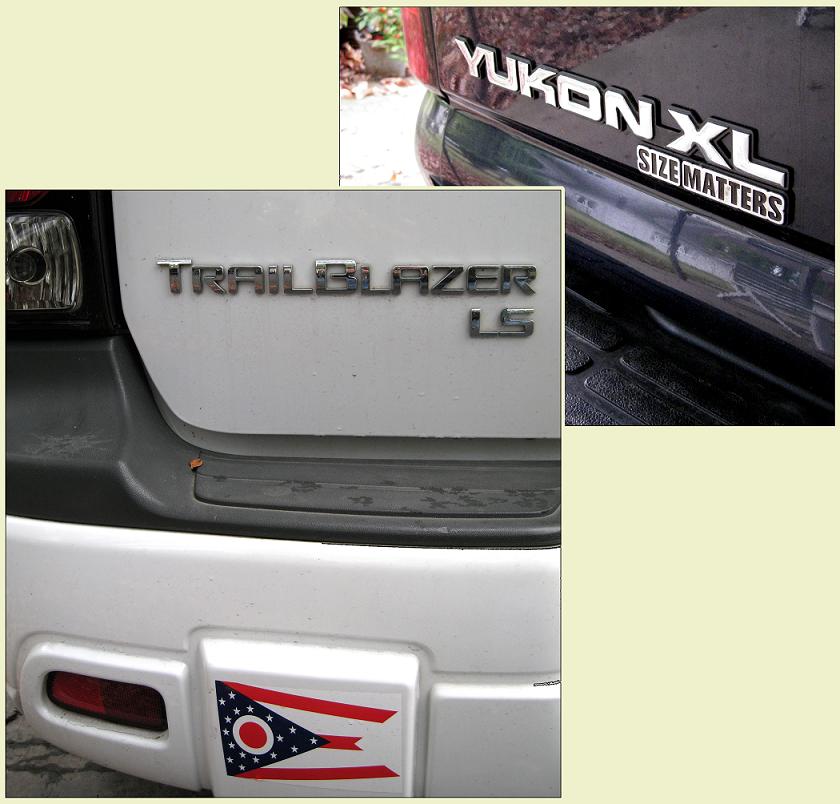
Here in the KintlaLake household we're big fans of buying used. In previous posts I've written about buying used furniture, a used Spyderco Endura I, a used Estwing carpenter's hatchet and, out of dire necessity a couple of years ago, a used Chevy TrailBlazer.
 Last summer we picked up a second SUV, a 2004 GMC Yukon XL with over 106,000 miles on the odometer. It's an absolute beast that quickly became my wife's daily driver.
Coincidentally (and sadly), buying the big Yukon now gives us two vehicles assembled in plants that GM closed on December 23rd, 2008.
Whether shopping a car lot, an antique shop or a secondhand store, the key to buying used is avoiding items that are bona fide lemons, irreparable or well-and-truly huffed. That can be tricky at times, but a good used product often can be had less expensively than an inferior new item. And in the case of "pre-owned" vehicles, all that nasty depreciation was somebody else's problem.
Shopping the roadside
Each region has its own name for these sales -- garage, yard, tag, rummage -- and we drive by them all the time. That's probably a good idea, since they're magnets for hoarders and full of useless junk.
Still, private sales can be a great source of decent used stuff. I suggest treating them like a trip to the grocery -- make a mission of it, shop from a list and buy with care.
Don't forget that roadside commerce also gives us orchard stores, farmers' markets and garden stands. Some of the best produce I've ever had came from a table under a tree in someone's front yard.
Bazaars of the bizarre
For the purposes of this discussion, I'll lump flea markets and eBay together into this category.
 Flea markets these days make Wal-Mart look like Bloomingdales -- they're dominated by cheap Chinese junk -- but they still can yield a pearl or two. I've found good used garden tools at great prices, for example, at a weekly market south of here. I once saw a retired military truck there, a real steal of a deal that I wish I could've afforded at the time.
As for eBay, it's definitely a big part of The Other Economy, but rarely do I find true bargains there, nor does it satisfy my penchant for keeping commerce close to home. (craigslist is better for that, actually.) For the most part I limit my patronage of eBay to selling items that have some sort of recognized collectible value.
'Will work for...'
Bartering was part of my upbringing, though at the time I didn't have a name for it -- it's just what we did. My father often would work for local farmers in return for milk, cheese, meat or produce, even carpentry and masonry.
Over the years I've bused restaurant tables and mucked horse stalls, receiving my "payment" in the form of home-cooked meals. I've traded my writing for everything from herb plants to custom knives, my photography for concert tickets and my graphic-design services for film and lenses.
One of my fellow punkin' pickers last month was working for bow-hunting privileges on the farmer's land. With luck, he'll take a deer that'll help feed his family this winter.
And so on -- you get the idea. Bartering arguably is the lynchpin of The Other Economy.
Build a 'DIY bank'
The Economy generally expects us to be greedy, lazy, disinterested and have limited competence. Its success depends on impatient consumers farming-out even the simplest of tasks.
The Other Economy demands thoughtful participation; it cultivates independence and personal responsibility. It requires that individuals acquire, develop and share skills.
Every skill that we have goes into a "DIY bank" that (at a minimum) conserves our other resources. A skill can be bartered or "spent" in more conventional commerce. Skills, if practiced, don't lose their value -- they only appreciate.
It's never too late to learn how to repair plumbing, drive a tractor, fix a flat tire, change engine oil or sharpen lawn-mower blades. Saving money is only the beginning -- the right collection of skills, employed in the right community, can become a downright windfall.
Give it away
One important component of The Other Economy, the last I'll cover in this installment of Urban Resources, is neither obvious nor is it typically quid pro quo -- the decidedly un-capitalistic practice of volunteering labor, goods and services.
I'm talking about doing something for a neighbor or for the community at large and expecting nothing in return. Fix a furnace or prune a tree. Mow the village green or cook a pot of chili for the township's firehouse. Don't advertise it -- pay forward:
"There is a force that makes us all brothers. None goes his way alone. All that we send into the lives of others comes back into our own."
See, what makes The Other Economy really hum is that it values principles that'd make Gordon Gekko sneer -- and that's precisely why, in my opinion, its time has come.
Fatwood, the resin-rich heartwood of pines, is the ultimate natural firestarter. Until you've watched it burn -- whether you harvested it laboriously from a lightning-struck tree or bought a bundle from your favorite outfitter -- you've been working way too hard at getting your fires going. I recommend carrying a stick or two in every fire kit, survival kit and 72-hour bag.
 There's no question that old conifer stumps produce the best fatwood, but even a living tree will push resinous sap toward any injury. When a branch breaks off or is cut, resin will fill (and eventually ooze out of) the wound. The photo at right shows one of our backyard pines where I removed a three-inch limb at the trunk last month.
In my experience, the most convenient source of utility-grade fatwood is the stubs of lower branches. In urban settings, thanks to tidy homeowners and the ubiquitous ornamental pine, it's easy to find.
 This morning I used the saw blade of my Victorinox Farmer to harvest one such thumb-sized stub. My first clue that it contained a fair bit of resin was the chalky buildup at the end. The wood was relatively hard, too, and it didn't yield easily to the saw, another sign that I'd made a good choice.
Once I'd sawed the stub from the trunk, I put the freshly cut end to my nose -- a strong whiff of turpentine confirmed the presence of turpene, the volatile compound that makes fatwood burn so well.
Next, using the knife blade as a wedge and a stick as a baton, I split the stub a couple of times to expose "the good stuff." Batoning a folding knife can put a lot of stress on the pivot and backspring, by the way, so I didn't open the blade completely to its "locked" position.

To liberate the best fatwood in this particular piece, I looked for sticky, dark-orange veins of concentrated resin. (Click on the photo above to see what I was after.) The resulting sticks will be shaved into curls or scraped into powder for starting our next backyard fire.
Did I mention that fatwood will burn even when it's wet?

Our house sits on a postage-stamp lot, a tiny patch of land in a Midwestern village. On its face, it appears to offer little in the way of natural resources.
A closer look reveals what a first glance doesn't.
I believe this post will be the first of a series I'll call "Urban Resources" -- seeking and finding materials often discarded and practices neglected. Today I'll talk about making use of a ridiculously simple source of firewood for our backyard pit or, in a pinch, the indoor fireplace.
There are but four trees on our lot -- two maples, a crabapple and a 60-year-old ash. On township property to the east are a magnificent bur oak and a catalpa, each estimated to be 180 years old, as well as a handful of tall pines and spruces. Our southern neighbor's sweetgum and poplar hang over our driveway.
 Because all of those trees are relatively mature, they shed onto our lawn every day -- just how much depends on the weather. I've made an early-morning ritual of collecting fallen wood and carrying it to a semi-tidy pile I've built behind the garage.
It's not all small twigs, either. We had an arborist prune the ash of dead limbs back in May, which added some respectably large rounds, and our decrepit crabapple seems to lose a branch or two every time the wind blows.
Bucking the larger limbs requires nothing more than a pruning saw, although occasionally I resort to using a small chainsaw that operates on rechargeable batteries. I also break out my old Estwing hatchet from time to time. The tool I use most often, however, is a machete.
Specifically, it's 22-inch Collins that I've had for 27 years. The blade is stained and the edge is nicked, and the fractured phenolic handle is wrapped in adhesive tape -- that is, it's just about broken-in. A few minutes' attention with a flat file and a genuine Carborundum stone is all it takes to keep the blade brutally effective.
In four months I've gathered about one-third of a cord of imperfect firewood for my inelegant woodpile. Yes, much of it is kindling and some of it is tinder, but I figure I have enough wood for about a dozen good cooking fires -- so far -- and every bit of it was free.
In the next installment, I'll talk about a surprising source of the ultimate natural firestarter: fatwood. Stay tuned.