One of the benefits of cruising Google Books, Internet Archive and similar sites is unexpectedly tripping over something useful or entertaining (or both). Today's surfing uncovered three such pearls, all in Outing magazine.
In the July 1922 issue, writer L.E. Eubanks gave us "Your Emergency Camp Fire." His guidance -- from making the last match count (even if it's wet) to more aboriginal techniques -- is ageless and valuable, presented in friendly fashion.
Is this one-pager the sine qua non of firemaking? Of course not -- the ultimate authority, for each of us, is our own experience. From that perspective, what Eubanks wrote is well worth our time.
Published seven years earlier, "Fire-Making in the Wet Woods" was a quarter-page filler that Outing's editors attributed only to "a correspondent." The author revealed that there is, in fact, dry fuel in damp landscapes -- we simply have to know where to look.
I'll flip back to that 1922 issue for the final clip, "Let's Get Rid of Everything: Just a Few Precious Thoughts for the Anti-Firearms Agitators." It lacks a by-line, but I suspect that it was an editorial.

Clearly, the author was a crank -- a constitutionally righteous crank, but a crank just the same. His rant should remind present-day Americans that gun-grabbing legislators were around even back in the (mythical) "good old days."
(C'mon, admit it -- when you saw the title of this post, you thought I was gonna talk about nuclear radiation. Am I right?)
I absolutely love my Zippo lighter. Its brass case, over time, has developed a wonderful patina. (No, I don't polish it.) Like old leather, it's smooth and warm in my hand. As long as I keep it fed with fluid and flints, it fires every time.
 If there's a down-side to a Zippo, it's the tendency for the fluid to evaporate. That's not a big problem, practically speaking, when I'm carrying it every day, but it's downright annoying (to say the least) when I pull it out to start a backyard fire, only to get all flick and no flame.
Yesterday I employed a trick that helps prevent the vapor from escaping. I cut a 3/4-inch Ranger Band from a mountain-bike inner tube and slipped it over my Zippo, right where the case splits. It's by no means a hermetic seal, but it'll definitely extend the life of a fillup.
Even with this fix, it's always smart to top-off a Zippo before heading into the woods. Carrying a little extra fluid isn't a bad idea, either.
Now, about the tin in the background of the photo -- it's one of several that Mrs. KintlaLake and I picked up at an after-Valentine's candy blowout (75% off). The rectangular box is hinged, measuring a useful 5-1/2 inches long by 2-1/2 inches wide by 3/4 inch deep.
I suspect that it'll be "re-purposed" soon to hold a kit of some sort.
 In Tuesday's post I talked about using a small leather pocket sheath to carry an everyday fixed-blade knife and a single-AAA light. Happy with that result (and sensing a bit of momentum), I dug another unused sheath out of my box of orphans and put together a pocketable kit (right) better suited to woodcraft.
The butt of a Bark River Little Creek (McKnight Grind, Antique Ivory Micarta), borrowed from my EDC rotation, peeks out of one side of the sheath. What's hiding in the other compartment? Take a look:

The sheath easily swallows a quartet of firemaking basics -- firesteel and striker, a chunk of fatwood and a length of jute twine that serves as both tinder and tether. And yes, I could spark the firesteel with the spine of the knife, but it's no bother to carry a dedicated striker.

Together with the Little Creek -- my favorite small fixed-blade, by the way -- this is quite a functional setup, but I may add another item. There's plenty of room to stuff some dryer lint into the bottom of the fire-kit compartment.
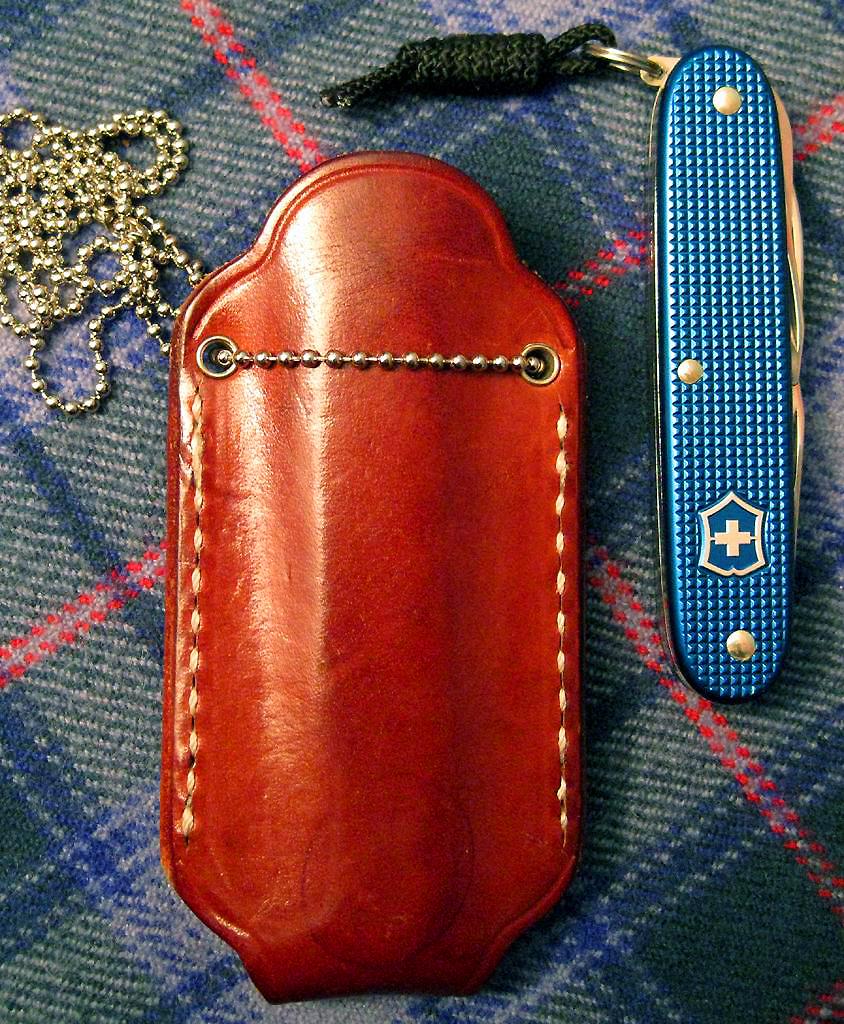
I've got one more small sheath in my box of orphans, a leather sleeve like the one that holds my Victorinox Farmer. I'm thinking that it might be a good choice for a neck-carry fire kit -- stay tuned.

Yes, that's a Duraflame log. More about that in a bit.
My wife, younger spawn and I relaxed at the village diner late this afternoon, filling our bellies with comfort food and watching snow swirl outside. The tiny restaurant doesn't have much of a dinner crowd this time of year, so we had the place to ourselves.
The Big Winter Storm was pretty much of a yawner for us. Yesterday's round brought freezing rain, which encased our world in a half-inch of ice. Schools were closed and Mrs. KintlaLake shut down her shop ninety minutes into the day. We lost a couple of branches off of one of our maple trees. That was it.
Last night we got still more rain, but temps rose into the mid-40s and the ice buildup melted off the trees and utility lines -- a good thing, since winds today were gusting to near 50mph. There's a heap of fallen limbs under a long-needle pine behind our house, but again we emerged otherwise unscathed.
Schools closed for the second straight day. (Don't get me started.)
Now we're seeing the back edge of the storm, squalls of snow driven by a stiff wind. No accumulation is expected.
(Yawn.)
Not everyone in metro Columbus was so lucky, of course -- the ice-wind combo took down lots of trees and power lines, leaving more than 100,000 central-Ohio residents without electricity.
And that brings me back to the Duraflame log.
 This morning one of my wife's co-workers, a fellow about my age, said that his home was among those without power and announced that he was going to stop at Wal-Mart on his way home to stock-up on Duraflame logs.
To burn in his fireplace -- to heat his house.
When my wife asked him why (on earth) he'd choose manufactured logs over the real thing -- never mind that his fireplace will suck more heat out of his house than it'll ever add -- he insisted that Duraflames would be more cost-effective.
Seriously?
It wasn't that he misunderstood the question. He's simply a middle-aged man in search of a clue, just another of our society's hamsters.
You don't need my permission to laugh at this guy's foolishness, but you have it anyway -- along with my blessing to feel a whole lot better about yourself.
Sheesh...
Finding uses for empty Altoids tins has become, for some people, an obsession. I'll admit to having a mild case of tin-tin-adulation myself, having mentioned the subject a few times here on KintlaLake Blog.
They beg to be recycled (or, as a jargonista would say, re-purposed). Lots of other products come to us in similarly useful containers, too -- take this sturdy hinged tin, which originally held a gift card presented to me last Christmas.


The slimmer gift-card tin is a comfortable fit for a hip, jacket or cargo pocket. While it's not as deep as an Altoids tin, it has a larger footprint and greater interior volume -- roughly 20% more space for tinder, first-aid supplies, snare wire, a fishing kit or other survival bits. It has enough headroom to swallow a 3/8-inch firesteel and enough length to accommodate a decent single-blade pocketknife (the 108mm Victorinox Safari Solo Adventurer, for example).
Sure, for less than three bucks it's possible to buy this (or another) gift-card tin, minus the gift card. But as I said about Ranger Bands, spending real money defeats the purpose -- sorry, the re-purpose.
 The venerable Altoids tin will continue its reign, of course. Other minty tins worth recycling: the Altoids Chewing Gum tin, slightly more than half the size of the standard Altoids tin; and the Altoids Smalls tin, which a year ago inspired me to build an ultra-compact fire kit.
Let the tinnovations roll on.
I'll admit to being hesitant about this installment of Urban Resources. I mean, just about every outdoorsman, farmer, biker, cop and firefighter I know is familiar with Ranger Bands. I figure most KintlaLake Blog readers are, too, and the subject has been covered extensively on the Web.
Then last week I saw an online retailer selling a pack of ten for $9.95, and it occurred to me that this post might be worthwhile after all.
 My Scoutmaster, while prepping a group of us for a trip to Philmont Scout Ranch, introduced me to making industrial-strength rubber bands by cutting up inner tubes. On our trek through the Sangre de Cristo range, the bands were indispensable for securing all kinds of gear.
I've been using them ever since. It wasn't until years later that I learned that they're commonly called "Ranger Bands."
 Depending on the type of inner tube -- mountain bike, road bicycle, truck, tractor, motorcycle, etc. -- and the width of section cut, it's possible to make custom bands for specific tasks. Some folks use a utility knife; I prefer scissors. Either way, it's ridiculously easy.
So there's no need to spend money on pre-packaged "official" Ranger Bands. And although it may be forgivable (and less expensive) to buy new inner tubes for the purpose, that's not necessary, either.
Last evening, for example, the younger spawn needed professional help lacing a BMX wheel, so we paid a visit to a local bicycle shop. As the shop owner patiently wove spokes onto the rim, I asked him if he had any huffed tubes laying around.
"We've got tons of 'em," he said, gesturing toward a large cardboard box in the corner. "Help yourself."
I rummaged through the castoffs, picking out a couple of skinny road-bike tubes that should yield about a hundred small bands -- and they were absolutely free.
Over the years I've done the same thing at tire installers, motorcycle shops and tractor-supply stores. All I had to do was ask.
 There's truly no limit to the ways that Ranger Bands can be used. In the photo, there's a band around my motorcycle's tool roll and another securing the optics wrench supplied with my new Leatherman MUT. Lengths of bicycle tube make the Bic lighters grippier. Each of the Altoids tins holds a fire kit -- Ranger Bands keep the lids shut and the rubber can come in handy as a firestarter.
The band shown on my Bravo Necker's sheath gives me a place to stow a whistle, a compass, fatwood sticks or other small items. My modified Mora 640 no longer fits securely in its plastic sheath, but adding a wide mountain-bike band fixed the retention problem.
Beyond what's pictured, I'm always using Ranger Bands around the garage -- to clamp wood or leather, to suspend brake calipers while I have the wheels off my motorcycle, and more. Also, long strips of inner tube make dandy tie-downs.
I could go on, but I won't. Use your imagination -- just don't spend any money.
It was well after dark tonight when I set about building our backyard fire. The mercury had fallen back into the single digits, but this wasn't to be a warming fire -- I wanted a cooking fire.
 Although the fat pine chunks took flame quickly, predictably the buckeye didn't. It took quite a long time and a lot of coaxing for the stuff to catch. Once it did, however, it produced a decent (albeit short-lived) bed of cherry-red coals.We broke out our trusty pie-iron (one of my favorite pieces of campfire cookware) and collected fixings for "hobo pies" -- a stick of margarine to grease the iron, slices of white bread for "crust" and a can of cherry pie filling. I made the first pie for our 15-year-old, another for my wife and, just as the coals were dying, one for myself.Gathering wood on a bright winter morning, bathing in the glow of a fire on a cold evening, savoring a sweet dessert drawn from pantry staples -- these are the simplest of pleasures.
It's the perfect winter's morning -- there's snow on the ground, the sun shines from a clear sky and the winds are calm. Bitter as it is, it doesn't feel unpleasantly cold.
The temp hadn't reached 10°F when I headed outside to liberate our American flag, which had hung up on the front-porch gutter and froze fast. As I was putting the ladder away after, I spied my old Estwing carpenter's hatchet hanging on the garage wall and hatched an idea.
 Grabbing the hatchet and a folding saw, I walked back to the edge of the woods. I'd had my eye on a dead hardwood, probably an Ohio Buckeye, for a while now. At four inches in diameter and about eight feet long it'd be easy to process. And because it was a "leaner," held off the snow-covered ground by surrounding growth, it was ideally dry.
I used the saw to cut it into three portable sections -- crown, trunk and base -- and hauled it home in one trip. After stripping twigs and smaller limbs, I bucked the trunk (with the saw) into 12-inch lengths.
A carpenter's hatchet may not be my first choice to split kindling, but for this backyard fire I'm using backyard tools. My antique-store Estwing worked just fine cleaving the dry, frozen wood (stubborn knots notwithstanding).
 I made one more trip back to the tree line, harvesting a couple of resinous pine stubs to serve as a natural firestarter. Less than 45 leisurely minutes after I began, I had the makings of a respectable fire.
One of the best things about this morning's exercise, I think, was doing the job with less-than-ideal hardware -- a used hatchet and a cheap lawn-and-garden saw. It's a reminder that skills, not tools, matter.
I'm not sure when we'll light our backyard fire -- maybe later today, maybe tomorrow. That'll be Part II.
Horace Kephart caught up with me today.
"The success of outdoor cookery depends largely on how a fire is built and how it is managed. A camper is known by his fire. It is quite impossible to prepare a good meal over a higgledy-piggledy heap of smoking chunks, a fierce blaze, or a great bed of coals that will warp iron and melt everything else."
Those words were published a hundred years ago, excerpting Kephart's Camp Cookery in the August 1910 issue of The Outing.
 Fire is fire. It doesn't observe leaps in technology or whims of rhetoric. Elemental and constant, fire is fire.
Kephart's guidance reflects the savvy of a woodsman and the thoroughness of a librarian. He devotes much of this century-old primer to the selection of fuel -- how different woods split and how they burn, how to gather them and the coals they yield.
His simple wisdom is as valuable today as it was then.
Firemaking is the most important woodcraft skill. Beyond cooking and comfort, knowing how to build a fire quickly can be a lifesaver. Each of us should learn firemaking and practice it often, especially under less-than-perfect conditions -- cold, wet, windy and when fuel is scarce.
For those who haven't yet graduated from "a higgledy-piggledy heap of smoking chunks," that 1910 article wouldn't be a bad place to start.
(Many volumes of The Outing, along with the classic Forest & Stream, have been preserved on Google books. To go directly to "How to Build a Camp Fire" by Horace Kephart, click here.)
Fatwood, the resin-rich heartwood of pines, is the ultimate natural firestarter. Until you've watched it burn -- whether you harvested it laboriously from a lightning-struck tree or bought a bundle from your favorite outfitter -- you've been working way too hard at getting your fires going. I recommend carrying a stick or two in every fire kit, survival kit and 72-hour bag.
 There's no question that old conifer stumps produce the best fatwood, but even a living tree will push resinous sap toward any injury. When a branch breaks off or is cut, resin will fill (and eventually ooze out of) the wound. The photo at right shows one of our backyard pines where I removed a three-inch limb at the trunk last month.
In my experience, the most convenient source of utility-grade fatwood is the stubs of lower branches. In urban settings, thanks to tidy homeowners and the ubiquitous ornamental pine, it's easy to find.
 This morning I used the saw blade of my Victorinox Farmer to harvest one such thumb-sized stub. My first clue that it contained a fair bit of resin was the chalky buildup at the end. The wood was relatively hard, too, and it didn't yield easily to the saw, another sign that I'd made a good choice.
Once I'd sawed the stub from the trunk, I put the freshly cut end to my nose -- a strong whiff of turpentine confirmed the presence of turpene, the volatile compound that makes fatwood burn so well.
Next, using the knife blade as a wedge and a stick as a baton, I split the stub a couple of times to expose "the good stuff." Batoning a folding knife can put a lot of stress on the pivot and backspring, by the way, so I didn't open the blade completely to its "locked" position.

To liberate the best fatwood in this particular piece, I looked for sticky, dark-orange veins of concentrated resin. (Click on the photo above to see what I was after.) The resulting sticks will be shaved into curls or scraped into powder for starting our next backyard fire.
Did I mention that fatwood will burn even when it's wet?

As we wrapped up our purchases Saturday afternoon, Mrs. KintlaLake and I were asked about magazines. The LCP and the P22 were supplied with just one apiece, so we bought two more for each pistol.That decision, like many others we make, came down to a single fundamental principle of preparedness:"Two is one, and one is none."
It's a truism closely related to Murphy's Law, "shit happens" and "best-laid plans" -- having a tool or a plan is essential, but having a backup can save your life.My wife and I view magazines as consumable items, arguably the weakest mechanical link in the armed-defense chain. Being prepared with two loaded mags is a no-brainer, really, and for us that means three, assuring us of two -- which is, in principle, one.Beyond this case-in-point are myriad other examples of our pattern of three-fers, notably:Starting a fire (matches, lighter, firesteel);
Purifying water (boiling, chemicals, filtration);
Communication (mobile phone, GMRS, CB); and
Evacuation (three escape routes, three shelters).
It's less versatility than contingency. Nessmuk and Kephart advocated their trios, a concept evolving from the need to accomplish multiple tasks, not from a wish for redundancy. Their approach is instructive, however, if not quite parallel, and it can be useful when extended to the rest of a preparedness scheme.It's a mindset thing.And so, whenever possible, we prefer to have three. Actually, specific to magazines, we consider it wise to have ten (at least) for each firearm -- but that's another story for another day.
 Checking out with my purchases at the drug store last week, I glanced over the selection of mints and chewing gum. Next to the regular-sized tins of Altoids was something called "Altoids smalls."
The tiny cinnamon mints appealed to me. The tiny stamped-metal package inspired me even more. Unable to resist, I bought one.
Fifty mints later, left with an empty tin measuring 2-3/8 by 1-5/8 by 5/8 inches, I set about building an ultra-compact (and yet effective) fire kit that'd nest inside.
Some of the contents were no-brainers: an eighth-inch firesteel blank two inches long; a four-inch stick of fatwood, quartered to fit; a length of jute twine; and a piece of bicycle inner tube (a.k.a. the multi-purpose "Ranger Band").
 I struggled a bit with what to use to strike the little firesteel, ultimately choosing a knockoff of the Victorinox Classic, a freebie that I had hanging around. If I'd had an old LMF striker or a hacksaw blade to cut down I might've done that -- smaller, lighter and arguably stouter -- but this knife will do in a pinch.It occurs to me that the el cheapo pocketknife can be used to shave the fatwood, too, and make small fuzz sticks. It was a tight fit for the Altoids mini-tin, so I filed-off its key-ring tab to make it a bit easier to stow.
With a firesteel and striker, jute, fatwood and yes, rubber -- that Ranger Band not only keeps the tin shut, a chunk of it also will burn for quite a while -- I've got a useful pocket-sized fire kit. It may not be ideal or perfect but it'll work, and the whole thing cost me less than a buck in real money.
That's damned near free.

 Most days, I prefer to "roll my own" kits -- first aid, survival, bug-out and so on -- but there's no denying the convenience of turn-key solutions, especially if they're done right.
The KnivesShipFree Fire Kit is done right.
Firemaking is an essential skill, potentially a life-saving one, and in a survival situation conditions may not cooperate. Rain, snow, or wind can interfere, turning a bad situation dire. That's when having the right gear (and knowing how to use it) makes all the difference.
With that in mind, KSF included these items in its Fire Kit: - A firesteel
- A hacksaw blade (to strike the firesteel)
- Two wax-impregnated cotton "Tinder Disks"
- Two wax-impregnated "Fire Cards" (printed with instructions)
- Two "Fuel Bars"
- Two wax-impregnated sisal "Kindle Sticks"
- A sheet of aluminum foil
Here's the drill: - Gather wood for fuel and arrange it into a flame-ready teepee (or lean-to, or whatever).
- Fashion the foil into a tray, placing it on the ground where you want to start your fire.
- Fold a Fire Card and set it on the foil tray.
- Tear a Tinder Disk (to expose the inner fibers) and set it on the Fire Card.
- Strike the firesteel, directing sparks onto the Tinder Disk's fibers 'til it lights.
- Lean a Fuel Bar over the flame.
- Un-braid a Kindle Stick into three strands and position them over the burning fuel bar.
- Slide the fire-bearing foil tray under the waiting teepee.
- Get warm, dry out, boil water, signal for help, etc.
Now that's turn-key -- easy, wot?
KSF ships its Fire Kit in a watertight OtterBox -- which is handy, but everything in the kit works when wet anyway. The standard kit I've described costs $29.95; a Deluxe Fire Kit, with twice the fuel and a length of waxed jute cord, is available for $39.95.Personally, I'm a believer in having three ways to start a fire, so I'll probably supplement my KSF Fire Kit with a disposable butane lighter and a half-dozen waterproof NATO matches (and a strip of striking paper, of course). There's plenty of room in the kit's OtterBox 1000 to accommodate my additions.Like I said, I like to roll my own. As smart as the KSF Fire Kit is, I just can't leave anything alone.
"Son, act like you've been there before." (Paul Brown, legendary football coach, to a player who had danced in the end zone after scoring a touchdown)
It's been almost a year since I was reminded that I live among hamsters, that rainy morning when flash flooding exposed many of my neighbors as totally clueless about their surroundings.
They didn't have the knowledge, experience or attitude to confront unfamiliar circumstances -- because they hadn't been there before.
That's inexcusable. There's no reason not to expect the unexpected because, sooner or later, trouble of some sort will find us.
A major traffic accident or a chemical spill will close the freeway. The power will go out some summer evening. An ice storm will leave us without heat for hours, or even days, in the dead of winter.
Traffic jams and weather events might well be on our personal radar, but sometimes the threat is greater and the stakes are higher -- much higher. An intruder will invade our home in the night. We'll suffer an injury at a place or time when medical help isn't available.And at the risk of sounding like a tin-hatter here, consider this: A natural disaster will hit or civil unrest will boil over when we're miles from home. Could we defend ourselves? Find water and shelter? Build a fire? With or without a vehicle, could we get home?For a graphic description of such a scenario, see "Cold, cold water."Dealing effectively with these and other what-ifs depends largely on mindset. The biggest mistake we make, I think, is believing that we can wait 'til the last minute to conjure our must-do SHTF attitude.Put another way, we can't "act like we've been there" if we've never even been close.Whether we like it or not, personal preparedness is a full-time job. Fundamental to success -- and survival -- is actively and continually cultivating a working familiarity with tools, skills and surroundings.It can start with something as ridiculously simple as spending time each day living in the dark. (No kidding.) There's nothing wrong with switching on a light, of course, but how often do we do that out of habit rather than need? By being aware of my using artificial light unnecessarily, I've seen how often I can do without it -- which, as it turns out, is most of the time.My practice has given me confidence and familiarity (as well as night vision) that come in handy every time the power winks out. Obviously, keeping everything in its place helps. I mean, there's nothing quite as pathetic as needing a flashlight to find the candles -- or the batteries.Our electric bills are a bit lower, too. The time may come when embarrassment and utility bills would be the least of my concerns. If an armed intruder were to threaten my family and me in the middle of the night, I can lay my hands on everything I might need -- phone, eyeglasses, defensive weapon, etc. -- in ten seconds or less.I know that for a fact because I do low-light, dry-fire drills at least once a week. Practice, promise.When the fuel gauge on our vehicle starts approaching E and we're not sure when we'll see the next gas station, we start driving much more conservatively. We've all done it, trying to squeeze as much mileage as possible out of those last precious fumes in the tank.The question is, what could we learn by driving that way -- on purpose -- more often? Or all the time? If the SHTF and we're stuck 25 miles from where we want to be with only enough gas to go 20 miles, maybe we could actually get there. Through practice, we stand a good chance of replacing "maybe" with "probably."In eight months with my Chevy TrailBlazer, I've managed to increase overall fuel efficiency by 20% just by changing the way I drive. I wasn't a maniac to begin with, by the way, nor do I now pose a rolling hazard to my fellow motorists. The bottom line is that it is possible.Firesteels and knives are essential survival tools, and a handgun can be an effective means of personal defense. Even the best tools are useless, however, if we don't practice with them long before our life depends on the outcome.Building a fire in a Weber or backyard pit with only found materials, and then lighting it with a firesteel, hones what could be a lifesaving skill. An acquaintance likes to do it while being showered by a lawn sprinkler, to simulate doing it in the rain -- now that's an attitude.The folding knife in our pocket or the fixed blade we carry in our last-ditch kit someday may be called upon to fashion an emergency shelter, a splint or a deadfall trap. Using those knives for ordinary lawn-and-garden chores, leaving fancy saws and pruners in the shed, can show us what can be done long before it must be done. The experience, albeit ordinary, can prove invaluable.As for firearms, once again I defer to Col. Jeff Cooper: "You are no more armed because you own a gun than you are a musician because you own a piano. The instrument is not the answer; the skill to use the instrument is the answer."
Rust is lethal. Get to the range, dammit. 'Nuff said.There's much more, of course, but I believe I've begun to make the point that being prepared for the unexpected involves more than a full pantry, fresh batteries and a well-stocked bug-out bag. Since circumstances could turn against us any day, preparedness is a mindset we must live every day.That's not paranoia -- it's only common sense.

 One of the benefits of cruising Google Books, Internet Archive and similar sites is unexpectedly tripping over something useful or entertaining (or both). Today's surfing uncovered three such pearls, all in Outing magazine.