Spyderco's unusual designs first caught my eye back in the mid-'80s, and I've owned various patterns over the years. These days I have an Endura4, a Delica4 and a LadyBug3, as well as an Endura II that I bought used. I deploy a second-gen Chicago at work every day.
Each of those Spydies is a keeper; all, as it turns out, were minted offshore, in either Japan or Taiwan. It wasn't until late last year that I picked up my first US-made model -- the Spyderco Para-Military2.
 Right out of the box the Para-Military2 is impressive. It doesn't inspire the same wow as, say, a Reeve or a Hinderer -- rather a nicely done, especially in light of its price (MSRP $175, street $100).
 The knife's fit and finish are excellent, with no evidence of shortcuts or sloppiness. The pivot is smooth and precise, best of the Spydies I've owned and rivaling my Benchmade 755 MPR. The compression lock -- a type of liner lock, this one featuring a release tab on the spine -- is solid and easy to use. The CPM S30V stainless-steel blade, sporting a full flat grind, came shaving-sharp and has stayed that way through three weeks of warehouse duty.
 The Para-Military2 falls between the Endura4 and the Delica4, size-wise -- not too big, not too small. Its textured G-10 scales feel just right and the handle shape allows for a variety of grips.
I'm especially fond of Spyderco's choice to employ jimping both on the thumb ramp and on the integral choil. Together they aid in no-look indexing and make the grip that much more secure.
Honestly, I've found nothing to dislike about this knife. And while that may sound like I'm damning it with faint praise, nothing could be further from the truth.
The Spyderco Para-Military2 isn't flashy, nor does it possess the cachet of more expensive überfolders. But like certain other all-business/no-drama knives -- Benchmade's Griptilians come to mind -- it's easy to like a solidly built tool that just flat works.
To boot, the made-in-USA Para-Military2 can be had for a hundred bucks. If someone were to call this Spyderco the ideal EDC folder, I'd be hard-pressed to argue the point.

I believe it was Holiday Inn that coined the advertising slogan, "The best surprise is no surprise." Myself, I'm a fan of pleasant surprises.
 I'd put off sampling Zero Tolerance Knives for years, judging them (from afar) shamelessly "tacticool." Then, on something of a whim, I decided to take ZT's 0350 folder for a spin.
Color me pleasantly surprised.
The Zero Tolerance 0350 (MSRP $175, street $100) is a downsized-and-detuned version of the 0300 (MSRP $340, street $220), which is a higher-end folder designed in collaboration with Strider. The made-in-USA 0350 features a 3.25-inch recurve blade of coated CPM S30V, thick stainless-steel liners incorporating a beefy liner lock, textured G-10 scales and a four-position pocket clip.
 The 0350 is equipped with Kai-Kershaw's SpeedSafe assisted-opening system. Pulling back with an index fingertip on the "flipper" protruding from the spine snaps the blade open with authority. Ingeniously, the flipper becomes a guard when the blade is deployed.
Now, if you read the maker's description of SpeedSafe, you'll see that the blade also can be opened "with a manual push on the blade's thumb stud." Problem is, when the blade is closed the ambidextrous stud nests very close to the frame. It's virtually useless as a natural and reliable means of opening the knife.
The stud functions primarily as a stop-pin, it appears. And since the flipper works so well, not having the thumb-opening option is no loss.
It took a week or so of EDC (and a few drops of Benchmade BlueLube) for the 0350's pivot to get over its initial stickiness. Since then it's been smooth and precise -- no wiggle whatsoever.
This ZT's handle fits my large paws perfectly, and the G-10 slabs are wonderfully grippy. The CPM S30V blade takes and holds a scary-sharp edge; quick touchups, rarely necessary, have been easy. That's a good thing, since it's trickier to hone a recurve than a straight edge.
After carrying and using the Zero Tolerance 0350 for several weeks, I'm not just pleasantly surprised -- I'm damned impressed. It's a hell-for-stout tool and, with the exception of that vestigial thumb stud, very well designed. Best of all, considering the street price, it's a whole lot of knife for the money.

 "When a man picks up a knife, there's an old memory from the collective unconscious that surfaces. A knife is an atavistic experience. It was man's first tool and weapon. Man was chipping flint into cutting edges before he invented the wheel. No matter how sophisticated we become, a knife takes us back to the cave."
(Legendary knifemaker Bob Loveless, as quoted in "On the Cutting Edge," published in the July 14, 1980 issue of Sports Illustrated. Also worth reading: "His Knives Pioneered Handmade Movement," a remembrance published in The Wall Street Journal on September 10, 2010.)
Sharps-wise, my interests tend to wander around. For a while there I had my attention on fixed blades -- mostly Bark River but also RAT (now ESEE), Fiddleback Forge and others -- and various slipjoints.
 Now, for some reason, I'm drawn to folders, and a couple of weeks ago I picked up one dandy of a folder -- a Benchmade 755 MPR.
The 755 essentially is a production version of custom maker Shane Sibert's "Mini Pocket Rocket." The Benchmade's weighty price tag (MSRP $235, street $200) and the materials used in its construction (titanium for the frame, G-10 for the scales and Böhler-Uddeholm M390 "super steel" for the blade) have some comparing it to high-end offerings from the likes of Chris Reeve and Mick Strider.
Now, for some reason, I'm drawn to folders, and a couple of weeks ago I picked up one dandy of a folder -- a Benchmade 755 MPR.
The 755 essentially is a production version of custom maker Shane Sibert's "Mini Pocket Rocket." The Benchmade's weighty price tag (MSRP $235, street $200) and the materials used in its construction (titanium for the frame, G-10 for the scales and Böhler-Uddeholm M390 "super steel" for the blade) have some comparing it to high-end offerings from the likes of Chris Reeve and Mick Strider.
 Honestly, that sort of apples-oranges exercise isn't terribly useful. Having handled and used Sebenzas and Striders, however, I'll say this: The Benchmade 755 MPR deserves the compliment.
It's well-designed and extraordinarily well-built. The action is smooth and precise, the blade scary-sharp and the construction so solid as to qualify for the "bomb-proof" label.
I won't attempt a full review here -- Woods Monkey (for example) did a credible job with that -- but after carrying the overbuilt Benchmade for a week I've formed a few impressions.
The 755 is both a small knife and a big knife, compact enough to skirt statutes that frown upon blades longer than three inches and yet large enough to be a hand-filler that begs for tough duty. It's surprisingly lightweight but by no means is it a slight "gentleman's knife" -- clipped to a blue-jeans pocket, the beefy folder's thick profile always reminds me that it's there.
I found the lanyard tube disappointingly small, for what it's worth, and I would've preferred tip-up carry, but those are nits -- this is one helluva knife.
As for the price, yes, it's considerably higher than I'm inclined to pay for a folder, no matter how good it is. But when I saw a KnifeWorks coupon code (still active as I post this) that knocked 25% off the street price I mentioned above, I couldn't resist pulling the trigger.
Think about it -- for the going rate of a Small Sebenza you could buy two Benchmade 755 MPRs and feed a family of four at Golden Corral.
Now that's what I call value.
Honestly, that sort of apples-oranges exercise isn't terribly useful. Having handled and used Sebenzas and Striders, however, I'll say this: The Benchmade 755 MPR deserves the compliment.
It's well-designed and extraordinarily well-built. The action is smooth and precise, the blade scary-sharp and the construction so solid as to qualify for the "bomb-proof" label.
I won't attempt a full review here -- Woods Monkey (for example) did a credible job with that -- but after carrying the overbuilt Benchmade for a week I've formed a few impressions.
The 755 is both a small knife and a big knife, compact enough to skirt statutes that frown upon blades longer than three inches and yet large enough to be a hand-filler that begs for tough duty. It's surprisingly lightweight but by no means is it a slight "gentleman's knife" -- clipped to a blue-jeans pocket, the beefy folder's thick profile always reminds me that it's there.
I found the lanyard tube disappointingly small, for what it's worth, and I would've preferred tip-up carry, but those are nits -- this is one helluva knife.
As for the price, yes, it's considerably higher than I'm inclined to pay for a folder, no matter how good it is. But when I saw a KnifeWorks coupon code (still active as I post this) that knocked 25% off the street price I mentioned above, I couldn't resist pulling the trigger.
Think about it -- for the going rate of a Small Sebenza you could buy two Benchmade 755 MPRs and feed a family of four at Golden Corral.
Now that's what I call value.

My new shipping-and-receiving job is going fine, thank you very much. On September 2nd I mentioned using the opportunity to justify buying a knife especially for the purpose. I ended up buying two.
 The Tim Wegner-designed Blade-Tech Ratel Lite (retail $24, street $20, made in Taiwan) features a saber-ground, 1-15/16-inch leaf-shape blade of AUS 8 stainless steel. It's a lock-back, with textured scales of fiberglass-reinforced nylon and a reversible pocket clip.

The second-gen Spyderco Chicago (retail $65, street $41, made in Taiwan) has G-10 scales, replacing a now-discontinued carbon-fiber version. Its flat-ground, 440C leaf-shape blade is two inches long, held open with a liner lock. The wire-style pocket clip is reversible to accommodate either left- or right-hand carry.
Fit and finish are good on both knives. Perhaps the Blade-Tech is a touch stiffer, the Spyderco slightly smoother, feeding my perception that the latter is more refined (for lack of a better descriptor). After two weeks of hard use in the warehouse, both blades have held up well -- the AUS 8 and 440C are, I found, durable and easy to maintain.
I should mention here that the pocket clip on my particular Ratel Lite started out extremely tight -- secure is one thing, but this was something else entirely and, from what I gather, pretty common.
A short loop of paracord, threaded through the lanyard hole, was required to facilitate an easy draw from my pocket. Eventually I modified the bend of the clip by stuffing a thick stack of cardboard under it and leaving it that way overnight. That fixed the problem.
 Despite having been conceived as EDC or "suit" knives that sneak under annoyingly silly "two-inch-max" laws, both the Ratel Lite and the Chicago have performed admirably for me as box-cutters. I have no complaints, practically speaking, about either.
That's not to say that I don't have a preference. Sure, it's possible to buy two Ratel Lites for the street price of one Chicago, which certainly makes the Blade-Tech the better value. But the Spyderco is the better knife, in my opinion, for several reasons.
First, I find the liner-lock quicker and more natural to use. I also like the grip -- not just the feel of G-10 slabs, but the way that my fingers index to the handle and the choil formed when the knife is open. And finally, the flat grind and thinner blade make it a better and more versatile cutter -- 1/8 inch (Ratel Lite) versus 3/32 inch (Chicago) may seem like a nit, but the 25% difference shows up big in performance.
I'll keep and will continue to use both of these knives. I lean toward the Spyderco, but your mileage (as they say) may vary.
Back to the Backwoods
One steamy Saturday three years ago, my wife and I fled a raucous gameday scene for the relative calm of the Thornville Backwoods Fest.
We reprised that trip yesterday afternoon, minus the hot weather and tailgating. (This year the Buckeyes played late, away and badly, getting spanked 24-6 by Miami.) Our experience at the 2011 festival was virtually identical to what I described in 2008 -- wonderful.
 We returned home refreshed, toting a pound of wildflower honey from a nearby village, a quart of syrup drawn from maple trees next door to the festival grounds, and a big ol' bag of fresh cracklings (a.k.a. pork rinds) cooked in a iron kettle over an open fire.
Local is best. Life is good.
Mrs. KintlaLake and I, together nearly six years now, are fortunate to share many interests. Our individual approaches to life are by no means identical, but we complement each other well.
When choosing a folding knife for everyday carry, each of us favors a mid-size Benchmade -- me a 556 Mini Griptilian, she a 585 Mini Barrage. Both are solid, relatively affordable and American-made. In terms of quality, utility and durability, neither gives ground to knives costing two or three times more.
 My wife prefers the Mini Barrage's spring-assist -- convenient, sure, but in her male-dominated workplace, every time she snaps the 585 to open a box or cut a wire, she gains a smidgen of cred.
I'm content with my less-flashy (yet easily flickable) Mini Griptilian.
The missus and I also differ on how (and how often) we maintain our knives. I strop mine on a pant leg after each use and on a leather belt at the end of each day. She, ignoring my example, tends to work hers until it's hopelessly dull.
This morning I found her Mini Barrage on her dresser, the blade gummed-up with packing-tape residue, unable to even draw-cut paper. I could've taken advantage of Benchmade's LifeSharp℠ warranty service, but instead I spent an hour with sandpaper, stropping compound and bare leather, coaxing the edge back to respectability.
When I presented the result to my wife, she got a stern (but kind-hearted) lecture -- and I got a hug.
My wife prefers the Mini Barrage's spring-assist -- convenient, sure, but in her male-dominated workplace, every time she snaps the 585 to open a box or cut a wire, she gains a smidgen of cred.
I'm content with my less-flashy (yet easily flickable) Mini Griptilian.
The missus and I also differ on how (and how often) we maintain our knives. I strop mine on a pant leg after each use and on a leather belt at the end of each day. She, ignoring my example, tends to work hers until it's hopelessly dull.
This morning I found her Mini Barrage on her dresser, the blade gummed-up with packing-tape residue, unable to even draw-cut paper. I could've taken advantage of Benchmade's LifeSharp℠ warranty service, but instead I spent an hour with sandpaper, stropping compound and bare leather, coaxing the edge back to respectability.
When I presented the result to my wife, she got a stern (but kind-hearted) lecture -- and I got a hug.
Back in October, I confessed my mixed feelings about Benchmade's acquisition of Lone Wolf Knives. I concluded that post with this:
"I'll be interested to see what Benchmade does with the brand."
What the company has done -- so far, anyway -- is slap the Lone Wolf name on a handful of lower-end folders and fixed-blades, some made offshore. It's kept alive Lone Wolf's Paul Poehlmann-design folders and re-branded them as Benchmade Pauls.
I respect Benchmade and its made-in-USA products, and re-branding the Pauls doesn't give me heartburn. But seeing "Lone Wolf Knives" applied to relatively cheap imports is a big disappointment.
 When I interviewed Jim Wehrs last year, he used the word "upscale" a lot. He spoke about heat-treat specs not only for blade steel but also for liners and pins.
"We're not after the Wal-Marts of the world," he said with pride.
I see nothing upscale about the Lone Wolf brand's second act. Those new low-buck models, while they're not yet vying for shelf space at Wal-Mart, make a sad move in that direction.
That said, original-production Lone Wolf Knives are still available, including "Double-Action" autos like my Eagle Talon and my wife's Diablo. One dealer, KnifeWorks, managed to buy a sizeable lot of them from Benchmade and is closing them out at ridiculous prices.
How ridiculous? I'm talkin' $140 to $155 for a D/A automatic with FRN or G-10 scales -- that's half-price (give or take) and an absolute steal on a high-quality American-made knife that generally sold for MSRP.
When I interviewed Jim Wehrs last year, he used the word "upscale" a lot. He spoke about heat-treat specs not only for blade steel but also for liners and pins.
"We're not after the Wal-Marts of the world," he said with pride.
I see nothing upscale about the Lone Wolf brand's second act. Those new low-buck models, while they're not yet vying for shelf space at Wal-Mart, make a sad move in that direction.
That said, original-production Lone Wolf Knives are still available, including "Double-Action" autos like my Eagle Talon and my wife's Diablo. One dealer, KnifeWorks, managed to buy a sizeable lot of them from Benchmade and is closing them out at ridiculous prices.
How ridiculous? I'm talkin' $140 to $155 for a D/A automatic with FRN or G-10 scales -- that's half-price (give or take) and an absolute steal on a high-quality American-made knife that generally sold for MSRP.
I've found KnifeWorks to be a stand-up outfit, by the way, and Benchmade will make good on Lone Wolf's limited lifetime warranty.
If this isn't a no-brainer, it's pretty damned close. Get 'em here -- while you can.
Dear Parents and Carers:
During the next few weeks we intend to pursue traditional Scoutcraft, teaching our Scouts about axemanship, bush saws and knives.
 We will teach good-practice dos and don'ts and use of woodcraft tools, encouraging responsibility and safety. We know this will be challenging for our Scouts, but we believe it will help develop responsibility and maturity.
Should you wish that your Scout not participate in an activity involving knives and axes, please make us aware of your wishes. You may choose to keep your Scout at home on those days. We will, of course, support your decision.
Please note that even after a Scout earns the Knife Badge, Scouting regulations prohibit the carrying of a knife under any circumstances without the express permission of the Scout Leader, and even then only when the Scout is in camp or is directly supervised.
Many thanks,
Your Scout Leaders
[That isn't a work of pessimistic fiction -- it's typical of letters sent to parents and "carers" of Scouts in the U.K. these days.]
We will teach good-practice dos and don'ts and use of woodcraft tools, encouraging responsibility and safety. We know this will be challenging for our Scouts, but we believe it will help develop responsibility and maturity.
Should you wish that your Scout not participate in an activity involving knives and axes, please make us aware of your wishes. You may choose to keep your Scout at home on those days. We will, of course, support your decision.
Please note that even after a Scout earns the Knife Badge, Scouting regulations prohibit the carrying of a knife under any circumstances without the express permission of the Scout Leader, and even then only when the Scout is in camp or is directly supervised.
Many thanks,
Your Scout Leaders
[That isn't a work of pessimistic fiction -- it's typical of letters sent to parents and "carers" of Scouts in the U.K. these days.]
It feels like a good time to re-visit some topics covered on KintlaLake Blog in recent weeks and months. In no particular order, then...
Scouting arms
I posted a pointed commentary last month about the disappearance of marksmanship from the list of essential Scouting skills. And while it may be endangered Scoutcraft, it's not yet gone.
 Two long-gun merit badges remain -- Rifle Shooting and Shotgun Shooting. Earning each requires a Scout to demonstrate knowledge and proper mindset as well as skill with firearms.
Rifle Shooting gives a candidate the option of firing a .22 rifle, an air rifle or a muzzle-loader. The marksmanship standards might sound simple -- putting five three-shot groups inside an inch at 50 feet, for example -- but I'll wager that many of us gray-haired shooters can't do that reliably with open sights. Shotgun Shooting is similarly challenging.
It's also worth noting that Shooting Sports is an elective Ranger Award in the Venturing program, which succeeded Exploring in the 1990s.
There's no telling how long it'll be before runaway political correctness relegates those awards to Scouting's trash heap, but I wanted to temper my previous pessimism with some (encouraging) facts.
Urban Resources: Ranger Bands
 Seldom does the sun set without another use for "Ranger Bands" popping into my head. It's a curse.
One sub-zero February evening I pulled a Mini Maglite from my TrailBlazer's console, and after just a few minutes the ice-cold aluminum had my hands aching. The next morning I cut a length of road-bike tube and slipped it over the housing -- problem solved.
I also found a neat idea (above) in a 1919 issue of Popular Science. Soon I believe I'll cannibalize a motorcycle tube and use that "cobbled" sheath on my Vaughan Sub-Zero Axe. Pictures (mine) to follow.
Sharps: Pocket sheaths
 Looking at my "pocket sheath for the woods" the other day, it occurred to me to dose the hide with Montana Pitch-Blend Leather Dressing -- beeswax would help repel water, protecting the knife and (especially) the tinder in the fire kit.
The sweet-smelling paste darkened the leather slightly and gave it a nice sheen. Tested afterward, the surface beaded and shed moisture well. I treated my smaller pocket sheath, too, but with the Leather Oil -- less water-repellent than Leather Dressing (owing to the lack of beeswax), but just fine for the application.
Waste management
I hate to see food go to waste -- any food, for any reason. It's safe to say that it's one of my pet peeves. And although composting is a perfectly responsible way for us to turn truly disposable matter into fertilizer, I've been thinking about better ways to save fresh fruits and vegetables that risk spoiling before we're able to eat them.
 At a local odd-lots store the other night I spied a brand-new five-tray food dehydrator. It was a convection-only model (no fan), so it wasn't ideal -- but it was "marked down" from $40 to $25. Besides, it came with a jerky kit.
So we brought it home. We'll do some drying, some vacuum-sealing and some canning and see how it goes over the next year or so. As for making jerky, I'll use the nifty convection oven that was in the kitchen when we moved into our house.
Winchester Model 67

I uncovered a relatively recent article about my old single-shot .22 -- "Winchester Model 67: A Product of Another Era," written by Gil Sengel and published in the January-February 2009 issue of Rifle Magazine. It covers the M67's history, development and variants, and I found it a fascinating read.
I'm unable to offer a hot-link to the piece, however -- it's vanished from Google Books. Go figure.
Scout at 16 weeks
 The last time I wrote about our new puppy, she could sleep in a teacup with room to spare. Now she's four months old (give or take) and weighs about 25 pounds. She looks more Lab-ish every day -- otter's tail and all.
I agree with our vet that she'll top-out between 50 and 60 pounds before she's done growing. I hope she doesn't grow out of her disposition, though -- she has the most amazing personality.
Smart? You betcha. She was obeying "sit" and "stay" a long time ago. And she doesn't just "shake hands" -- last week she mastered "gimme five," "high five" and "all ten, up high."
She's definitely Daddy's Girl -- and Daddy is incurably smitten.
 In Tuesday's post I talked about using a small leather pocket sheath to carry an everyday fixed-blade knife and a single-AAA light. Happy with that result (and sensing a bit of momentum), I dug another unused sheath out of my box of orphans and put together a pocketable kit (right) better suited to woodcraft.
The butt of a Bark River Little Creek (McKnight Grind, Antique Ivory Micarta), borrowed from my EDC rotation, peeks out of one side of the sheath. What's hiding in the other compartment? Take a look:

The sheath easily swallows a quartet of firemaking basics -- firesteel and striker, a chunk of fatwood and a length of jute twine that serves as both tinder and tether. And yes, I could spark the firesteel with the spine of the knife, but it's no bother to carry a dedicated striker.

Together with the Little Creek -- my favorite small fixed-blade, by the way -- this is quite a functional setup, but I may add another item. There's plenty of room to stuff some dryer lint into the bottom of the fire-kit compartment.
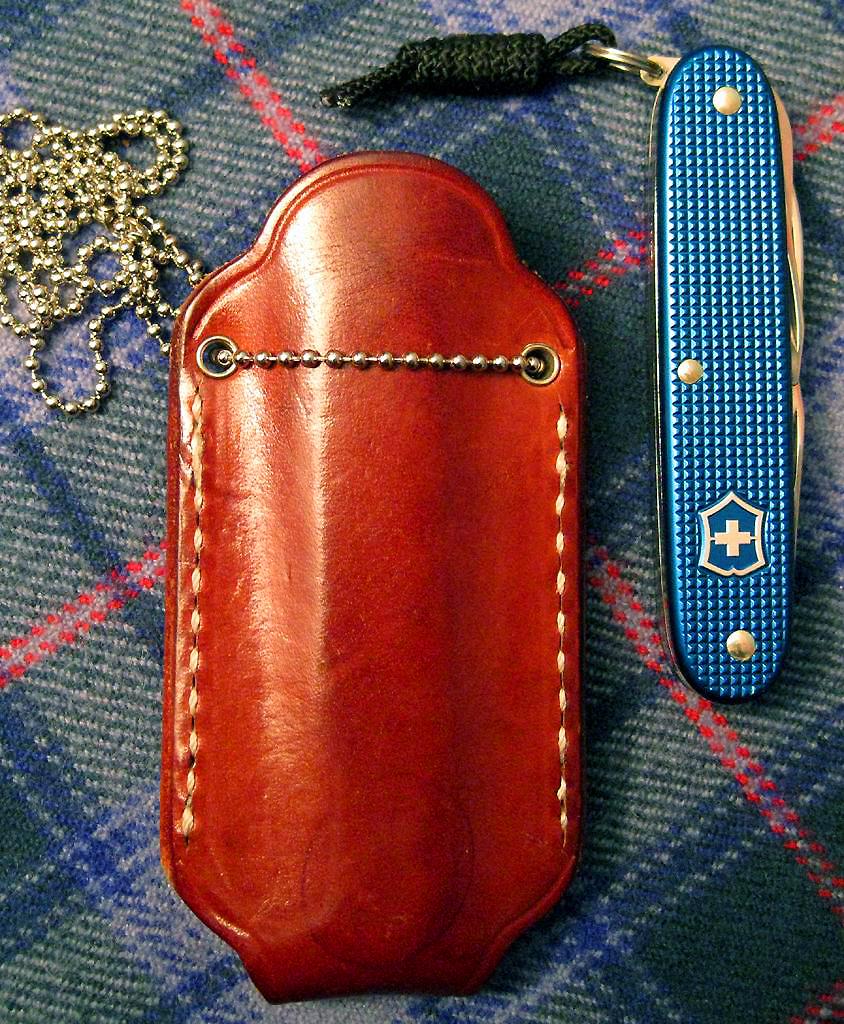
I've got one more small sheath in my box of orphans, a leather sleeve like the one that holds my Victorinox Farmer. I'm thinking that it might be a good choice for a neck-carry fire kit -- stay tuned.
My EDC schemes are pretty well set. Over the last six months or so I haven't tried anything new, which means that I haven't learned much, either. Such stability makes for a functional rut, but it's still a rut.
 Time to mix things up a little.
My Victorinox Farmer has been living in a leather sleeve in my pants pocket for quite a while. Last week I threaded a 29-inch ball chain through the hollow rivets at the open end of the sleeve, and voila -- a humble pocketknife became a necker.
The setup is comfortable to carry (leather beats Kydex every time) and access is surprisingly convenient. It doesn't work with all modes of dress, of course, but I declare this experiment a success.
 As small fixed-blades go, the Bark River Custom Micro Drop Point is a wonderful knife and part of my regular rotation. (Mrs. KintlaLake carries one, too.) Ordinarily it rides on my belt in a simple bushcraft sheath, but yesterday I decided to test-drive it in a two-up pocket sheath I had laying around.
The smaller compartment is perfect for a single-AAA light, so I'll probably alternate between an iTP EOS A3 (pictured) and a Fenix E01. Either way, it's a tight fit -- a good fit, that is -- and a short lanyard is a big help in withdrawing the light from the sheath. With both knife and light on-board, the pocket sheath rides nice and flat in the front pocket of my jeans. It's not as bulky as one might suspect -- just like the slipjoint sleeve, the pocket sheath makes its chunky cargo less noticeable by distributing the load.It'll be a couple of weeks of carrying before I can say for sure, but I think I have another winner. Whether I roll with this new setup for a long time or just a little while, I sure am glad that I crawled out of my rut.
As a kid I played with Tinkertoys, Lincoln Logs and an Erector Set. (Alas, no Legos.) The experience, which I suspect that many readers share, taught me how to envision something cool, beautiful or functional rising from a pile of parts.
Apparently the lessons stuck.
Tuesday morning, on my own advice, I surfed over to Wyoming Knife to order a spare bolt-and-wingnut for my Wyoming Saw I. It seemed inefficient, somehow, to drop just 80 cents (plus shipping), so I scanned down the list of parts -- and that's when it hit me.
I spent another $8.95, paid with PayPal and hoped that my Erector Set intuition hadn't misled me.
Here's the deal: Wyoming Knife doesn't promote the building-block design of its three collapsible bow saws, but descriptions and diagrams suggested to me that two additional parts might transform an 11-inch Wyoming Saw I into an 18-inch Wyoming Saw II. I decided that nine bucks was a reasonable price to pay for confirming a hunch.
The package arrived yesterday. Here's my original saw, pictured with the newly acquired frame tube and longer wood blade:

Adding the frame tube and swapping blades gives me this:

Ain't modularity great?
Like I said on Monday, there are times when "a longer blade...would make things go faster." And although the Wyoming Saw I will remain as-is in our emergency kit, the 18-inch version will be another handy tool for dispatching backyard woodpile chores.
Incidentally, just in case anyone is wondering about converting either of those saws to the mid-size Wyoming Saw III, all it takes is a replacement frame tube, a 14-inch blade and $7.49 (plus shipping).
In closing, I want to give the folks at Wyoming Knife "props" for quick shipping -- Colorado to Ohio in two days via USPS First Class Mail is damned impressive. Also, to my surprise, they enclosed a nifty-looking little knife at no additional charge.

I'm not sure what I'll do with the made-in-USA Wyoming Camp Knife (MSRP $4.95). Its double-grind recurve blade is three inches long, made of some sort of stainless at RC 66-70 (so stated). The exposed tang, secured by two brass pins, extends roughly halfway into the handle, which is laminated wood.
The recurve makes it a slicer, obviously, and it feels like a decent food-prep knife. Once I've put my personal touch on the edge, I think it'll find a home in our camp kitchen.
Our holiday haul came with a gift card, which we split among us. I used my share to buy a saw for our family preparedness kit.

The US-made Wyoming Saw I is the smallest of three collapsible bow saws offered by Wyoming Knife Corporation (which is headquartered, oddly enough, in Colorado). I judged this one to be best for our purposes -- 11-inch blade, 16 ounces, nylon case, $43.35 MSRP.
 The Wyoming breaks down into six bits: two stainless-steel frame pieces, cast-aluminum handle, bolt, wingnut and blade. It's supplied with both a wood blade and a bone blade; a hacksaw blade also is available. Everything nests neatly and securely in the case, making for a very compact package.
Any time I try out a new saw, especially a collapsible bow, I can't help but compare it to the well-loved Sven Saw I've been using since the late 1970s. Since many KintlaLake Blog readers probably are familiar with the Sven, for scale I've included it in a few of the photos.
That said, it'd be neither fair nor useful to pit the smallest Wyoming against the bigger Sven in a head-to-head cutting contest, so I won't.
 The Wyoming Saw I assembles quickly and cuts well for a short-stroker. This morning I ran it through some frozen ash from my woodpile and it did exactly what it's designed to do, with no drama whatsoever. A longer blade -- like the 14-inch Wyoming Saw III, the 18-inch Wyoming Saw II or the 21-inch Sven Saw -- would make things go faster, of course.
Each of the three Wyomings, as well as the Sven, employs a bolt-and-wingnut scheme for drawing the blade taut. That wingnut can go flying into low earth orbit at the most inconvenient moments, usually when assembling or disassembling the saw. (Don't ask me how I know.) It's a good idea to carry a spare.
I've rigged a simple wingnut-retention system, visible in the photo above. (Yeah, it's a Ranger Band.) If that should fail, Wyoming Knife will replace a lost or broken bolt-and-wingnut assembly at no charge -- all I have to do is drop them an e-mail. Nice perk, that.
Bottom line: I like this saw. Used within what I consider reasonable limits, it's a delightfully capable addition to our kit.

Nature doesn't observe man's calendar, of course, but as the eastern sky brightened on this, the first of December, the season's first snowflakes danced in the air.
Winter has arrived on-schedule here in our central-Ohio village. The timing is pure coincidence and yet it feels exactly right.
For the last week or so, with the exception of summoning the strength to attend The Game on Saturday, for health reasons I've been confined to quarters. I've managed my boredom by taking on a variety of simple, meditative tasks.
 While watching football on Thanksgiving Day, for example, I pulled out my Frosts Morakniv Viking 640 for some relaxed stropping. I took my time coaxing the carbon-steel edge to satisfactory keenness. Next I broke out a flat file and squared the spine, giving it wickedly sharp 90°corners that'll bite reliably on a firesteel.
The Mora 640 -- a wonderful little knife, by the way -- is equipped with a considerable self-guard (pictured in its original form here). That damned guard kept getting in my way, though, so about a year ago I began cutting it down. Bit by bit I shaved away the orange plastic with a utility blade, followed by filing and sanding (and then working with the altered handle) 'til I got it where I wanted it.
On Thursday I put the finishing touches on the mod, hitting the scuffed-up areas with a micro-torch to make them smooth again. I admired my work, stowed my tools and, on a whim, sat down at my computer to see what fellow blogger American Bushman was up to.
As it turns out, a day earlier he'd been doing his own maintenance and tuning -- on an orange-handled Mora 510, no less. Go figure.
Life has its coincidences.

It was a little over a year ago that I had a chance to chat with Jeff Randall, co-head honcho of Randall's Adventure & Training and ESEE Knives (formerly known as RAT Cutlery).
When we finally got around to talking knives, Jeff said a couple of things that still stick in my mind. First, this sound advice:
"The biggest fallacy is that gear is necessary to survive. You can't get by on gear -- you need skills. You need to prepare in every aspect of life. And if you don't have the proper mindset, you're going to die."
Translation: Singer, not song. Later, he said this:
"I never carry a RAT into the jungle -- I always carry someone else's knife. Really, just give me a three-blade Old Timer and a ten-dollar machete."
I wouldn't presume to stack my skills against a guy who's spent years training military types, cops and civvies in the art of jungle survival. With respect, however, I present two of my favorite tools.

That grimy, taped-up handle belongs to a 22" Collins machete bought new in 1983 to clear two acres of brush around the first house I owned. It was up to that task and hundreds of others since. Now endearingly scarred from hard use, the "Legitimus" mark barely visible, it continues to serve me well.
My own "three-blade Old Timer," a made-in-USA #34OT, is 25 years old. My dad often carried a Middleman just like this one, which remains in my regular EDC rotation.
I know I've written about pocketknives a couple of times already over the last month -- a moose and a trapper, as well as a pair of Scout knives. If you'll permit me another...

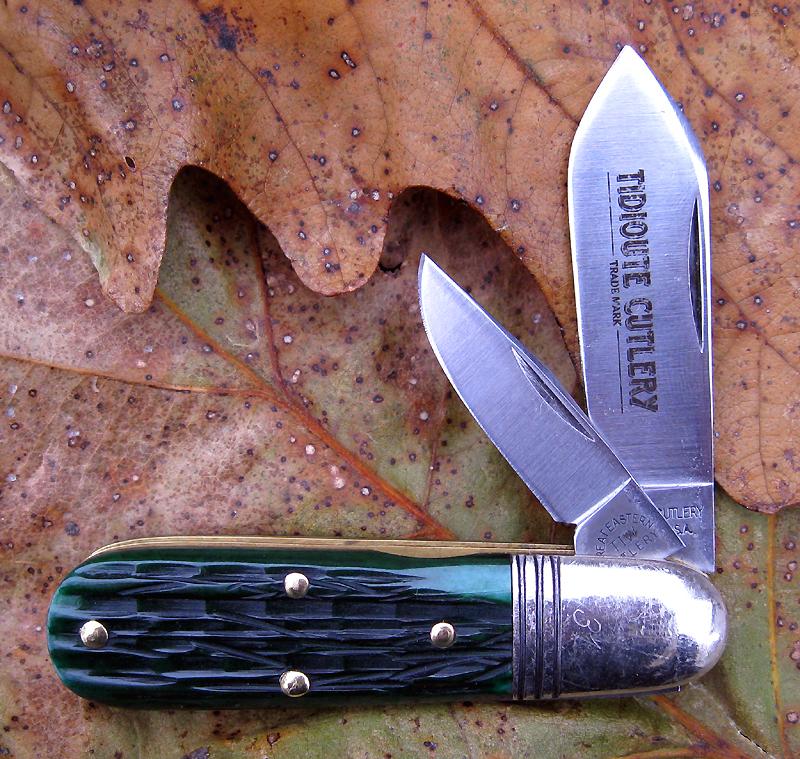
I've been carrying this slipjoint, a Tidioute #25 Barlow by Great Eastern Cutlery, quite a bit lately. It's a "baby Barlow," just three inches long when closed, the kind of knife that easily bridges the gap between everyday utility and dressier affairs.
The #25's spear-pattern main blade and smaller clip are of 1095 carbon steel. The knife has great fit and finish, with nickel-silver bolsters, brass liners (three) and brass pins. Its scales are what GEC calls "Tractor Green Jigged Bone."
After really putting the spurs to this knife, I judge it very stout for its size -- no wiggle, no wobble, strong snap. Edge-holding is good, too, and I've begun the process of convexing the larger blade, leaving the clip with its original bevel.
(Incidentally, I had a chance to handle a number of GECs earlier this year. This is the only one I bought, however, because it's the only one with backsprings that weren't absurdly stiff. Reportedly that's the way Great Easterns are because that's the way Great Eastern collectors like them. I'm a user, not a collector, and for me there's no good reason for a slipjoint pocketknife to be a "nailbreaker.")Suggested retail for the Tidioute #25 Barlow is just shy of $130, with a street price around $70. That's dear, especially considering alternatives from makers like Canal Street, Case and others.
That's not to imply that this isn't a great little knife or that it's not worth the price. I'm simply saying that it's not the only high-quality, American-made option -- buyer's choice.