Showing posts sorted by relevance for query EDC. Sort by date Show all posts

Sunday, September 5, 2010

EDC revisited

Assembling an array of EDC tools is a process, not an event. My personal choices have evolved (and will continue to evolve) as my awareness, needs and abilities change.

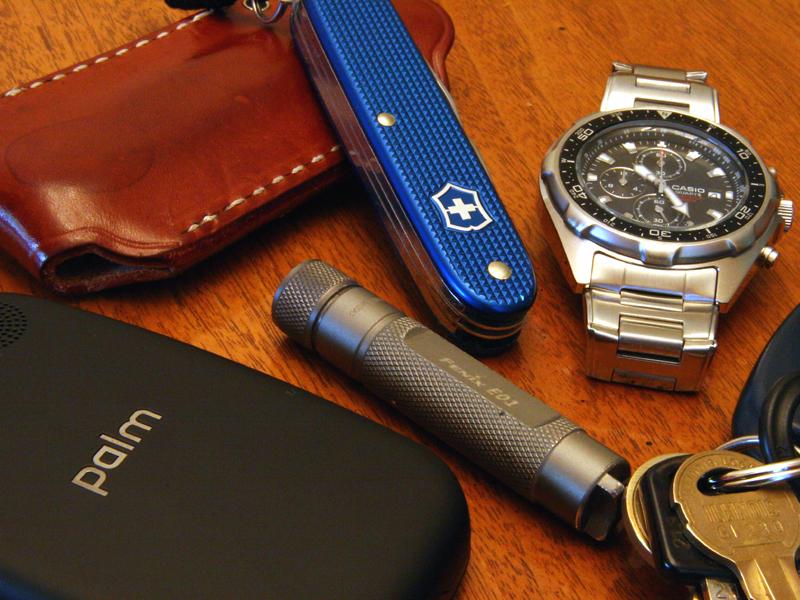
A Palm Pre Plus and a Victorinox Farmer are holdovers, for good reason -- they work. Another phone will replace the Pre in due course but the Farmer, which lives in a leather pocket sleeve, is a keeper.

I still carry a light on my key ring (I'm constantly amazed at how often I use it) but I replaced the cheap squeezer with a Fenix E01. I did audition two other single-AAA lights -- neither holds a candle (you should pardon the expression) to the little Fenix.

An iTP EOS A3 proved less than durable and a Mag-Lite Solitaire, while American-made and sturdy as hell, is almost laughably dim compared to LEDs. The E01, in contrast, is bright and stout. It stays.

A wristwatch is an indispensable EDC item, one that I haven't mentioned 'til now. Not long ago I picked up a Casio AMW330D-1AV Dive Chrono in stainless steel, and it's well on its way to becoming my favorite watch -- ever. It's everything I ask a watch to be -- analog, accurate, water-resistant, readable (even in low light), rugged and inexpensive (less than a hundred bucks).

When I got my concealed-carry license in April, I knew that my Glock 19 would become my EDC handgun. Just how I'd carry it was far less certain.

After some experimentation I've settled on a Kydex
Comp-Tac Two O'Clock IWB holster. Appendix carry isn't for everyone, I know, and (depending on how I'm dressed) I often carry the G19 at 4 o'clock in a leather OWB rig, but right now I'm liking the Two O'Clock -- a lot.

Because two is one and one is none, I carry a spare 15-round mag, weak-side, in a simple Fobus paddle magazine pouch. My defensive round: Cor-Bon 115gr JHP +P.

I'll wrap this snapshot of my EDC inventory with the plain-edge Benchmade 556 Mini-Griptilian I've been toting since July. I bought it (somewhat impulsively) at a cozy
gun shop over in Morgantown and, having come to love the full-size 551 already, the Mini held no surprises -- same great knife, downsized for more convenient EDC.

Friday, August 19, 2011

EDC vs. EWC

The process of choosing EDC items is part-and-parcel of developing a preparedness mindset. Although I continue to fiddle with my own kit, it's changed little since last September.

I still carry a multi-blade pocketknife as well as a folding knife with locking blade, semi-auto pistol and spare magazine, flashlight, pry bar, wristwatch, cell phone, keys and wallet.

Preparedness isn't simply a collection of gadgets, of course, so cultivating the skills to use the tools I've chosen is essential. And beyond that, I must have the discipline to carry those tools -- ownership and mastery, indispensable though they are, become useless without possession. I believe it was Jeff Cooper who said,
"Remember the first rule of gunfighting: Have a gun."
For some time now I've been honing my discipline to carry not just every day, but everywhere practicable. I've found focusing on EWC (as opposed to EDC) to be an eye-opening exercise.

We humans are reasonable creatures -- that is, we tend to want good reasons to do stuff. I'm just walking to the mailbox, so do I really need a knife? Why should I bother to have a handgun on my belt while I'm sitting here at my desk? It's daytime -- what good is a flashlight?

Those questions don't reflect a preparedness mindset. Anyone who's moved past EDC to EWC understands what I'm talking about.

Choosing what to carry means choosing to carry it -- establish the reason and then (for the most part) dismiss it. And for me, choosing to carry an item means carrying it all the time.

Ok, not all the time. Carrying a knife or a firearm isn't permitted everywhere. And no, I don't carry my kit to bed or in the shower, but in both places they remain within arm's reach.

By the time that Mrs. KintlaLake and I are enjoying pre-dawn coffee and conversation on the patio, I'm carrying every item mentioned above. Likewise when I mow the lawn or walk the dogs, cook dinner or change the oil in the truck, ride my bicycle or water the garden.

All together now: Not just every day -- everywhere.

Wednesday, December 16, 2009

Follow-up: EDC reconsidered

When I posted about juggling my everyday-carry lineup last month, I speculated that I'd "make more adjustments as time goes by."

I already have.

The Nite Ize Clip Case Cargo remains, as do the Victorinox One-Hand Trekker and Palm Centro. The Nite Ize pouch, while anything but slim, is convenient and capable. My Centro gets used only once or twice a day, maybe, but it stays with me regardless.

The OHT, which replaces my Victorinox Farmer on workdays, is the EDC tool I turn to most often. Its screwdrivers and one-hand-opening blade keep me from having to run to the rollaway cabinets. None of my co-workers carries such a pocketknife -- or, for that matter, a knife of any kind -- which I find positively puzzling.

Until I signed-on with the motorcycle shop, I hadn't held a job requiring portable light since I worked campus security in the 1970s. Back then I carried a massive Kel-Lite; these days something much smaller is in order.

I decided on the iTP C7T for a number of reasons. First, like every other iTP I've used, it's an extremely solid, high-quality piece at a reasonable price.

Second, I chose the "T" (tactical) version for its momentary-on feature and because it lacks the silly (to me) strobe and S-O-S functions found on the "R" (regular) C7.

And third, although I considered the more-compact iTP C9 (powered by one CR123A battery) and larger C8 (two AAs), I picked the mid-size C7 because it takes but a single AA -- a common cell, especially around the shop, and if I run out of juice I don't need to score more than one battery to get my light up and running again.

In use, the C7T is great. It's just the right size and throws a powerful, practical beam, whether I'm rummaging for a 1950s-vintage final drive buried at the back of a dark shelf or locking the gates and storage containers after nightfall. The power-saving adjustable-intensity feature is a plus, too.

Speaking of adjustments, I did make a change to my back-up folding knife. A week ago I swapped the Gerber Ultralight LST for a plain-edge Spyderco LadyBug3.

The littlest Spydie is a more costly choice, for sure, but thanks to the thumbhole it can be opened easily with one hand. To me, that feature alone is worth the additional expense -- and besides, it's a VG-10 Spyderco. 'Nuff said.

Finally, a
Bark River Bravo Necker -- in the standard-issue Kydex sheath, with firesteel, suspended from a hardware-store ball chain -- has joined my EDC kit for the last few weeks. I don't know if it's a lifetime commitment, but the rig rides so naturally under shirts and sweaters that it might well become permanent.

Just in case, I mean.

Tuesday, February 15, 2011

Sharps: EDC mixup

My EDC schemes are pretty well set. Over the last six months or so I haven't tried anything new, which means that I haven't learned much, either. Such stability makes for a functional rut, but it's still a rut.

Time to mix things up a little.

My
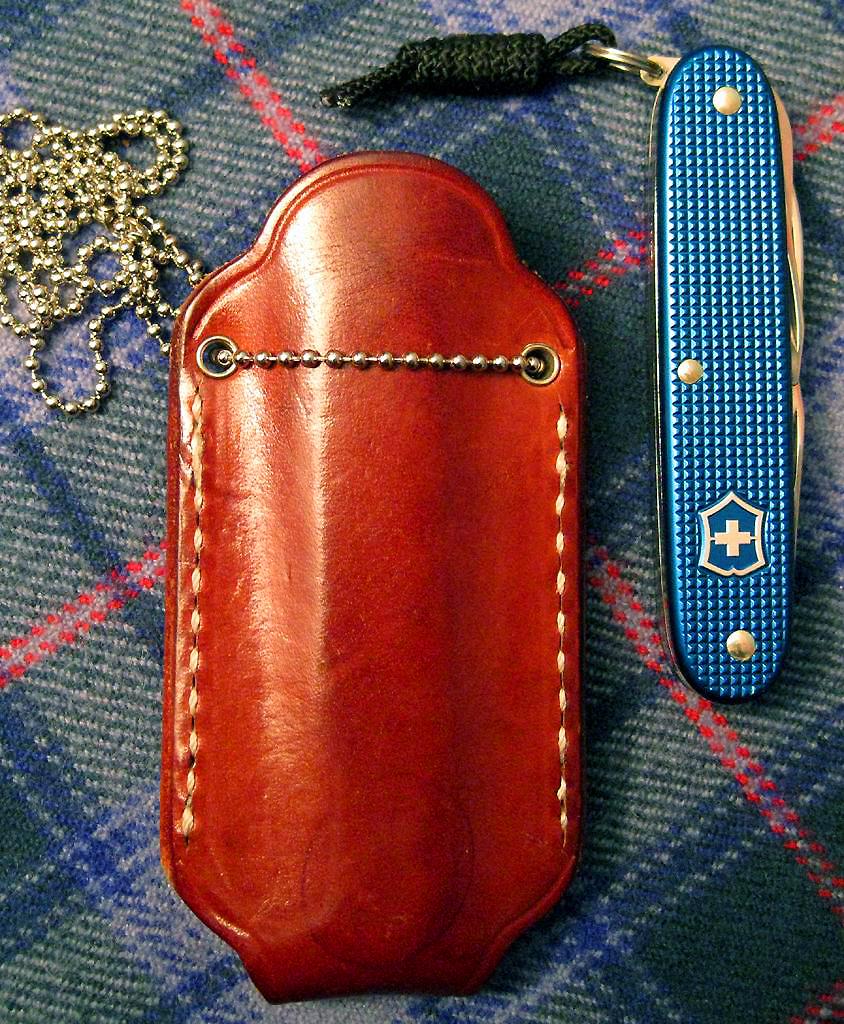
Victorinox Farmer has been living in a leather sleeve in my pants pocket for quite a while. Last week I threaded a 29-inch ball chain through the hollow rivets at the open end of the sleeve, and voila -- a humble pocketknife became a necker.

The setup is comfortable to carry (leather beats Kydex every time) and access is surprisingly convenient. It doesn't work with all modes of dress, of course, but I declare this experiment a success.

As small fixed-blades go, the Bark River Custom Micro Drop Point is a wonderful knife and part of my regular rotation. (Mrs. KintlaLake carries one, too.) Ordinarily it rides on my belt in a simple bushcraft sheath, but yesterday I decided to test-drive it in a two-up pocket sheath I had laying around.

The smaller compartment is perfect for a single-AAA light, so I'll probably alternate between an iTP EOS A3 (pictured) and a
Fenix E01. Either way, it's a tight fit -- a good fit, that is -- and a short lanyard is a big help in withdrawing the light from the sheath.

With both knife and light on-board, the pocket sheath rides nice and flat in the front pocket of my jeans. It's not as bulky as one might suspect -- just like the slipjoint sleeve, the pocket sheath makes its chunky cargo less noticeable by distributing the load.

It'll be a couple of weeks of carrying before I can say for sure, but I think I have another winner. Whether I roll with this new setup for a long time or just a little while, I sure am glad that I crawled out of my rut.

Wednesday, October 28, 2009

Sharps: EDC, within the rules

Good news -- our older spawn has been accepted to college, a small tech school in the northwest part of the state.

The bad news (other than the fact that we have to find a way to pay for it) is that the school's humorless "weapons" policy prohibits students from carrying knives with blades longer than two inches.

Oh, for cryin' out loud...

Since learning of the rule, I've been keeping my eyes peeled for useful folders that would comply. There aren't many, but I found two: the
Buck #425BK-9200 MiniBuck Lockback (MSRP $19, street $7 or less), and the Gerber #22-06050 Ultralight LST (MSRP $21, street $13 or less). The now-discontinued Buck is still widely available.

At first glance, the knives are similar -- both are lockbacks with 400-series stainless-steel drop-point blades and black plastic handles, and both are made in the USA. On closer examination, however, a few differences become apparent.

The Buck's uncoated blade is hollow-ground, while the Gerber features a flat grind and some sort of satiny coating. Even though the Gerber's blade is longer (2 inches versus the Buck's 1-7/8 inches) and broader, the Buck is the larger knife when closed. It's a bit of a fooler.

The MiniBuck's bigger handle makes it a bona fide three-finger knife, whereas the LST accommodates little more than two. The lockback releases are in different places -- Buck puts its lever farther toward the butt of the handle, presumably to lessen the chance of depressing it by accident.

Any difference in weight between the Gerber and the Buck, by the way, is negligible. Let's face it -- on knives this small, only a gram-counting geek (or maybe an astronaut) would care.

I won't get into which knife emerged from its box sharper (both edges are crude and need attention) or which is a better value. I mean, for less than 20 bucks you can buy both, try 'em out and decide for yourself.


I will say, for what it's worth, that I prefer the Gerber Ultralight LST. Maybe that's because I favor a flat grind over hollow, or because I've owned one of these little EDC gems since they first hit the market in the early 1980s.

The Buck is a perfectly fine choice as well. In fact, this particular MiniBuck is the knife that our spawn will be taking to college.

Friday, August 21, 2009

Sharps: For the move

Over the weeks and weeks it took us to execute our household move, hundreds of times I reached for a folding knife or a multi-tool. Since the bulk of my sharps were packed away, only three saw duty.

Most often I pulled a Victorinox Farmer from my pocket -- no surprise to regular readers. From cutting cardboard and tape to removing a handful of wood screws securing a dinner bell to a door frame, this knife was unremarkably competent at everything I asked it to do.

If I have one complaint, it's that it takes two hands to open the Farmer -- but that's picking nits. Truth is, I could've unpacked a Bundeswehr or a new Soldier if I'd really wanted a one-hander. The bottom line is that the humble Farmer turned in a predictably solid performance.

I got up one morning a few weeks ago knowing that I'd be pulling a lot of RG-59 cable from the joists in our old house, and a multi-tool seemed right for that job. I clipped a
SOG Paratool to my belt -- not my first choice, but it happened to be the only multi-tool that wasn't already buried in a box -- and headed down to the basement.

It didn't take long before I wished that I'd gone digging for my Leatherman Wave instead. The SOG's pliers proved plenty capable of twist-breaking dozens of cable ties and snipping the occasional wire, but whenever I needed to deploy a knife blade or a screwdriver tool, I was reminded how bloody inconvenient (and borderline unsafe) the Paratool is. I really want to love the American-made SOG, but I can't.

Note to self: Either sell the Paratool or pack it away.

I'm going to mention my new
Benchmade 551 Griptilian here, even though I've been using it for less than a week. This is one excellent folder -- solid, sharp, smooth, well-designed and comfortable. Especially at its price ($63 street), in my opinion the made-in-USA Griptilian deserves consideration as a truly great knife.

No, my big orange Grip doesn't sport pliers and it can't turn screws. All the same, it's earned a place in my EDC rotation. It's a keeper.

I did, by the way, think about carrying and using a small fixed-blade during the move but decided against it. Maybe next time.

As for when "next time" might be, if it's a hundred years before we move again, it'll be too soon.

Sunday, August 21, 2011

My sketchpad

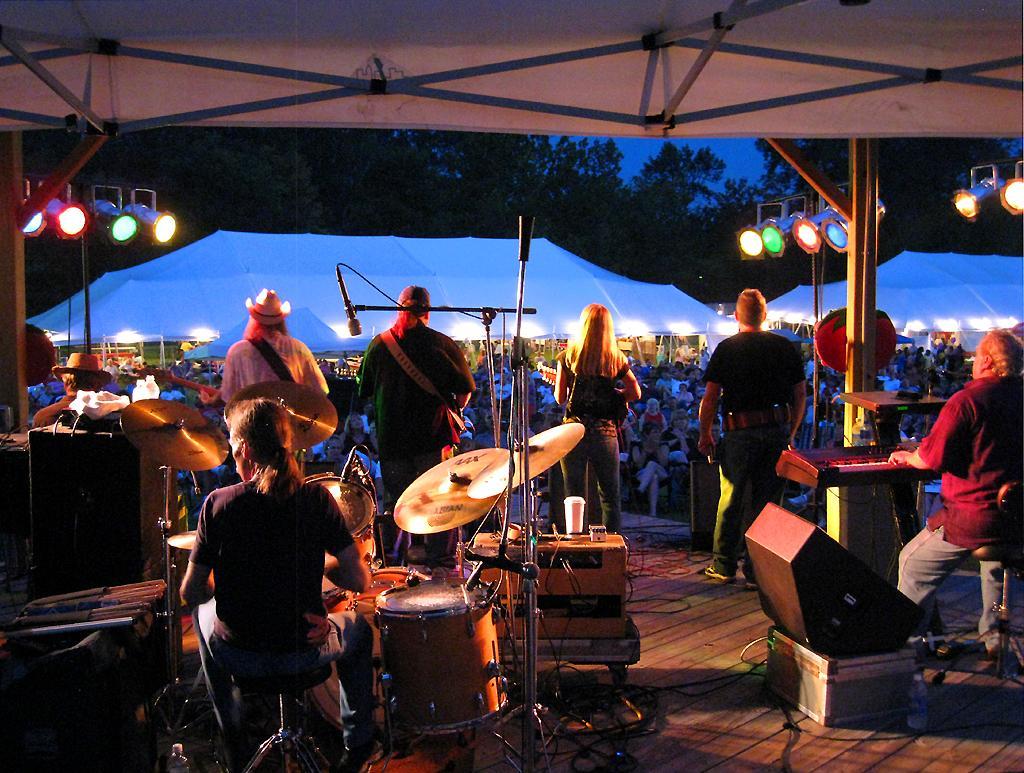
My wife and I made a spur-of-the-moment decision to drop in on the annual Reynoldsburg Tomato Festival last night. It was no coincidence that McGuffey Lane occupied the main stage when we arrived, making this the second straight weekend that we've caught their act.

This time I wasn't there to photograph the performance. I left my pro gear at home but, as I often do, I brought along my digital pocket camera and snapped about a dozen images of the show.
A little silver PhD* camera naturally is less capable than a big black SLR with interchangeable lenses. It works well for documenting events and preserving memories, but even its best work should be passed through the filter of lower expectations.

Then again, because it's much smaller it's more likely to be carried. (That should sound familiar, by the way.) And "getting the shot" requires actually having something to shoot with.

Put another way -- if Jeff Cooper, quoted in Friday's post, had been a photographer instead of the Father of Modern Pistolcraft, he might well have said,
"Remember the first rule of photography: Have a camera."
So a point-and-shoot camera is, potentially, an EDC item. For the committed photographer, however, a high-quality PhD* has other, less obvious applications.

Photography's components -- composition, exposure, highlight and shadow, color, etc. -- are fundamental. Different equipment may render a given subject in different ways, but I've found that spending time with a pocket camera and then transferring lessons learned to a like-branded SLR (I choose Canon) to be extraordinarily helpful.

Most often I use the smaller camera to play around with composition. I bring the results of those tests back to my PC, looking for promising angles worth exploring with my SLR.

Essentially, it's equivalent to the artist's sketchpad.

That's what I did two years ago with the barns. I do it whenever I shoot a knife, a morning's harvest or other subject to accompany a post on KintlaLake Blog. It was my mission last night, too, as I captured McGuffey Lane's show from a band's-eye perspective.
The images I've posted here today document a scene but by no means are they great photos. That's ok by me -- the goal of the exercise was to create sketches, continuing my exploration of the medium.

*PhD = "push here, dummy"

Sunday, October 18, 2009

Horizontal property

Pockets are good.

In the EDC game, more pockets are better. But as much as I love pockets, I tend to hang a lot of my everyday-carry items on my belt.

My cell phone, encased in a protective Body Glove, rides just forward of my right hip. An oh-so-handy Nite Ize S-Biner corrals a wad of keys and fobs and dangles from a belt loop. Depending on the day's destination and purpose, occasionally I'll make room for a sheath holding a small fixed-blade or a multi-tool.

Belt carry is convenient, sure, but some days my waistline looks positively tactical. I really don't need to add anything else to this already-crowded piece of real estate.

That said, I have.

Early each morning, my first chore is to take two dogs on a "business trip" -- attach their leashes to their collars, walk them to the edge of the yard, clip their tie-outs, unclip their leashes...wait...then reverse the process and return the critters to their crates.

This time of year I perform that ritual well before dawn. Despite outside lighting, I'm clipping and unclipping in shadows, a two-handed task which is neither easy nor certain. Yesterday I began bringing some illumination of my own, in the form of a compact LED squeeze-light.

Hanging from my S-Biner, the LED light gets squeezed on before I leave the house. It puts a just-right spot of bluish light at my feet, leaving both hands free for tethering.

It's simple and it works. It won't be long before the mornings will be colder and a heavier coat will cover my waist, though, so at that point the LED light will leave my belt and become a zipper pull.

The second addition to my belt-carry arsenal, a
KSF Leather Horizon, has involved more of a commitment on my part. Because the large version of this folder pouch occupies over six linear inches of belt space, it's required me to re-think and re-arrange my scheme.

I've been toting my SOG Tomcat 3.0 in the Horizon for about a week. Rather than offer a full review here and now (I expect to do that later), I'll say simply that I'm really getting to like the big Horizon. It's like no sheath I've ever carried.

Innovation is, often by definition, unconventional, so it should be no surprise that adding the Horizon would be an exercise in adapting. I have no problem with that, of course, especially when it allows me to carry my favorite big folder in a way I hadn't imagined.

In short, the Horizon is cool. Give me another week to settle my system and I'll say a bit more than that.

Monday, June 1, 2009

Sharps: Cheap therapy

I think it was sometime on Friday afternoon that I decided to retire my Wenger Basic Camper from my everyday-carry rotation and treat myself to a new Victorinox Farmer.

A red one.

The Wenger, a 20-year-old Euro-only model engraved with my name, is still quite serviceable although it's not really very stout. It's simply always there on the nightstand when I fill my pockets every morning. Sure, I could've gone back to my old-style Victorinox
Soldier, but to be perfectly honest, I was looking for an inexpensive pick-me-up.

I placed my order with
FelineVet on Saturday morning, and shortly thereafter I got a message from Tim saying that he'd ship today.

To my surprise, it arrived today. Same-day USPS shipping from California to Columbus? Now that's service (and quite impossible, of course -- my package ended up making Tim's Saturday shipment).

Now that I have a Farmer of my own, I can confirm that it's my kind of multi-blade pocketknife. It officially becomes my regular EDC knife tomorrow morning. And before week's end, I believe I'll give it a new
paracord lanyard.

Earlier posts
Sharps: Errata & addenda
Sharps: A modern-day Soldier
Sharps: Rite of passage
Sharps, Part I: In the pocket

Links
Victorinox
Swiss Army
FelineVet
Secret Order of Swiss Army Knives

Monday, November 22, 2010

Sharps: Proper mindset, simple tools

It was a little over a year ago that I had a chance to chat with Jeff Randall, co-head honcho of Randall's Adventure & Training and ESEE Knives (formerly known as RAT Cutlery).

When we finally got around to talking knives, Jeff said a couple of things that still stick in my mind. First, this sound advice:

"The biggest fallacy is that gear is necessary to survive. You can't get by on gear -- you need skills. You need to prepare in every aspect of life. And if you don't have the proper mindset, you're going to die."
Translation: Singer, not song. Later, he said this:
"I never carry a RAT into the jungle -- I always carry someone else's knife. Really, just give me a three-blade Old Timer and a ten-dollar machete."
I wouldn't presume to stack my skills against a guy who's spent years training military types, cops and civvies in the art of jungle survival. With respect, however, I present two of my favorite tools.

That grimy, taped-up handle belongs to a 22" Collins machete bought new in 1983 to clear two acres of brush around the first house I owned. It was up to that task and hundreds of others since. Now endearingly scarred from hard use, the "Legitimus" mark barely visible, it continues to
serve me well.

My own "three-blade Old Timer," a made-in-USA #34OT, is 25 years old. My dad often carried a Middleman just like this one, which remains in my regular EDC rotation.

Sunday, February 12, 2012

Sharps: Zero Tolerance 0350

I believe it was Holiday Inn that coined the advertising slogan, "The best surprise is no surprise." Myself, I'm a fan of pleasant surprises.

I'd put off sampling Zero Tolerance Knives for years, judging them (from afar) shamelessly "tacticool." Then, on something of a whim, I decided to take ZT's 0350 folder for a spin.

Color me pleasantly surprised.

The Zero Tolerance 0350 (MSRP $175, street $100) is a downsized-and-detuned version of the 0300 (MSRP $340, street $220), which is a higher-end folder designed in collaboration with Strider. The made-in-USA 0350 features a 3.25-inch recurve blade of coated CPM S30V, thick stainless-steel liners incorporating a beefy liner lock, textured G-10 scales and a four-position pocket clip.

The 0350 is equipped with Kai-Kershaw's SpeedSafe assisted-opening system. Pulling back with an index fingertip on the "flipper" protruding from the spine snaps the blade open with authority. Ingeniously, the flipper becomes a guard when the blade is deployed.

Now, if you read the maker's description of SpeedSafe, you'll see that the blade also can be opened "with a manual push on the blade's thumb stud." Problem is, when the blade is closed the ambidextrous stud nests very close to the frame. It's virtually useless as a natural and reliable means of opening the knife.

The stud functions primarily as a stop-pin, it appears. And since the flipper works so well, not having the thumb-opening option is no loss.

It took a week or so of EDC (and a few drops of Benchmade BlueLube) for the 0350's pivot to get over its initial stickiness. Since then it's been smooth and precise -- no wiggle whatsoever.

This ZT's handle fits my large paws perfectly, and the G-10 slabs are wonderfully grippy. The CPM S30V blade takes and holds a scary-sharp edge; quick touchups, rarely necessary, have been easy. That's a good thing, since it's trickier to hone a recurve than a straight edge.

After carrying and using the Zero Tolerance 0350 for several weeks, I'm not just pleasantly surprised -- I'm damned impressed. It's a hell-for-stout tool and, with the exception of that vestigial thumb stud, very well designed. Best of all, considering the street price, it's a whole lot of knife for the money.

Tuesday, June 2, 2009

Cordage: Farmer's friend

It took me just fifteen minutes this morning to turn out a basic tether for my new Victorinox Farmer.

This is what I'd call a medium-sized survival lanyard, packing about ten feet of intact paracord into a relatively tidy bundle. It's woven in a double (overlapping) cobra stitch, with a spring clip on one end and a split ring on the other. Nothing complicated, nothing fancy.

No skull beads this time.

The knot, by the way, is a figure-eight-on-a-bight. Depending on my mood, it seems, I tend to go back and forth between that and a stevedore knot, which essentially is a figure-eight with an extra wrap.

Later I'll do a simple paracord fob for the Farmer, maybe capturing a tiny firesteel, for those times when I want something less bulky. If I had this lanyard to do over again, I might make it with a shorter run of double cobra, but as-is it'll serve my EDC purposes just fine.

Friday, September 24, 2010

Notes from the pumpkin patch

Ok, so my Monday didn't turn out so well -- a willing spirit lost to weak flesh -- but I still managed to come home with useful experience.

Under a cloudless sky, with low humidity and temps pushing 90°F, drinking plenty of water was a must -- and I did, although it's unlikely that I could've chugged enough to prevent the world-class bonk that knocked me out of the game. Nutrition came in the form of three
PowerBars, and that was adequate.

If I had it to do over again I'd employ a canteen or a hydration bladder, some way to keep water with me rather than in an ice chest in the truck, which often was 200 yards away.

I dressed for battling the spiny overgrowth -- sturdy boots and comfortable socks, blue jeans and a long-sleeved denim shirt. Although I prefer deerskin gloves, that day I wore a well-loved cowhide pair and they did the job.

Under the loose-fitting long-sleeved shirt I wore a polypropylene t-shirt (
layers aren't just for cold weather), which kept me much cooler than a cotton tee or nothing at all. For headgear I chose Amish over redneck -- a broad-brimmed straw hat, bought for five bucks at an odd-lots store earlier this summer, ventilated much better than a feed cap and allowed me to carry a 360° patch of shade around with me.

I also had the good sense to tuck a bandanna into my hip pocket. In addition to serving as headband and sweat rag, soaked with water from the ice chest and tied around my neck it provided blessed (albeit temporary) relief from the heat. Honestly, I don't know why I don't carry one of these indispensable cloth squares every day.

I brought along a pair of short-handled loppers for cutting pumpkins from their vines. That's what I ended up using 99% of the time, but I thought that a medium-sized fixed-blade knife might come in handy, too, so I slipped a Bark River Gunny onto my belt -- not the one that I wrote about a year ago, rather a Micarta-handled version bought at well below dealer cost from a shop that was reducing inventory.

Capable as the Gunny is, it generally isn't the right tool for the job of harvesting pumpkins. (My 18-year-old, who carried his own bargain-basement Gunny on Monday, concurs.) See, at this point in the season their tough, woody stems no longer are securely attached, and it proved almost impossible to apply enough force to cut the stem without breaking it off (thereby junkin' the punkin). I did use the knife a few times to clear vegetation, but that was about it.

I had my
EDC Victorinox Farmer with me, of course. I never took it out of my pocket.

Finally, I left my Glock 19 in the safe and carried my
Walther P22 -- lighter on the belt and arguably a more reasonable choice should I have had to dispatch a pumpkin-patch pest. (I didn't.) Loaded with ten rounds of CCI Stinger, the P22 rode at 4 o'clock in an El Paso Saddlery Tortilla OWB leather holster, joined at 8 o'clock by a spare ten-round magazine in an El Paso Mag Pouch.

Whatever else came out of that imperfect day, I got to spend quality time sorting out kit. If I were headed back to the pumpkin patch tomorrow -- and I'm not -- with just a few changes I believe I'd equip myself the same way.

Saturday, February 19, 2011

Sharps: A pocket sheath for the woods

In Tuesday's post I talked about using a small leather pocket sheath to carry an everyday fixed-blade knife and a single-AAA light. Happy with that result (and sensing a bit of momentum), I dug another unused sheath out of my box of orphans and put together a pocketable kit (right) better suited to woodcraft.

The butt of a
Bark River Little Creek (McKnight Grind, Antique Ivory Micarta), borrowed from my EDC rotation, peeks out of one side of the sheath. What's hiding in the other compartment? Take a look:

The sheath easily swallows a quartet of firemaking basics -- firesteel and striker, a chunk of
fatwood and a length of jute twine that serves as both tinder and tether. And yes, I could spark the firesteel with the spine of the knife, but it's no bother to carry a dedicated striker.

Together with the Little Creek -- my favorite small fixed-blade, by the way -- this is quite a functional setup, but
I may add another item. There's plenty of room to stuff some dryer lint into the bottom of the fire-kit compartment.

I've got one more small sheath in my box of orphans, a
leather sleeve like the one that holds my Victorinox Farmer. I'm thinking that it might be a good choice for a neck-carry fire kit -- stay tuned.

Tuesday, May 1, 2012

Looking back: 'The preparedness mindset'

This post, admittedly a re-hash, follows naturally from yesterday's nod to the Scout Motto. It's also timely, I think, in light of today's news out of Cleveland, and the May Day push by Occupy, and the first anniversary of Osama bin Laden's demise, and much more that percolates beneath the surface of our fractured society.

Over the last four years I've invoked the term "preparedness mindset" a number of times. I humbly offer these posts for further reading:
Cold, cold water (June 16, 2008)

Been there? Done that? (June 22, 2009)

Back fifty-two to 'Fifty-nine (February 11, 2011)

EDC vs. EWC (August 19, 2011)

On channeling Glenn (November 1, 2011)

The Scout Motto: 'Be Prepared' (April 30, 2012)
I hope that my thoughts provoke yours. Better yet, maybe my words will kick-start a dinner-table conversation or two.

Sunday, September 18, 2011

Sharps: A tale of two box-cutters

My new shipping-and-receiving job is going fine, thank you very much. On September 2nd I mentioned using the opportunity to justify buying a knife especially for the purpose. I ended up buying two.

The Tim Wegner-designed Blade-Tech Ratel Lite (retail $24, street $20, made in Taiwan) features a saber-ground, 1-15/16-inch leaf-shape blade of AUS 8 stainless steel. It's a lock-back, with textured scales of fiberglass-reinforced nylon and a reversible pocket clip.


The second-gen Spyderco Chicago (retail $65, street $41, made in Taiwan) has G-10 scales, replacing a now-discontinued carbon-fiber version. Its flat-ground, 440C leaf-shape blade is two inches long, held open with a liner lock. The wire-style pocket clip is reversible to accommodate either left- or right-hand carry.

Fit and finish are good on both knives. Perhaps the Blade-Tech is a touch stiffer, the Spyderco slightly smoother, feeding my perception that the latter is more refined (for lack of a better descriptor). After two weeks of hard use in the warehouse, both blades have held up well -- the AUS 8 and 440C are, I found, durable and easy to maintain.

I should mention here that the pocket clip on my particular Ratel Lite started out extremely tight -- secure is one thing, but this was something else entirely and, from what I gather, pretty common.

A short loop of paracord, threaded through the lanyard hole, was required to facilitate an easy draw from my pocket. Eventually I modified the bend of the clip by stuffing a thick stack of cardboard under it and leaving it that way overnight. That fixed the problem.

Despite having been conceived as EDC or "suit" knives that sneak under annoyingly silly "two-inch-max" laws, both the Ratel Lite and the Chicago have performed admirably for me as box-cutters. I have no complaints, practically speaking, about either.

That's not to say that I don't have a preference. Sure, it's possible to buy two Ratel Lites for the street price of one Chicago, which certainly makes the Blade-Tech the better value. But the Spyderco is the better knife, in my opinion, for several reasons.

First, I find the liner-lock quicker and more natural to use. I also like the grip -- not just the feel of G-10 slabs, but the way that my fingers index to the handle and the choil formed when the knife is open. And finally, the flat grind and thinner blade make it a better and more versatile cutter -- 1/8 inch (Ratel Lite) versus 3/32 inch (Chicago) may seem like a nit, but the 25% difference shows up big in performance.

I'll keep and will continue to use both of these knives. I lean toward the Spyderco, but your mileage (as they say) may vary.

Back to the Backwoods
One steamy Saturday three years ago, my wife and I fled a raucous gameday scene for the relative calm of the Thornville Backwoods Fest.

We reprised that trip yesterday afternoon, minus the hot weather and tailgating. (This year the Buckeyes played late, away and badly, getting spanked 24-6 by Miami.)
Our experience at the 2011 festival was virtually identical to what I described in 2008 -- wonderful.
We returned home refreshed, toting a pound of wildflower honey from a nearby village, a quart of syrup drawn from maple trees next door to the festival grounds, and a big ol' bag of fresh cracklings (a.k.a. pork rinds) cooked in a iron kettle over an open fire.

Local is best. Life is good.

Friday, October 8, 2010

Sharps: A good edge gets rolled

I'm still trying to sort out how I feel about Tuesday afternoon's news release from Benchmade:
Benchmade Knife Company Acquires Lone Wolf Knives
Acquisition Brings Breadth and Variety to Benchmade...
I'm glad for Benchmade, a solid company that has every reason to be proud of its success. Thing is, I'd developed an affection for Lone Wolf -- both the company and its products.

Early this year I had the pleasure of interviewing Lone Wolf Knives boss Jim Wehrs for a short-term project I was doing. His enthusiasm for the business intrigued me and his commitment to quality won my admiration. Not long afterward I bought one of his Eagle Talon "Double-Action" automatics.

To say that I'm thrilled with the knife is an understatement. Its blade is CPM-S30V stainless steel, the scales fiberglass-reinforced nylon. Pivot and lock are Swiss-watch precise. I love that it can be opened either via the auto mechanism or manually with the thumb stud.

The Eagle Talon auto is the perfect size for EDC (where the law permits). For comparison, I photographed it (ironically, perhaps) next to my Benchmade 556 Mini-Griptilian.

Anyway, back to the acquisition. I carry a Griptilian every single day and have no complaints, but when I heard that big Benchmade had swallowed much smaller Lone Wolf it gave me pause.

Even without knowing details about Lone Wolf's prospects or its financial condition, I'm saddened to see it absorbed by a larger competitor. I'm somewhat consoled, I guess, that at least it became part of another American knifemaker. I'll be interested to see what Benchmade does with the brand.

Monday, November 30, 2009

EDC reconsidered

Not long after starting my new "regular job," it became clear to me that I'd have to adjust my everyday-carry arsenal. To wit:

Victorinox One-Hand Trekker
iTP C7T LED flashlight
Gerber Ultralight LST
Palm Centro
Nite Ize Clip Case Cargo


My keys now get parked on my desk as soon as I arrive at the shop. The OHT lives in a pants pocket, while the other items ride on my belt in the Nite Ize holster. I'm quite sure that I'll make more adjustments as time goes by.

More about my choices -- and the range of everyday tasks that prompted them -- next month.

Tuesday, October 6, 2009

Back at it

Our new digs -- aka "home" -- are working out fine these days. Our surroundings are comfortable, but being thrust into suburbia has exacted a price.

I miss the country.

The cornfield and tumbledown farm buildings framed by our former home's front windows have been replaced by a front-row view of a cul-de-sac. Tinkling dime-store wind chimes hanging above the deck are no substitute for the whisper of wind in the pines.

There is, however, an unexpected benefit of living in this planned, association-governed community -- it's called "common space."

Just a few steps from our back door is a trail than winds behind the development's back yards. The paved path follows a small creek, on the opposite side of which is a sliver of woodland -- hardwoods, mostly, tall trees that only within the last week have hinted that fall has arrived.

I've taken to escaping there whenever I can, enjoying something that wasn't available to me at our previous home, at least not without trespassing or making a short drive.

This morning's walk brought me the gurgle of water, the rustle of wrens and a close encounter of the chipmunk kind. I wandered off the path to hear the crunch of dried leaves under my boots, visiting the musty aroma of the October woods.

On my belt I toted a recent acquisition -- yes, there's another Barkie in the house, this time a Mini-North Star, a compact spear-point knife designed for everyday carry rather than full-on bushcraft.

I like the Mini-North Star a lot. It's light and nimble, a helluva slicer with a 12C27 stainless-steel blade. Time will tell, but right now I'm thinking that this is the EDC fixed-blade I've been looking for.

Emerging from my hour in the woods (such as the woods are for me lately), I re-enter a world of relative civilization and, worse, inescapable disinformation.

Shameless opponents of an upcoming ballot measure that'd allow casino gambling in Ohio continue to spew their lies. The health-care debate -- or, more accurately, the health-insurance debate -- is full of political posturing which will, in the end, change nothing. While financial pundits crow about the markets rebounding from their March lows, I find myself wondering if they know the difference between growth and volatility.

On the bright side, the Supreme Court has agreed to hear McDonald v. Chicago, another landmark Second Amendment case.

It's the world in which I live, giving me yet more reasons to be glad for the uncommon relief of common space.